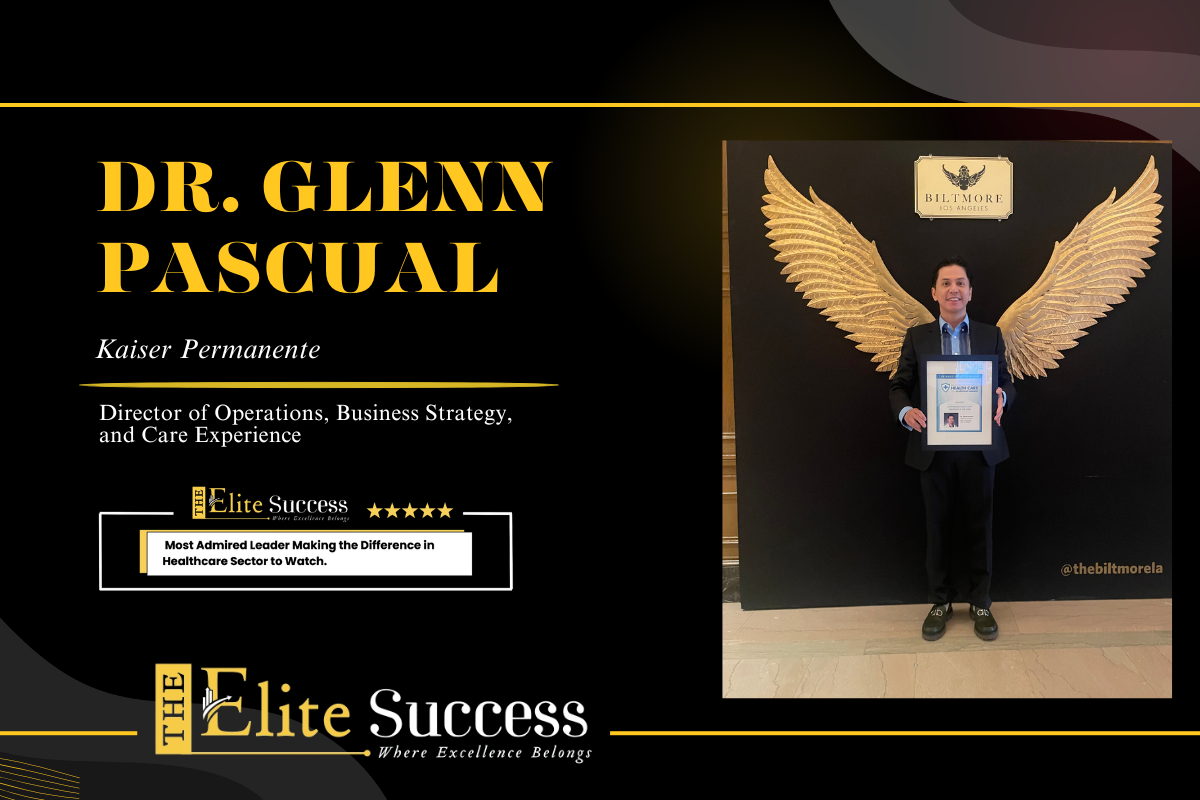
Healthcare in the United States represents nearly 20% of the nation’s GDP, employs millions of professionals, and touches every life at its most vulnerable moments. Yet despite its scale and sophistication, the industry continues to grapple with widening gaps — between access and equity, innovation and implementation, clinical outcomes and patient experience. Bridging those gaps requires more than operational expertise; it demands leaders who understand both the science of systems and the soul of service. Few exemplify this rare balance as powerfully as Dr. Glenn D. Pascual of Kaiser Permanente. As Director of Operations, Business Strategy, and Care Experience, Dr. Pascual stands at the intersection of clinical excellence and transformational leadership, guiding systems not only to perform better, but to care better.
Her journey, however, did not begin in boardrooms. It began with love — the steadfast, formative love of a grandmother who shaped her character long before she shaped healthcare institutions. In her book, Crossing the Crevasse of Healthcare Leadership, Dr. Pascual writes about navigating the daunting gaps that exist in healthcare leadership — the divide between intention and execution, between authority and empathy, between success and significance. That philosophy was born from personal trials: global transitions, cultural immersion, oncology specialization, and the deeply personal experience of caring for her grandmother through Acute Myelogenous Leukemia.
From the halls of Johns Hopkins Hospital to executive leadership roles in Los Angeles, her story is one of resilience, reinvention, and purpose. Today, recognized as one of the most awarded healthcare leaders of her generation, Dr. Pascual continues to bridge operational strategy with human-centered care — proving that leadership in healthcare is not merely about managing systems, but about honoring lives.
At its heart, her story reminds us: service is everyone’s responsibility — but transformative service begins with love.
Love Begets Leadership: The Grandmother Who Shaped a Vision
Long before she became a senior executive at Kaiser Permanente, Dr. Glenn D. Pascual was a child shaped by movement, culture, and sacrifice. Born into a family that balanced professional ambition with deep-rooted values, she was raised primarily by her grandmother while her parents built their lives in California. Growing up across countries with established American bases, Glenn learned early what it meant to adapt — to new schools, new languages, new identities. Yet through every transition, one constant remained: her grandmother’s unwavering presence.
“I grew up obeying her,” she reflects. “She was my compass.”
Their bond was tested when Glenn expressed her desire to pursue higher education abroad. Years later, after her grandmother’s passing, she discovered that the conversation about leaving home had been one of the most painful moments of her grandmother’s life — a revelation that forever reframed her understanding of love and sacrifice.
Nursing, for Glenn, was never a second choice. While others questioned why she did not pursue medicine, she saw nursing as a calling — a profession that transcended borders and brought her closer to humanity at its most vulnerable. Her path led her into oncology and eventually to bone marrow transplant (BMT) care at the prestigious Johns Hopkins Hospital. But just as her career was ascending, her grandmother was diagnosed with Acute Myelogenous Leukemia.
Watching her endure the pain of BMT — and ultimately choose quality of life over prolonged treatment — changed Glenn profoundly. “Respect life,” her grandmother told her. “See my face in the face of your patients.”
That moment became her awakening. From grief emerged purpose. From love emerged leadership. And from loss, a lifelong promise: to serve with compassion, lead with positivity, and bridge the human gaps in healthcare — one patient at a time.
From Oncology to Operations: A Purpose-Driven Professional Evolution
Dr. Glenn D. Pascual’s career did not unfold in straight lines — it evolved through intensity, introspection, and intentional growth. Oncology was not merely a specialty; it was a calling shaped by experience and empathy. Working in high-acuity environments, particularly in Bone Marrow Transplant (BMT), she encountered medicine at its most complex and emotionally demanding. At the renowned Johns Hopkins Hospital, she sharpened her clinical expertise while witnessing firsthand the fragility and resilience of life.
“There is no room for mediocrity in oncology,” she often reflects. “Every decision carries weight. Every action affects a family.”
Yet as the years progressed, Glenn began to see a broader truth: excellent clinical care alone was not enough. Systems, processes, culture, and strategy directly influenced patient outcomes. She recognized gaps — between frontline staff and executive leadership, between operational efficiency and patient experience, between vision and execution. Rather than remain solely at the bedside, she chose to step into those gaps.
Her transition into leadership roles was not about leaving patient care behind; it was about amplifying it. She pursued advanced degrees in healthcare administration, business, and leadership, equipping herself with the tools to influence care delivery at scale. “If I wanted to protect patients’ quality of life,” she says, “I needed to understand the business of healthcare as deeply as I understood the science of it.”
That decision propelled her into executive leadership, ultimately serving in senior operational roles at Kaiser Permanente. Today, as Director of Operations, Business Strategy, and Care Experience, she bridges clinical insight with strategic execution — ensuring that systems are designed not just for efficiency, but for dignity, compassion, and measurable excellence.
Her evolution from oncology nurse to healthcare executive reflects a simple belief: leadership is the most powerful form of patient advocacy.
Crossing the Crevasse: Leadership as a Deliberate Choice
For Dr. Glenn D. Pascual, leadership is not a title — it is a decision. In her book, Crossing the Crevasse of Healthcare Leadership, she introduces a powerful metaphor: the crevasse represents the dangerous gaps in healthcare — the space between intention and execution, authority and accountability, innovation and implementation. Many leaders stand at the edge, she explains, but few are willing to cross.
“I’ve seen brilliant clinicians struggle as leaders,” she shares. “Not because they lacked intelligence, but because they were never taught how to navigate the human and strategic dimensions of leadership.”
Drawing from decades of experience — from oncology units to executive boardrooms at Kaiser Permanente — Dr. Pascual outlines a framework grounded in vision, values, and virtues. She challenges leaders to move beyond reactive management and instead adopt intentional behaviors that inspire trust, accountability, and resilience. Leadership, in her view, is about alignment: aligning mission with measurable outcomes, people with purpose, and strategy with service.
The book also reflects her deeply personal philosophy shaped by her grandmother’s influence: eliminate negativity, stay grounded in purpose, and see the human face behind every metric. “You cannot cross the crevasse alone,” she writes. “You build bridges through culture, collaboration, and courage.”
Blending operational insight with emotional intelligence, Crossing the Crevasse is both a practical guide and a reflective manifesto. It calls on healthcare leaders to confront systemic challenges without losing compassion — to be bold enough to innovate, yet humble enough to listen.
For Dr. Pascual, crossing the crevasse is not a one-time act. It is a continuous commitment to evolve, elevate others, and transform healthcare from within.
Transforming Care at Kaiser Permanente: Strategy with a Human Pulse
At Kaiser Permanente, Dr. Glenn D. Pascual’s leadership finds its fullest expression — where operational strategy meets the lived experience of patients and caregivers. As Director of Operations, Business Strategy, and Care Experience, she does more than oversee performance metrics; she shapes the culture that drives them.
Healthcare systems are complex ecosystems. Efficiency, financial stewardship, workforce engagement, regulatory compliance, and patient satisfaction must move in synchrony. Dr. Pascual understands that sustainable excellence requires alignment at every level. “Operations is not about numbers alone,” she explains. “Behind every metric is a mother, a grandfather, a child — someone trusting us with their life.”
Her approach integrates frontline insight with executive foresight. Having worked in high-acuity clinical settings, she brings credibility to leadership conversations, ensuring that policies are grounded in real-world impact. She champions interdisciplinary collaboration, strengthens labor-management partnerships, and advances initiatives that elevate both workforce morale and patient outcomes.
Under her influence, care experience is not treated as a department — it is embedded into operational strategy. She advocates for streamlined processes that reduce patient anxiety, data-driven decisions that improve quality outcomes, and leadership accountability that fosters trust. “If we design systems with empathy,” she says, “performance naturally follows.”
Colleagues describe her leadership style as disciplined yet deeply compassionate — a balance of structure and soul. Whether guiding strategic planning sessions or mentoring emerging leaders, Dr. Pascual remains anchored in a simple belief: healthcare transformation begins from within.
In an organization known for innovation and integrated care, she continues to build bridges — not just across departments, but across the human divides that define modern healthcare leadership.
Excellence with Accountability: The Most Awarded Healthcare Leader of Her Generation
Impact in healthcare can be measured in many ways — patient outcomes, operational performance, cultural transformation. For Dr. Glenn D. Pascual, it is also reflected in recognition earned through sustained excellence. With over 80 state, regional, national, and international awards, she stands among the most decorated healthcare leaders of her generation. Yet for her, accolades have never been the destination.
“Awards are not achievements to collect,” she says. “They are reminders that responsibility grows with recognition.”
Her professional journey is defined by relentless academic and intellectual rigor. Dr. Pascual holds five advanced degrees spanning nursing, healthcare administration, business, and leadership, along with multiple board certifications that underscore her multidisciplinary expertise. Each credential represents not status, but preparation — preparation to lead complex systems with both competence and conscience.
Even at the height of her executive career at Kaiser Permanente, she continues to pursue advanced doctoral education, reinforcing her belief that leadership must evolve alongside healthcare itself. “Creating success is tough,” she reflects. “Keeping it is tougher. You have to keep producing. You can never stop.”
Her discipline is as notable as her distinction. Colleagues describe her as precise, strategic, and uncompromising when it comes to accountability. Excellence, in her view, is not episodic — it is habitual. It is built through measurable outcomes, ethical decision-making, and an unwavering commitment to patients and teams.
For an industry navigating rapid change and mounting complexity, Dr. Pascual’s voice carries weight not simply because she leads — but because she has consistently delivered.
Service Is Everyone’s Responsibility: Building a Movement Beyond Titles
For Dr. Glenn D. Pascual, leadership does not end with recognition — even with more than 80 awards to her name. If anything, distinction has deepened her conviction that influence must extend beyond personal success. “Titles don’t transform organizations,” she says. “People do.”
Her guiding philosophy — Service Is Everyone’s Responsibility — has become more than a statement; it is a cultural expectation embedded in her leadership approach at Kaiser Permanente. Whether working with frontline clinicians, operational teams, or executive peers, she emphasizes shared ownership of outcomes. No role is too small to impact patient experience, and no leader is exempt from accountability.
A strong advocate of collaboration, Dr. Pascual plays an active role in strengthening Labor and Management Partnership (LMP) initiatives, ensuring that dialogue between leadership and workforce remains transparent, respectful, and solution-driven. She believes that sustainable transformation occurs when leaders listen as intently as they direct.
Mentorship is another cornerstone of her ripple effect. She invests time in developing emerging healthcare leaders, particularly nurses aspiring to executive roles. “I want them to see that clinical excellence and executive leadership are not separate paths,” she explains. “They can — and must — coexist.”
Her grandmother’s advice continues to guide her daily practice: stay positive, eliminate negativity, and see the human face in every interaction. That mindset permeates her book, Crossing the Crevasse of Healthcare Leadership, influencing a new generation of healthcare executives who seek purpose alongside performance.
Through culture-building, mentorship, and unwavering optimism, Dr. Pascual is not just leading — she is shaping a movement.
A Legacy of Courage: Shaping the Future of Healthcare Leadership
With more than 80 awards recognizing her excellence across state, national, and international platforms, Dr. Glenn D. Pascual’s legacy is already firmly established. Yet when asked about legacy, she shifts the focus away from accolades and toward impact. “Legacy,” she says, “is not what you accumulate — it’s what continues when you’re no longer in the room.”
For Dr. Pascual, the future of healthcare leadership must be intentional, interdisciplinary, and deeply human. She envisions a system where clinical expertise and business acumen are no longer viewed as separate domains, but as complementary forces driving equitable, high-quality care. Leaders, she believes, must be both data-literate and emotionally intelligent — capable of interpreting analytics while understanding the lived experiences behind the numbers.
Her own journey — from oncology specialist to executive leader at Kaiser Permanente — reflects the kind of multidimensional leadership she advocates. “Healthcare is evolving faster than ever,” she notes. “If we don’t evolve with it — intellectually, strategically, and spiritually — we risk widening the very gaps we are trying to close.”
Looking ahead, she remains committed to mentoring the next generation, advancing research, and continuing her academic pursuits to refine the science of leadership itself. The crevasse she once wrote about is still there — but so are the bridges.
Her vision is clear: a healthcare system led by courageous, accountable, and compassionate leaders who understand that service is not a department — it is a duty.
And in that vision, her grandmother’s lesson lives on.