How Pablo Perez Is Engineering the Operating Systems Defining the Future of Global Food Manufacturing
Global food manufacturing is entering a decisive era. Valued at more than $4 trillion worldwide, the industry now operates under a convergence of pressures that are structural rather than cyclical: supply chain volatility, labor constraints, rising input costs, uncompromising food safety standards, and accelerating digital disruption. In this environment, isolated plant excellence is no longer sufficient. Competitive advantage belongs to enterprises capable of operating as unified, adaptive systems.
For decades, manufacturers pursued performance through incremental gains—optimizing lines, reducing waste, improving yield. Those disciplines remain essential. Yet the complexity of modern food networks has exposed a deeper truth: sustainable excellence cannot be achieved through fragmented initiatives. It must be engineered into the architecture of the organization itself.
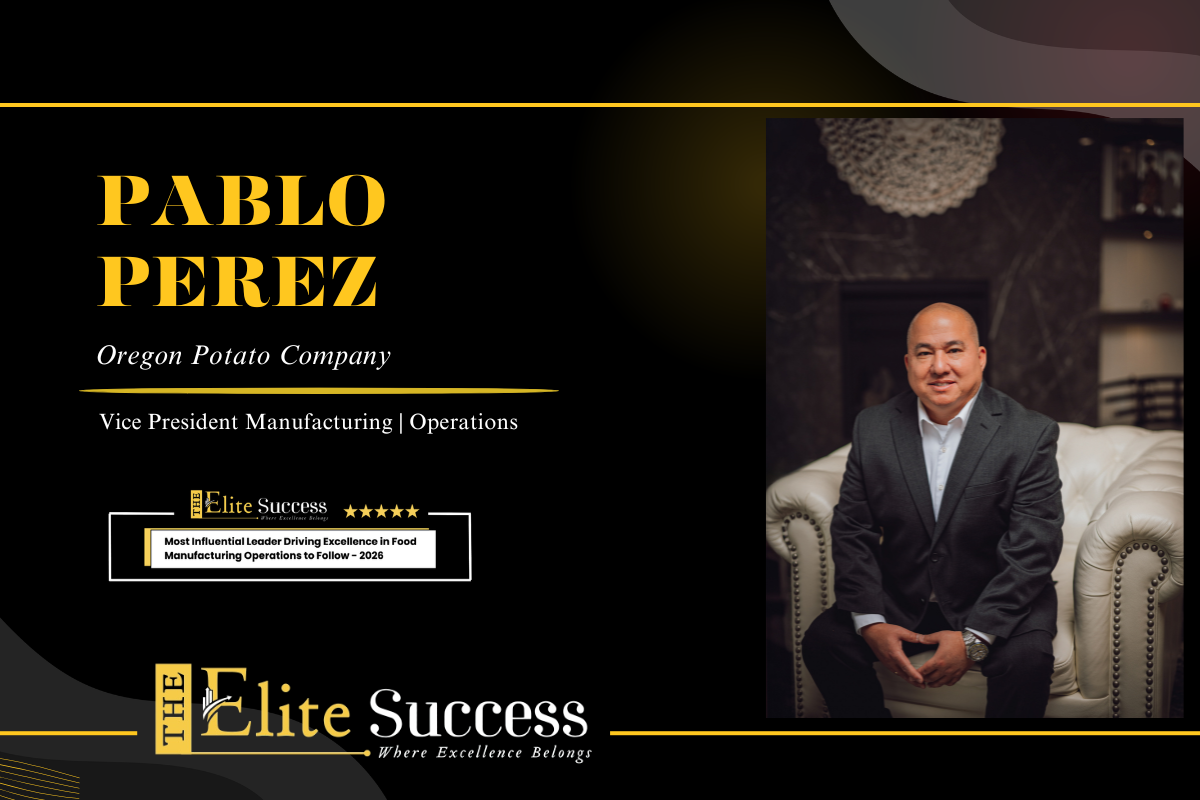
Few executives articulate this shift more clearly than Pablo Perez, Vice President of Manufacturing and Operations at Oregon Potato Company. Across a career spanning enterprise roles at Kraft Heinz, Nestlé Waters, Unilever, and Johnson & Johnson, Perez has led complex, multi-site operations through periods of transformation, harmonization, and scale. His perspective has evolved beyond performance management to something more foundational: the design of operating systems that allow enterprises to learn faster than their environments change.
Perez refers to this framework as the Adaptive Manufacturing Architecture™—a disciplined integration of structural governance, human capability, and digital intelligence engineered to convert volatility into advantage. In his view, operational excellence is not a program, nor a set of initiatives layered onto existing structures. It is infrastructure. And in the next era of global food manufacturing, infrastructure will determine which organizations lead—and which struggle to keep pace.
Designing the Adaptive Manufacturing Architecture™
For Pablo Perez, operational excellence begins with a design question: Is the system built to perform under pressure? After decades leading complex manufacturing networks, he has come to see that performance gaps are rarely caused by effort alone. More often, they stem from fragmented structures—plants optimizing locally while the enterprise absorbs variability globally.
“The breakthrough for me,” Perez explains, “was recognizing that improvement cannot live outside the operating model. It has to be the operating model.”
This conviction shaped what he calls the Adaptive Manufacturing Architecture™—a framework that integrates structural discipline, human capability, and accelerated learning into a unified enterprise design. At its core, the model establishes shared performance definitions, clear governance routines, and visible escalation paths so that every facility speaks the same operational language. But structure alone is not enough. Perez pairs it with deep investment in frontline ownership and problem-solving capability, ensuring that systems are lived, not laminated.
Digital tools then serve as accelerators—shortening feedback loops, strengthening reliability, and transforming data into faster decision-making. “The goal isn’t more dashboards,” he notes. “It’s fewer recurring losses.”
In Perez’s view, when architecture aligns discipline, people, and intelligence, performance becomes repeatable. Manufacturing excellence stops being episodic—and starts behaving like infrastructure.
Architecture in Action: Enterprise Alignment at Scale
The true test of any operating philosophy is not how it performs in a single facility, but how it behaves across an enterprise. For Pablo Perez, that test came during a large-scale network harmonization effort at Kraft Heinz, where manufacturing and logistics systems supporting more than 200 million pounds of annual production required alignment across multiple plants.
Individually, several facilities were performing well. Collectively, the network was unstable. Local optimization had created systemic variability—service inconsistencies, scheduling friction, and uneven performance visibility. “Each plant was improving its own metrics,” Perez recalls, “but the enterprise wasn’t behaving as a coherent system.”
Rather than pursuing isolated fixes, he reframed the challenge as an architectural issue. Shared performance definitions were introduced. Scheduling disciplines were standardized. Governance routines created transparency across sites. Improvement priorities were linked directly to enterprise-level outcomes rather than local targets.
The impact was not immediate perfection, but progressive stabilization. Variability declined. Service performance strengthened. Best practices began moving laterally instead of remaining siloed. The network started to function less like independent factories and more like a coordinated organism.
For Perez, the lesson was decisive: scale performs when alignment becomes structural. When operating architecture defines how decisions are made, how performance is measured, and how learning is shared, growth becomes repeatable rather than episodic. In complex food manufacturing, coherence—not heroics—is what ultimately drives sustained advantage.
Reliability as a Strategic Advantage
If alignment creates coherence, reliability creates confidence. For Pablo Perez, equipment performance is not a maintenance metric—it is a reflection of organizational maturity. “Reliability tells you whether your systems are truly disciplined,” he says. “You can’t hide instability for long in asset-intensive operations.”
That conviction was tested and refined during his leadership tenure at Nestlé Waters, where sustained equipment performance was elevated to world-class levels, with Overall Equipment Effectiveness exceeding 92 percent. More striking was the transformation in stability: mean time between failures increased from 24 minutes to 6.8 hours within 18 months.
The breakthrough did not come from technical adjustments alone. Perez integrated Autonomous Maintenance principles with structured leadership routines, ensuring operators understood not just how to run machines, but how to own them. Standard work was reinforced through disciplined audits, coaching, and visible performance tracking. Preventive and predictive maintenance systems were strengthened, but equally important was the cultural shift—from reactive firefighting to proactive asset stewardship.
“Machines behave the way systems allow them to behave,” Perez explains. When reliability is embedded into daily management rather than treated as a specialist function, variability declines across safety, quality, and service simultaneously.
For enterprise leaders, the lesson is clear: technical excellence is inseparable from human capability. In modern food manufacturing, reliability is not a departmental outcome. It is a strategic advantage engineered into the operating system itself.
Leadership as Architecture
For Pablo Perez, leadership in manufacturing is fundamentally an act of design. Results matter, but they are downstream of structure. “Systems outlast personalities,” he says. “If performance depends on heroics, the architecture is weak.”
Over the course of leading multi-site operations across North America, Perez has come to see executive impact not as direct control, but as environmental engineering. Clear standards. Visible metrics. Consistent routines. Disciplined follow-through. When those elements are intentionally constructed, the right behaviors become natural and repeatable. When they are absent, even talented teams struggle against ambiguity.
He rejects the idea that discipline stifles innovation. In his experience, the opposite is true. Stable processes create the bandwidth to improve. When safety, quality, and reliability are predictable, organizations gain the confidence to experiment and scale intelligently. “Clarity liberates people,” he explains. “When expectations are explicit, energy shifts from guessing to improving.”
Central to his philosophy is capability development. Perez measures success not only by throughput or cost performance, but by the strength of the leaders emerging within the system. Coaching on the plant floor, structured problem-solving, and governance routines are not compliance exercises—they are leadership incubators. Over time, competence compounds.
For boards and CEOs navigating volatility, this approach offers something rare: resilience independent of any single executive. Perez’s legacy is not defined by short-term gains, but by organizations engineered to sustain excellence long after he has moved on.
Digital Systems as Accelerators of Learning
In an era defined by Industry 4.0 and accelerating automation, Pablo Perez is clear about one distinction: technology is only transformative when it strengthens discipline. “The objective isn’t more data,” he says. “It’s faster learning and fewer recurring losses.”
Across his leadership roles—including his current oversight of integrated food manufacturing operations at Oregon Potato Company—Perez has seen digital investments succeed and fail. The differentiator, in his experience, is not the sophistication of the platform, but the maturity of the operating system beneath it. When processes are unstable, digital tools amplify noise. When governance and standard work are strong, technology becomes an accelerator.
Real-time performance visibility allows teams to detect downtime, rate loss, and scrap deviations as they occur rather than after reports are closed. Structured maintenance systems convert asset history into predictive insight. Integrated quality and traceability platforms compress containment timelines and strengthen root-cause analysis. But none of these tools replace leadership routines; they reinforce them.
Perez integrates digital dashboards directly into daily management, tiered accountability meetings, and cross-site governance reviews. Data flows into structured conversations, not parallel reporting channels. “When information moves seamlessly into decision-making,” he explains, “learning compounds.”
For enterprise leaders navigating margin pressure and supply volatility, this philosophy reframes digital transformation. It is not an IT initiative. It is an architectural enhancement—one that shortens the distance between action and insight and enables manufacturing organizations to adapt at the speed their markets demand.
Powering Stability in a Volatile Food Ecosystem
If architecture defines performance, the food industry tests it daily. At Oregon Potato Company, Pablo Perez operates within a system shaped by forces no executive can control—weather volatility, seasonal harvest variability, shifting consumer demand, and uncompromising food safety standards. “Agriculture introduces natural variability,” he notes. “Our responsibility is to convert that variability into predictability for our customers.”
Overseeing integrated manufacturing operations across the United States and Canada, Perez leads asset-intensive facilities that transform agricultural inputs into frozen and packaged products serving retail, foodservice, and private-label partners. The mandate is clear: protect safety, ensure cold-chain integrity, maintain throughput, and deliver consistent quality—every day.
Seasonality places extraordinary pressure on scheduling, storage, and logistics coordination. Grower partnerships must align with production planning. Inventory strategy must anticipate both abundance and constraint. In this environment, disciplined governance and real-time visibility are not abstract principles; they are operational necessities.
Perez emphasizes end-to-end alignment—often describing the value chain as extending “from seed to fork.” Reliability, traceability, and cross-functional communication ensure that upstream variability does not become downstream disruption. “Stability isn’t accidental,” he explains. “It’s engineered.”
In a sector where margins are tight and service expectations are unforgiving, this ability to deliver consistency amid natural fluctuation becomes a competitive advantage. For Perez, food manufacturing is more than production—it is stewardship of a critical supply ecosystem, sustained through disciplined execution and resilient system design.
Building Leaders Who Sustain Excellence
For Pablo Perez, the ultimate measure of operational success is not throughput, yield, or even reliability—it is leadership replication. “Results are important,” he says, “but they are temporary if capability doesn’t grow behind them.”
Across roles at Kraft Heinz, Nestlé Waters, and now Oregon Potato Company, Perez has viewed every transformation as an opportunity to develop leaders who can sustain and extend the system. Structured problem-solving routines become teaching platforms. Governance reviews double as coaching forums. Plant-floor presence reinforces standards while building trust. Over time, competence compounds—not just in processes, but in people.
He encourages emerging manufacturing leaders to master fundamentals first: safety, quality, and reliability. From that base, disciplined improvement becomes possible. “Go to the floor. See the work. Verify with data. Be consistent,” he advises. In volatile environments, credibility is built through presence and fairness, especially when trade-offs are difficult.
Perez believes organizations do not resist improvement; they resist confusion. Clarity of expectations, transparency of metrics, and consistent follow-through create psychological safety for performance. When teams understand both the mechanics and purpose of their work, ownership deepens.
In the next era of food manufacturing, the leaders who endure will be those who design systems that outlast them. Excellence will not depend on charisma or crisis response, but on architecture—disciplined, adaptive, and human at its core. And in that design lies the future of sustainable manufacturing leadership.
Top of Form
Bottom of Form