What does effective leadership require in an industry shaped by market uncertainty, rising client expectations and constant structural change?
The wealth management industry continues to evolve under pressure from volatility, regulatory demands and the growing need for transparency and personalization. Advisors now operate in an environment where clients expect clarity, disciplined decision making and strategies aligned with long term objectives rather than standardized solutions. Leaders in this space must combine technical competence with consistency, sound judgment and the ability to navigate complexity without losing focus on client responsibility.
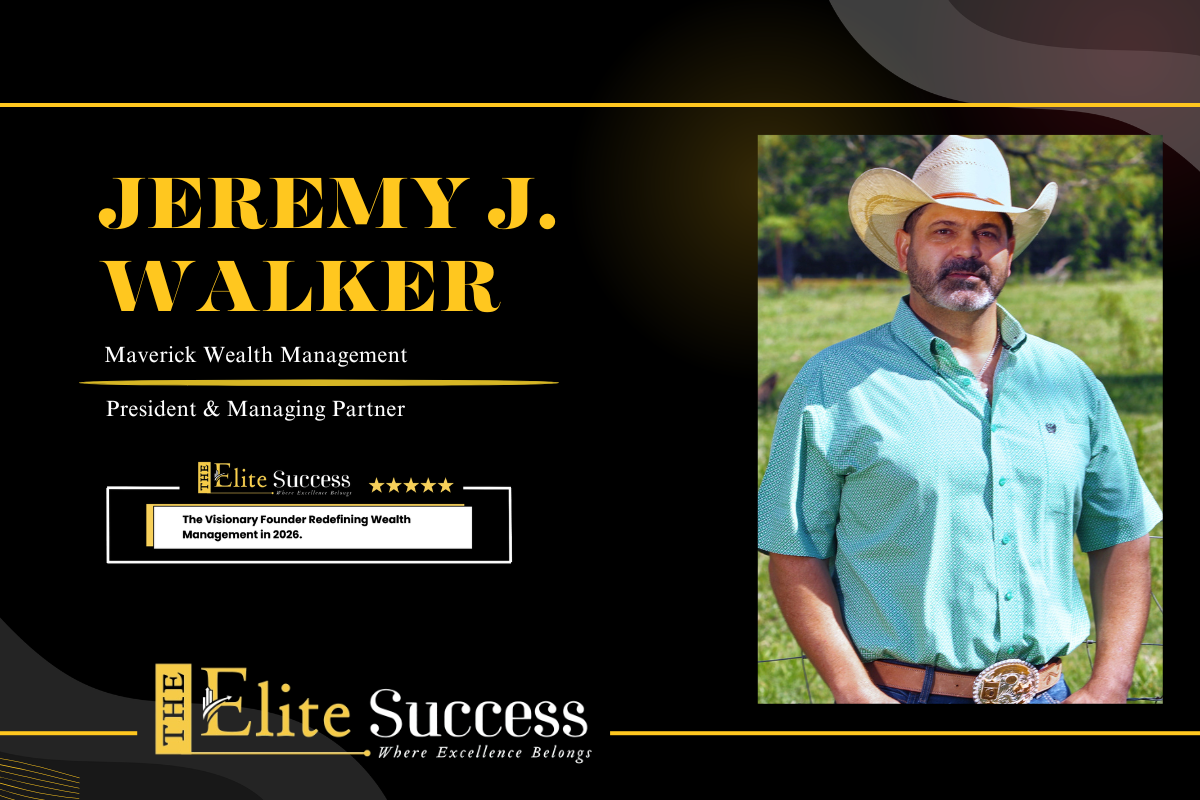
These qualities define Jeremy J. Walker, President and Managing Partner of Maverick Wealth Management. His leadership reflects a measured approach centered on accountability, intentional strategy and direct involvement in portfolio decisions. In this edition he is recognized as a visionary founder redefining wealth management in 2026 by leading a firm from rural Texas roots to national recognition through challenging traditional advisory models while staying focused on client outcomes and disciplined stewardship.
From Rural Texas to Nationwide Recognition
Jeremy set out with a clear intention when establishing Maverick Wealth Management. He wanted to create a firm that combined what he describes as the best of all the worlds in the investment space. Drawing on experiences in wire houses, large brokerage firms, a commodities desk, and an educational background in comprehensive financial planning, he sought to integrate these perspectives into a more tactical and risk-adjusted return-focused approach. The firm deliberately moved away from what he views as the traditional advisory model characterized by high cost mutual fund products, choosing instead to concentrate on individual stocks, bonds, private equity holdings and other alternative investments.
In its early stages, Maverick Wealth Management focused on serving affluent clients in rural Texas. Over time, the firm’s distinct approach began to attract broader attention, and its name steadily gained nationwide recognition for how different it was perceived to be.
Jeremy attributes much of his professional philosophy to his upbringing. He notes that his roots instilled in him a deep commitment to the value of a man’s word, a principle he does not compromise on. The firm’s name reflects this ethos. In western culture, a maverick is an unbranded bull, and he says that description fits the firm precisely. In his view, Maverick Wealth Management operates vastly differently from the majority of advisors working today.
While Jeremy proudly claims to be a Christian and makes a conscious effort to keep ego and pride in check, he also emphasizes the importance of confidence in leadership. Those who lead, he believes, must project assurance.
Jeremy describes his life and work as grounded in four F pillars:
Faith, Family, Finances, and Fitness. He believes that without faith, he would be lost and hopeless. Without family, he would lack motivation and a true north. Without finances in order, he would feel insecure. Without fitness, he would be unhealthy, which in turn would slow his work ethic. These pillars, he suggests, form the personal foundation that supports his leadership and the direction of Maverick Wealth Management. These principles and experiences directly guide how Mr. Walker approaches his role as a wealth manager, shaping the firm’s philosophy and operational model.
Redefining the Role of the Advisor
Maverick Wealth Management operates with a clear conviction about the role of an advisor. The firm believes clients hire advisors to be the advisor, not to outsource those responsibilities to mutual fund companies and or third party money managers. In its view, if that is all the advisor does, the value proposition to clients becomes questionable, at best.
That perspective was shaped in part by observing the prevailing model in rural Texas, where wealthier clients were often aligned with broker-dealers whose advisors turned over asset management to the home office. As a result, clients nationwide were receiving the same portfolios. Maverick Wealth Management chose not to subscribe to that structure.
The firm also approaches risk differently. Maverick examines the correlation of assets to each other, as well as the overlap in holdings and sectors. In its experience, most people do not realize how much overlap exists when they hold a portfolio of mutual funds or ETFs. Rather than relying on standardized allocations, the firm does not use model portfolios for its clients. It maintains that it cannot name another advisor or firm that still custom-makes portfolios for all of its clients.
Its focus instead is on individual stocks, bonds, and private equity holdings. Drawing from what it describes as a page taken from the wealthiest people in the world, the firm places a heavy emphasis on private equity, private credit, and venture capital. The approach is an example of what Maverick calls being tactical contrarians. Often, the firm is buying when no one is talking about an asset and conversely selling when everyone is talking about it. Within the affluent community in the industry, it is widely held that being proactive is the key. One of the many reasons Maverick Wealth Management prioritizes proactivity.
While technology has introduced efficiencies and improved documentation, Maverick Wealth Management intentionally limits its dependency on it. This is a concentrated effort to maintain the personability the firm believes is being forgotten by many in the industry in search of higher profit margins. At the same time, it stays innovative in its communication. After meeting with clients, the firm texts 60 second summary videos and follows up with a bullet point email that includes the client’s next pre scheduled meeting date and time so clients can plan accordingly.
Underlying the Maverick strategy is a philosophy centered around care, compassion, and service. The firm notably appears to care on a different level. To Maverick, clients are family, and their family becomes the firm’s family. While markets cannot be controlled, service and attitude toward clients can. The firm offers what it describes as the best illustration of this philosophy. It does not measure its success by its own growth. This may be surprising within the industry, notwithstanding Maverick measures success by how satisfied clients are and how exceeding the firms service is to them. This philosophy of personalized, thoughtful service naturally extends to the firm’s leadership and day-to-day responsibilities, shaping how decisions are made, as well as and how clients are guided.
Leadership Anchored in Clarity and Direction
At Maverick Wealth Management, the foundation of leadership begins with clarity of direction. Jeremy articulates that in order to know the direction, one must first know the starting point, the targets along the way, and the desired ending point. Listening, in his view, is not only personable, but a requirement to guide investors according to their goals, needs and risk tolerances. This approach shapes how relationships are built and how decisions are made, ensuring that every strategy begins with a clear understanding of the client.
He emphasizes that communication is central to responsible portfolio management. If clients do not understand why decisions are being made, they will often try to look at each individual investment as a stand alone investment instead of the hedge, balance, growth, or income play that it is designed to be. For him, context is essential. Investments are not isolated selections, but instead components of a broader structure designed with intention and purpose.
That philosophy has guided decisive actions when required. The firm sold out of the market in early 2022, and then bought back in when technology went down significantly. The decision reflected a disciplined reading of conditions rather than reactionary movement, aligning market participation with a structured view of risk and opportunity.
Technology also plays a practical role in how he fulfils his responsibilities. He uses technology to work remotely more, which allows him to keep his personal touches and his hands on investment activity while still seeing clients on the road and doing in person due diligence reviews of investments. The ability to remain directly engaged, regardless of location, supports both accessibility and oversight, reinforcing the steady and attentive management style that defines his work. While this approach to leadership and client-focused management defines the firm’s strengths, it also presents a set of challenges that require careful navigation.
Preparing for Market Uncertainty
At Maverick Wealth Management, the central challenge has been scalability. As mentioned, the firm actively fights against scaling too much of its business. In an industry where growth is often equated with success, the leadership remains cautious of expanding in a way that shifts the core focus away from the client.
There is a conscious effort to guard against what is described as the prevailing trend of scaling everything and becoming merely a “prospecting advisor,” rather than fulfilling what clients are actually hiring an advisor to do. Which in Mr. Walker’s opinion, clients want advisors to treat them as the individuals they are and manage their money. The concern is that excessive scaling can dilute the very responsibility that defines the advisory relationship.
Innovation presents another dimension of challenge. In a world increasingly dependent on technology, differentiation does not come from adopting every available tool, but from being unique and personalizing investments rather than delivering what is characterized as a sales pitch. The emphasis remains on substance over presentation, and on tailoring strategies that reflect individual client circumstances rather than standardized solutions.
The current environment further underscores this approach. As the firm prepares for recessionary pressures, it does so at a time when others are leaning back on the momentum of the past few years. The focus is on forward preparation rather than reliance on recent performance, reinforcing a disciplined stance amid shifting economic conditions. Meeting these challenges effectively depends on a leadership approach and team management style that keeps the firm grounded in its core values.
Intentional Growth and Character Preservation
At Maverick Wealth Management, the foundation of the practice is clearly defined. Jeremy explains that Jesus is first in the practice. This belief is not imposed on clients, but it shapes the internal posture of the firm. The attitude of love, compassion, respect and ethical fortitude guides each movement and informs how decisions are made. It stands as a governing principle for conduct rather than a message directed outward.
Recognition, in his view, is something that should always be humbling. He maintains that acknowledgement is not a platform for self importance, but a reminder of responsibility. His philosophy of leadership is closely tied to service. As he states, “If serving is beneath you, then leadership is beyond you!” The conviction reflects his belief that leadership cannot exist without a genuine commitment to serving others. Strength and humility, he believes, must coexist. Strong enough to lead yet humble enough to adapt.
This perspective also shapes how Maverick Wealth Management approaches growth. The firm actively fights against scaling too much of its business. The restraint is intentional. It allows the company to protect its character and maintain the standards that define its work. Within that structure, the guiding belief remains central and consistent. This thoughtful approach to leadership and disciplined management has not only shaped the firm’s internal culture but also paved the way for tangible achievements and strategic growth in the wider market.
Work Ethic as a Foundation for Success
Jeremy observed that the Maverick Wealth Management name began to gain more and more nationwide growth for how different it was. That recognition marked a significant achievement for the firm and reinforced the distinct approach that set it apart. He stated that this recognition certainly helps to fortify his confidence as the firm continues to move forward.
Previously we described that in early 2022, the firm sold out of the market and later bought back in when technology was significantly down. Jeremy maintains that to be proactive in that type of environment requires a work ethic. As the firm looks ahead, success remains measured by how satisfied clients are and by how exceeding the firm’s service is to them, a standard that continues to guide both its present direction and future growth. Drawing on these experiences, Jeremy shares insights and guidance that reflect the lessons learned from both successes and challenges, offering a roadmap for others in the field.
Guiding Principles for Professionals
Jeremy’s advice reflects a philosophy grounded in discipline, individual responsibility, and long term resilience. He encourages professionals to return to fundamentals and to go back to the basics of yesteryear. In his view, doing one’s own research remains essential, and each client should be treated as the individual they are rather than as part of a broad process.
He cautions against complacency, noting that ease of business can gradually weaken professional standards. In his opinion, such weakness becomes most visible during periods of economic strain, when clients require steady and informed guidance. As he states, “Guard against laziness and ease of business, as these will only make you weak in the time when your clients will need you strong. In my opinion, that will be the kryptonite during the next recession that causes a windfall of losses.”
At the same time, he underscores the importance of collaboration and perseverance. Strength, courage, and consistency, he believes, remain essential, as works built on these foundations will ultimately be rewarded.
A Legacy of Discipline and Service
Jeremy’s legacy is measured not by scale, accolades, or industry visibility, but instead by the constancy of character and the discipline of keeping one’s word. He strives to leave behind “a man who keeps his word, a man who will never stop working for those who depend on him, and a man who receives his guidance from Jesus.” This guiding principle defines the reliability, endurance, and faith-centered leadership that mark his career.
At the heart of his approach is personal accountability. Jeremy believes that responsibility cannot be outsourced without compromising purpose. By maintaining hands-on oversight of portfolio construction and avoiding model-driven, standardized solutions, he ensures that every decision remains deliberate and every action reflects his personal commitment. For him, stewardship is a moral, as well as professional, duty. To be entrusted with another’s resources is to remain actively engaged and fully accountable.
Faith is central to how he measures impact. Drawing on Paul’s letter to the Corinthians, “Be watchful, stand firm in the faith, act like men, be strong. Let all that you do be done in love,” Jeremy aligns leadership with vigilance, strength, and compassion. Conviction and care, in his framework, are inseparable pillars of responsible leadership.
Jeremy, nor Maverick , define success by growth metrics. While both Mr. Walker and the firm have earned nationwide recognition for their differentiated approach, he evaluates achievement through client satisfaction and confidence. In his view, trust is the ultimate benchmark.
His enduring legacy is both practical and personal: disciplined execution, preparedness, and unwavering service, paired with dependability when it matters most. The mark he seeks to leave is of steadfast character, strong enough to lead, humble enough to serve, and guided by faith.
Insights Drawn from Jeremy J. Walker
1. Leadership equals accountability: Leaders stay directly responsible for decisions.
2. Clarity builds confidence: Clear communication sustains trust in uncertain markets.
3. Customization over scale: Personal stewardship creates greater value than standardization.
4. Discipline over reaction: Patience and research guide stronger long term outcomes.
5. Character defines leadership: Integrity and values shape culture and relationships.
6. Trust defines success: Client confidence matters more than growth metrics.