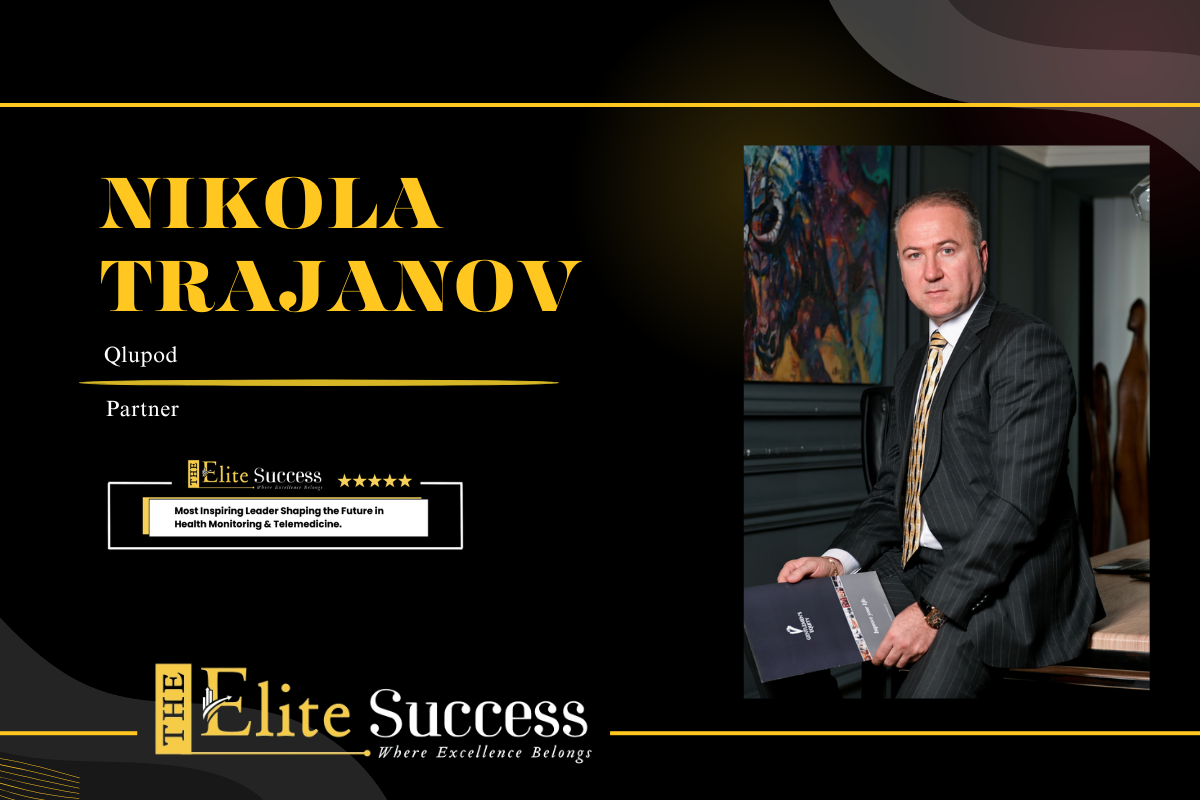
In an era where healthcare is rapidly evolving through digital transformation, visionary leadership is the driving force behind meaningful innovation. As a Partner at Qlupod, Nikola Trajanov stands at the forefront of this transformation, redefining how health monitoring and telemedicine are integrated into everyday life. Recognized under the edition “Most Inspiring Leader Shaping the Future in Health Monitoring & Telemedicine,” Nikola’s work reflects a deep commitment to making healthcare more accessible, proactive, and patient-centric.
With a strategic mindset and a passion for technology-driven impact, Nikola has played a pivotal role in positioning Qlupod as a forward-thinking force in remote health solutions. His leadership emphasizes innovation that is not only technologically advanced but also practical and scalable, bridging gaps between patients, providers, and healthcare systems. By focusing on seamless monitoring, real-time data insights, and intelligent telemedicine solutions, he is helping reshape the way individuals engage with their health.
Nikola Trajanov’s journey is defined by purpose and progress—championing a future where healthcare is continuous, connected, and empowering for all.
Top of Form
Bottom of Form
Clarity as Care: Leadership with Responsibility and Impact
With over 25 years of experience across leadership, consulting, coaching, and entrepreneurship, Nikola Trajanov has developed a philosophy grounded in a simple but powerful belief: clarity is a form of care. Throughout his journey, he has seen how complexity can overwhelm organizations, especially in high-stakes industries. As he often says, “In complex environments, people don’t need more noise. They need structure, priorities, and honest communication.”
At Qlupod, this principle shapes the way he leads. Nikola believes that whether addressing teams, investors, or healthcare stakeholders, transparency and alignment are essential. In medtech, the stakes are even higher. Innovation must move fast, yet patient safety and regulatory compliance can never be compromised. “You are constantly balancing speed with safety, ambition with regulation, innovation with responsibility,” he explains. His role, as he defines it, is to hold that tension rationally and guide decisions without sacrificing integrity.
Being recognized as a “Most Inspiring Leader” carries a meaning that goes far beyond personal acknowledgment. For Nikola, inspiration in healthcare is not about charisma — it is about accountability. He believes inspiring leadership means building solutions that genuinely help patients, empowering doctors instead of replacing them, and turning bold ideas into reliable systems.
Those who work with him describe a steady presence under pressure. He measures success not by attention, but by impact — by whether innovation remains ethical, practical, and truly beneficial to the people it is meant to serve.
Values-Driven Leadership Built on Listening and Discipline
Nikola Trajanov’s leadership style is deeply shaped by his diverse background in coaching, corporate training, and consulting. Each discipline added a critical dimension to how he approaches decision-making and team alignment. Coaching, he explains, taught him one essential habit: “Listen before solving.” Instead of rushing toward answers, he prioritizes understanding perspectives, motivations, and concerns — a practice that builds trust across teams and stakeholders.
Corporate training refined his ability to translate complexity into clarity. In highly technical environments such as Qlupod, innovation can easily become overwhelming. Nikola learned how to distill intricate ideas into structured frameworks that teams can execute with confidence. Meanwhile, consulting strengthened his discipline in structured decision-making, stakeholder alignment, and consistent execution. He understands that in technology-driven healthcare initiatives, success is rarely purely technical; it depends on communication, trust, and reliable delivery.
Underlying these professional influences is a strong foundation of personal values. Nikola is guided by integrity, transparency, responsibility toward patients and stakeholders, financial discipline, accountability, and a long-term orientation over short-term optics. In a startup environment, he acknowledges, the temptation to overpromise is constant. “But in healthcare, overpromising destroys trust. We prefer credibility over hype,” he states firmly.
Colleagues describe his leadership as steady and principle-driven. For Nikola, sustainable growth and ethical impact will always outweigh quick visibility — because in healthcare, trust is the most valuable currency of all.
Building a Structured Ecosystem for Measurable Remote Care
At the heart of Nikola Trajanov’s vision lies Qlupod AG, a Swiss health technology start-up redefining how remote healthcare is delivered. The company is building an integrated ecosystem that combines medical-grade multi-parameter measurement with a structured digital workflow designed for physicians, care providers, and patients alike. It is not simply about connectivity — it is about clinical structure.
Nikola explains that the foundation of this ecosystem is the QluPod device, a compact system capable of measuring five clinically relevant vital parameters in one integrated solution: blood pressure, heart rate, oxygen saturation, body temperature, and ECG. In selected regions, a sixth parameter — glucose — is technically available; however, the company clearly communicates that this feature is not offered in the US, EU, and Swiss markets. Transparency, he emphasizes, is non-negotiable.
“Our mission is not to launch another health gadget,” Nikola states. Instead, the objective is to enable medically structured remote monitoring at scale. While telemedicine has often been reduced to video consultations, he believes its true potential lies in measurable, supervised, and clinically actionable care.
Under his leadership, Qlupod AG is focused on transforming telemedicine from a convenience tool into a reliable healthcare infrastructure — one where data is structured, doctors remain central, and patients are continuously supported beyond the walls of traditional clinical settings.
Navigating Regulation, Complexity, and Market Perception
Building Qlupod AG within the highly regulated healthcare industry brought immediate and significant challenges. For Nikola Trajanov, the first and most important principle was clear: do it right. “In healthcare, shortcuts destroy trust,” he emphasizes. Regulation exists for good reason, and from the outset, the company had to align with stringent medical device standards, quality management systems, data privacy frameworks, and the practical realities of clinical workflows.
He observed that many digital health solutions fail because they are built like consumer apps rather than healthcare infrastructure. Qlupod AG deliberately avoided that path. Instead of prioritizing speed over substance, the team focused on building a system that physicians could confidently integrate into structured care models.
The second challenge was positioning in an increasingly crowded telemedicine market. Telemedicine is often reduced to video consultations, with limited or no medically accurate measurement. Even when data is captured, it is frequently restricted to a single parameter. Nikola and his team chose a more demanding route: multi-parameter measurement combined with physician and care interfaces — a complete ecosystem rather than isolated components.
The third hurdle was typical for medtech start-ups: longer development timelines, extended sales cycles, and higher capital requirements. “When you build hardware together with a secure, scalable software stack, patience and financial discipline are essential,” Nikola explains. It is this disciplined, long-term approach that continues to define the company’s trajectory.
From Validation to Infrastructure: The Strategic Shift That Drove Sustainable Growth
For Qlupod AG, growth did not come from rapid expansion alone — it came from deliberate, structural decisions. As Nikola Trajanov explains, there were two defining inflection points that shaped the company’s trajectory.
The first came at the end of 2023, when Qlupod received the “Best Telemedicine App” award at The Future Innovation Summit in Dubai — notably for a test version of the solution. “That recognition validated that we were addressing a real problem with the right approach,” Nikola reflects. It provided external credibility at a critical stage and strengthened confidence among stakeholders and partners.
The second — and more strategic — turning point was an internal decision:
Instead of scaling prematurely, the company chose to invest heavily in completing its ecosystem by developing QluDoc and QluCare.
This shifted Qlupod’s positioning fundamentally:
- From a device story
- To an infrastructure story
The ecosystem now integrates:
- Multi-parameter measurement
- Medical supervision
- Structured care coordination
“In healthcare, growth is not just speed — it is structural readiness,” Nikola emphasizes.
This philosophy also explains the company’s growing relevance in telemedicine. Qlupod addresses a critical structural gap: objective, clinically usable health data. Many telemedicine models still rely on:
- Patient self-reporting
- Fragmented or single-parameter readings
- External devices without workflow integration
Qlupod changes that dynamic by combining five vital parameters into one system and linking them to a medically structured interface where physicians and care providers can take informed action.
Its relevance is further amplified by powerful macro trends:
- Aging populations
- Rising chronic disease burdens
- Healthcare workforce shortages
- The need to decentralize monitoring safely
By building for scalability — across private households, care facilities, municipalities, and national initiatives — Qlupod AG is positioning itself not just as a product company, but as a long-term enabler of sustainable remote healthcare infrastructure.
A Fully Integrated Ecosystem, Not Just a Device
At its core, Qlupod AG positions itself not as a single-product company, but as a structured remote healthcare ecosystem. Nikola Trajanov often emphasizes, “We are not building a gadget — we are building infrastructure.”
The ecosystem consists of several tightly connected components:
- QluPod device – measuring five vital parameters: blood pressure, heart rate, oxygen saturation, body temperature, and ECG (with glucose technically available in select regions, clearly limited outside the US, EU, and Switzerland).
- QluApp – the patient interface for guided measurements, health history tracking, and structured interaction.
- QluDoc – the physician interface enabling remote supervision and clinical workflow integration.
- QluCare – the coordination layer supporting structured programs and repeatable care processes.
- QluDoc Hub (in development) – infrastructure designed to enable 24/7 access and expand the physician network.
Nikola explains that each layer was built intentionally to avoid fragmentation. Instead of selling disconnected components, the company integrates measurement, supervision, and coordination into one coherent system.
He believes this architectural thinking is what differentiates Qlupod AG. “Healthcare does not improve through isolated innovation,” he says. “It improves when technology supports structured responsibility.” The ecosystem approach ensures that health data flows seamlessly from patient to physician to care structures — forming the backbone of measurable telemedicine at scale.
Technology That Reduces Friction and Builds Trust
For Nikola, technology only has value if it reduces friction. Seamless experience in healthcare means fewer manual steps, less fragmentation, and clearer responsibilities — not more features.
Through QluApp, patients are guided step by step during measurements. The process is simplified, and health data becomes understandable and actionable. Many users, he notes, find reassurance in structured tracking. “Clarity reduces uncertainty,” Nikola says, pointing out that guided measurement helps patients feel supported rather than overwhelmed.
For physicians, QluDoc transforms scattered readings into organized, multi-parameter data. Instead of reviewing fragmented information, doctors can evaluate structured trends and supervise patients remotely. This strengthens clinical decision-making without adding administrative burden.
In institutional settings, QluCare provides coordination capabilities that go beyond one-to-one interaction. Care facilities, municipalities, and structured programs benefit from repeatable workflows instead of ad-hoc communication. The system enables scalability while maintaining oversight.
Nikola believes that disruption in healthcare does not come from flashy dashboards but from improving process reliability. Traditional monitoring is episodic — a measurement here, a note there, a delayed conversation during the next appointment. Qlupod introduces continuous, structured data availability combined with supervision and coordination.
“It’s a shift,” he explains, “from measurement as a one-off event to measurement as part of a clinical workflow.” And that shift, he believes, is where meaningful transformation happens.
Innovation Through Integration and Execution Discipline
Operating in a rapidly evolving telemedicine landscape requires more than creativity — it requires discipline. Nikola describes four core strategies that keep Qlupod AG competitive:
- Integration over feature overload. Healthcare systems need reliable workflows, not endless functionalities.
- Proximity to stakeholders. Physicians, care facilities, and structured program operators remain central in product refinement.
- Strategic partnerships. Rather than attempting to dominate every market alone, the company builds distribution and ecosystem alliances.
- Execution discipline. Innovation only matters if it can be delivered, adopted, and sustained.
He stresses that healthcare innovation must remain grounded in practicality.
“You don’t win by being louder,” Nikola says. “You win by being reliable.”
With the ecosystem foundation largely established, 2026 marks a shift toward marketing activation and distribution expansion. The strategic focus has moved from building to scaling — carefully, and in alignment with regulatory and operational realities.
Nikola sees innovation as a long-term commitment rather than a race. For him, sustainable growth depends on credibility, structured implementation, and consistent delivery — not hype.
From Product Interest to Program Scale
A recent milestone illustrating this strategic evolution was Qlupod’s participation at World Health Expo (WHX Dubai) in early 2026. While the company attended with a modest stand, the outcome exceeded expectations.
Rather than generating simple device inquiries, the event validated international demand for structured multi-parameter monitoring programs. Serious discussions emerged with stakeholders exploring scalable telemedicine initiatives, including those linked to municipalities and regional deployments.
Nikola describes this as a pivotal moment. “What resonated was not the hardware alone,” he reflects. “It was the ecosystem.” Demonstrating five integrated vital parameters combined with QluDoc and QluCare shifted conversations from product features to program implementation.
Key success factors included:
- Clear differentiation through multi-parameter integration
- Demonstrating how data translates into actionable care
- An expansion mindset focused on partnerships over direct-only sales
This marked a strategic transition — from product interest to program interest. And, as Nikola concludes, “That is where real scale begins.”
Trust as the Foundation, Leadership as the Evolution
For Qlupod AG, trust is not a branding exercise — it is an operational discipline. Nikola Trajanov firmly believes that credibility in healthcare is earned through consistency. Compliance, data protection, medical accuracy, and professional conduct are not optional layers; they are the foundation. “Trust in healthcare is built when systems are structured, repeatable, and aligned with medical reality — not just market trends,” he explains.
Professionals and institutions evaluate reliability over time. Patients evaluate clarity and reassurance. By focusing on disciplined processes and transparent communication, Nikola ensures that Qlupod’s ecosystem reflects medical responsibility rather than technological hype.
As the company transitions from its building phase into a scaling phase, his leadership identity is evolving as well. He describes the shift from “builder” to “architect” — enabling distribution strategies, partnerships, governance frameworks, and long-term resilience. Those who observe his journey note that his personal brand is increasingly defined by calm execution and clarity under pressure.
For Nikola, entrepreneurship, coaching, and healthcare innovation share a common thread: enabling people to perform better. Whether supporting doctors with structured data, empowering patients through guided monitoring, or aligning teams around execution discipline, his leadership continues to mature alongside the infrastructure he has helped create.
Building in a Trust Market: Advice and Legacy
“Digital health, in my view, is not a typical app economy — it is a trust market. If I could offer advice to aspiring entrepreneurs entering this space, it would be practical and disciplined:
- Understand regulation early.
- Design around real clinical workflows.
- Validate your solution before scaling it.
- Secure sustainable funding for a realistic runway.
- Build partnerships instead of trying to win alone.
Most importantly, solve a systemic problem — not a superficial inconvenience. Healthcare systems are complex for a reason, and meaningful innovation requires respect for that complexity.
When I think about legacy, it is not about recognition. It is about contribution. I hope to help make structured multi-parameter remote monitoring a standard component of care rather than an exception. If we succeed at Qlupod AG, healthcare systems become more resilient, doctors gain stronger decision support, and patients feel safer outside hospital walls.
That is the kind of impact that matters to me — practical empowerment at scale, built on responsibility and trust.”