Shreyoshi Chakraborti: Redefining Scientific Frontiers and Shaping the Future of Global Healthcare
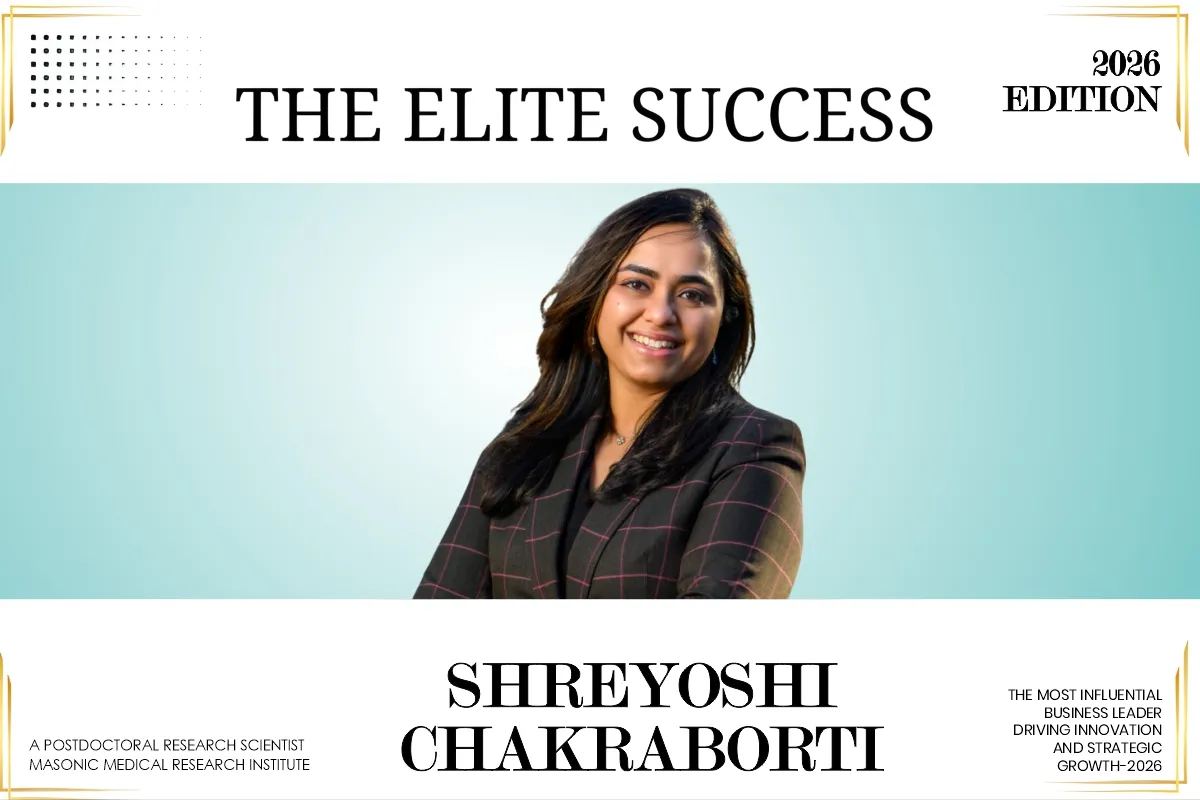
At a time when global healthcare stands at the cusp of transformation, one scientist is quietly—but powerfully—steering the tide of innovation. Dr. Shreyoshi Chakraborti serves as a post-doctoral research scientist at the prestigious Masonic Medical Research Institute (MMRI) — a facility renowned for its cutting-edge work in cardiovascular, neurocognitive, and autoimmune disorders.
Armed with a PhD from Stony Brook University, she has carved a distinguished path through biomedical research. Her expertise spans cardiovascular research, infectious diseases, analytical biochemistry and lipidomics — a combination that positions her at the frontier of tackling complex challenges like antibiotic resistance, metabolic disorders, and disease-driven inflammation.
At MMRI, Dr. Chakraborti contributes to a mission rooted in innovation and discovery — one that seeks to decode the molecular mechanisms of debilitating diseases and pave the way for tomorrow’s cures. Her work underscores a dual commitment: rigorous scientific inquiry, and a deeper vision of global health — improving quality of life for people everywhere.
Yet beyond the lab and data lies a broader mission: mentorship, advocacy, and community building. She believes deeply in living a holistic life—where science is just one meaningful part of a much larger personal landscape. Dr. Chakraborti balances her research with efforts to nurture the next generation of scientists, encourage women in STEM, and inspire future leaders.
In Dr. Chakraborti, we find not just a researcher, but a visionary — a scientist whose work today could shape the health outcomes of tomorrow. As MMRI pushes the boundaries of medical science, she stands at the center of that journey, helping transform complex research into real-world impact.
A Vision of Empowerment
“As an early-career researcher, I am still discovering what leadership means to me. My approach is rooted in integrity, curiosity, and the belief that people thrive when they feel valued and empowered.”
Even as an scientist, Shreyoshi believes in setting an example through her actions. And true to her core values, she demonstrates consistency in her actions, accountability in her decisions, and openness in her communication. She views leadership not as a title, but as a gradual process—something young scientists grow into with experience. For Shreyoshi, leadership is more about directing and more about creating a trusted environment. These are the conditions where creativity thrives, because it creates a sense of respect among everyone that their ideas here will be respected.
“This is how people take initiative and grow with confidence.”
Another aspect of leadership for Shreyoshi is the intellectual responsibility it represents. Especially in the field of science research it is extremely important how you stay curious, challenge the assumptions, and make decisions grounded in evidence, empathy and long-term vision. “I actively seek diverse perspectives because meaningful innovation rarely comes from uniform thinking. Above all, I strive to practice with humility—recognizing that progress is collective, success is shared, and a strong leader inspires others to lead as well,” she says.
A core part of this philosophy is building a workplace where people genuinely enjoy coming to work. When team members feel valued, trusted, and supported, the institution functions with purpose and harmony. While still early in her career, she remains intentional about the environment she hopes to help shape within scientific teams. A communal environment grounded in trust, loyalty, and collaboration not only strengthens relationships but also drives the highest levels of productivity and creativity.
The Thrill of the Unknown
“For me, curiosity is the heart of science, and that curiosity makes the work genuinely fun.”
Science is quite a dynamic field. And the more you observe, and more you keep digging, the more it surprises you. Yet, it can also get tiring at times. For Shreyoshi, entering the lab is an experience in itself. With anticipation running through the veins, she is in a constant thought whether an experiment will work, or what new insight will emerge today, or even, how the results of today might challenge what’s waiting for tomorrow. There is a thrill to that uncertainty; research feels like an adventure where each step brings you closer to understanding something that no one else has fully uncovered.
“Most experiments don’t succeed on the first try, but that is part of the excitement. Each setback pushes me to think more critically, refine my approach, and strengthen my hypothesis,” Shreyoshi notes. The iterative process—designing, testing, troubleshooting, and discovering—keeps me motivated and engaged. What drives me every day is the opportunity to try something new, to pursue unanswered questions, and to create knowledge that moves the field forward. That sense of exploration is what makes science endlessly inspiring and worth the effort.
Advancing Cardiac Science: Shreyoshi’s Role at the Masonic Medical Research Institute
Dr. Shreyoshi Chakraborti is a Scientist at the Masonic Medical Research Institute (MMRI) in Utica, New York—an institution renowned for its pioneering work in cardiovascular and molecular medicine. At MMRI, she contributes to a research environment dedicated to uncovering the biological mechanisms that underlie complex human diseases. Her work plays a central role in advancing the institute’s mission of driving discovery and improving global health outcomes.
Dr. Chakraborti’s current research centers on potassium ion channels, essential regulators of the heart’s electrical rhythm. She investigates how disease-associated mutations disrupt ion efflux at the molecular level and how these alterations precipitate cardiac arrhythmias and cardiomyopathy. By combining structural biology, biochemistry, electrophysiology, and functional studies, she examines these channels from multiple scientific vantage points—ranging from their three-dimensional structure to their behaviour in cellular environments and in the whole heart.
Through this integrated approach, she aims to illuminate how subtle protein perturbations translate into significant physiological dysfunctions. Her findings hold promise for informing the development of more precise diagnostics and targeted therapeutic strategies. At MMRI, Dr. Chakraborti is part of a collaborative, innovation-driven ecosystem where each discovery contributes to the broader goal of advancing cardiovascular science and improving patient care.
Overcoming Early Hurdles
When Dr. Shreyoshi Chakraborti began her journey into advanced scientific research, the transition was both exciting and demanding. Originally from India, she completed her bachelor’s and master’s degrees in Biochemistry at the University of Calcutta before moving to the United States to pursue her Ph.D. at Stony Brook University. Entering a new country, adapting to an unfamiliar culture, and navigating the intensity of graduate-level research all at once presented challenges that would profoundly shape her scientific identity.
Her doctoral work focused on infectious disease particularly on Multi drug resistant infection caused by Mycobacterium tuberculosis, where she uncovered novel metabolic and enzymatic pathways with potential for improved antibiotic development. Dr. Chakraborti recalls that her early years were marked by self-doubt and the pressure to constantly prove her ideas. “There were moments,” she says, “when I questioned my instincts, and I had to push myself to learn, adapt, and trust my scientific intuition.”
Criticism from peers and the inevitable failures inherent to scientific research could have been discouraging, but she chose to treat them as tools for growth. Her perseverance ultimately led to a significant milestone—publishing her Ph.D. findings as a corresponding author in American Chemical Society journals, a rare achievement for a graduate student.
Looking back, she believes that persistence, resilience, and confidence in one’s scientific instincts are the foundations of successful research. “Experiments will fail—that’s part of science,” she reflects. “But if you keep going, things eventually fall into place. ‘Never give up’ still guides me every day.”
How Curiosity, Community, and Creativity Shaped Her Journey
When asked about a single turning point that accelerated her professional growth, Dr. Chakraborti reflects that her journey has not been defined by one dramatic moment. Instead, her evolution as a scientist has unfolded through steady, intentional steps—small milestones that, over time, have shaped her into the researcher and leader she is today. “Every day feels like a new opportunity,” she says. “An opportunity to learn something new, to challenge myself, or to discover a fresh perspective.”
What sets Dr. Chakraborti apart is the balance she cultivates between her professional and personal passions. While science is her calling, she believes that growth happens when the mind expands beyond the boundaries of work. She is a trained yoga instructor, teaching senior groups in public libraries and local studios. For her, yoga is a way to give back to the community while fostering connection, mindfulness, and well-being.
Her love for books forms another essential part of her identity. Dr. Chakraborti runs multiple book clubs—one at a Long Island public library, another in Chicago, and she participates in several more. “Books spark conversations that go far beyond the story,” she explains. “They allow us to explore psychology, motivations, themes, and the deeper meaning behind human experiences.” She also writes regularly on Medium, sharing reflections and curated reading lists.
For Shreyoshi, science is a profound part of her identity, but it does not define her entire life. She believes that a fulfilling personal world—shaped by hobbies, movement, community, and creativity—is essential for sustaining long-term scientific curiosity and joy. Her pursuits outside the lab keep her grounded, energized, and connected to the world beyond research. They also offer valuable insight into the everyday experiences and needs of the broader public, which she strives to integrate into her scientific work. Shreyoshi emphasizes that engaging with a wider audience and understanding the perspectives of common people are crucial to addressing any challenge—whether in research, health care, or life. She often says that nurturing one’s passions is not a distraction from science, but a vital source of resilience, perspective, and fresh inspiration.
Ultimately, she believes that stories—whether scientific, literary, or personal—shape who we become. “Every day, I look for a new story,” she says. “Something to learn from, something to share, and something that will stay with me.” This curiosity and appreciation for narrative continue to guide her growth both inside and outside the lab.
Bridging Biochemistry and Computational Biology
Dr. Shreyoshi Chakraborti’s scientific expertise lies at the intersection of biochemistry, structural biology, and computational modelling—an integrated approach she has refined over years of advanced research. “I am a biochemist by training,” she explains, “with specialized experience in structural biology and mass spectrometry.” Her early work involved multi-omics investigations aimed at understanding the metabolic and enzymatic pathways that sustain persistent and latent Mycobacterium tuberculosis infections. These studies provided critical insights into enzymes that could serve as potential targets for improved antimicrobial therapies.
Building on this foundation, Dr. Chakraborti’s current research expands into cardiovascular science, where she examines how subtle molecular changes alter the function of potassium ion channels. She employs a dual experimental–computational strategy, using biochemical assays alongside advanced computational tools—such as molecular docking and molecular dynamics simulations—to probe how post-translational or structural modifications influence ion channel behaviour.
“This combination allows me to study mechanistic changes at atomic resolution,” she notes, “and then connect those findings to functional outcomes at the molecular and cellular levels.”
By integrating multiple disciplines, she aims to uncover fundamental mechanisms that drive complex diseases across both infectious and cardiovascular domains, contributing knowledge that could ultimately shape targeted therapies and diagnostic innovations.
Pushing Scientific Boundaries
In her journey as a biomedical researcher, she has consistently embraced scientific challenges that require unconventional thinking. Reflecting on her PhD work, she explains, “I was working on lipidomics in the context of infectious disease—a field where no prior expertise existed at my institution. That meant I had to think creatively, troubleshoot independently, and carve out a methodological path almost from scratch.” What began as an unexplored technique ultimately became a reliable protocol that future researchers could use. This experience embodies her belief that discovery thrives when scientists are willing to step beyond established boundaries.
When asked how she stays innovative in a rapidly evolving scientific landscape, she emphasizes the interplay between curiosity and discipline. “Reading and critical thinking go hand in hand,” she says. For her, staying competitive isn’t about consuming endless information—it’s about reading with purpose. She actively surveys the literature to understand what is known, what has been attempted, and where genuine knowledge gaps remain. This targeted approach helps her refine ideas, shape strong hypotheses, and design experiments that push scientific understanding forward. Colleagues note that this blend of intellectual focus and analytical rigor is a defining aspect of her methodology.
Her recent achievements reflect both her scientific commitment and her personal resilience. She published in the American Chemical Society in August 2025, a milestone quickly followed by her transition to the Masonic Medical Research Institute. She explains, “Perseverance and the support of the people around me made all the difference. Surrounding yourself with positive individuals who uplift you is essential. They give you the space to reflect, recover, and continue striving—especially on difficult days.”
Her story illustrates how innovation is driven not just by technical skill, but by the mindset, community, and determination that sustain scientific discovery.
Creativity as a Tool for Scientific Growth
For her, creativity is not separate from science—it is the foundation that shapes how she thinks, leads, and communicates. She often says, “Storytelling helps me turn experiences into narratives that reveal truth, emotion, and human complexity,” and this belief guides how she engages with colleagues, mentees, and the broader scientific community. By framing scientific journeys as stories, she makes complex ideas more relatable and spotlights voices and experiences that deserve to be heard. Those who work with her notice that her ability to humanize science fosters deeper connection and understanding.
Reading plays an equally transformative role in her identity. She describes it as both an intellectual engine and a source of empathy. Through books, research papers, and diverse narratives, she gains exposure to new ideas and worldviews. This continuous intake of knowledge informs everything from how she designs experiments to how she supports young scientists navigating their own paths. Colleagues often observe that her scientific perspective is strengthened by her ability to absorb diverse ideas.
Writing ties her creative practice together… a defining aspect of how she communicates and connects as an emerging scientist. “Writing forces me to be clear, intentional, and reflective,” she explains. Whether documenting scientific insights or capturing lived experiences, writing allows her to express ideas with purpose and authenticity. This blend of analytical precision and creative expression has become a defining aspect of her leadership—enabling her to communicate with impact, inspire through narrative, and lead with a sense of curiosity and humanity that resonates across the teams and communities she serves.
A Future Built on Discovery, Purpose, and People
“Looking ahead, my long-term vision as an aspiring independent scientist is to build a research program that blends rigorous inquiry with meaningful human impact. I want my work to push scientific boundaries—deepening our understanding of molecular mechanisms in ways that can one day translate into real therapeutic or societal benefit. I imagine my future lab as a space where curiosity is celebrated, bold questions are encouraged, and innovative ideas are nurtured into discoveries that matter.
But just as important as the science is the community I hope to cultivate. Looking ahead, I hope that over time, my contributions will be defined not only by the research I produce, but also by the people whose journeys I’ve helped shape. I want future generations—especially women, first-generation scholars, and trainees from underrepresented backgrounds—to feel seen, supported, and empowered in science. If I can give others the confidence to pursue their ideas, help them find their voice, and create an environment rooted in kindness, integrity, and resilience, then I will have contributed something truly lasting.
Ultimately, I hope my future impact takes two forms: discoveries that advance the field, and a community of young scientists who go on to build, question, and innovate with courage and compassion. If the next generation is better equipped, more confident, and more inspired because of the paths I helped open, then I will consider that my greatest scientific achievement.”