“Education is the kindling of a flame, not the filling of a vessel.” — Socrates
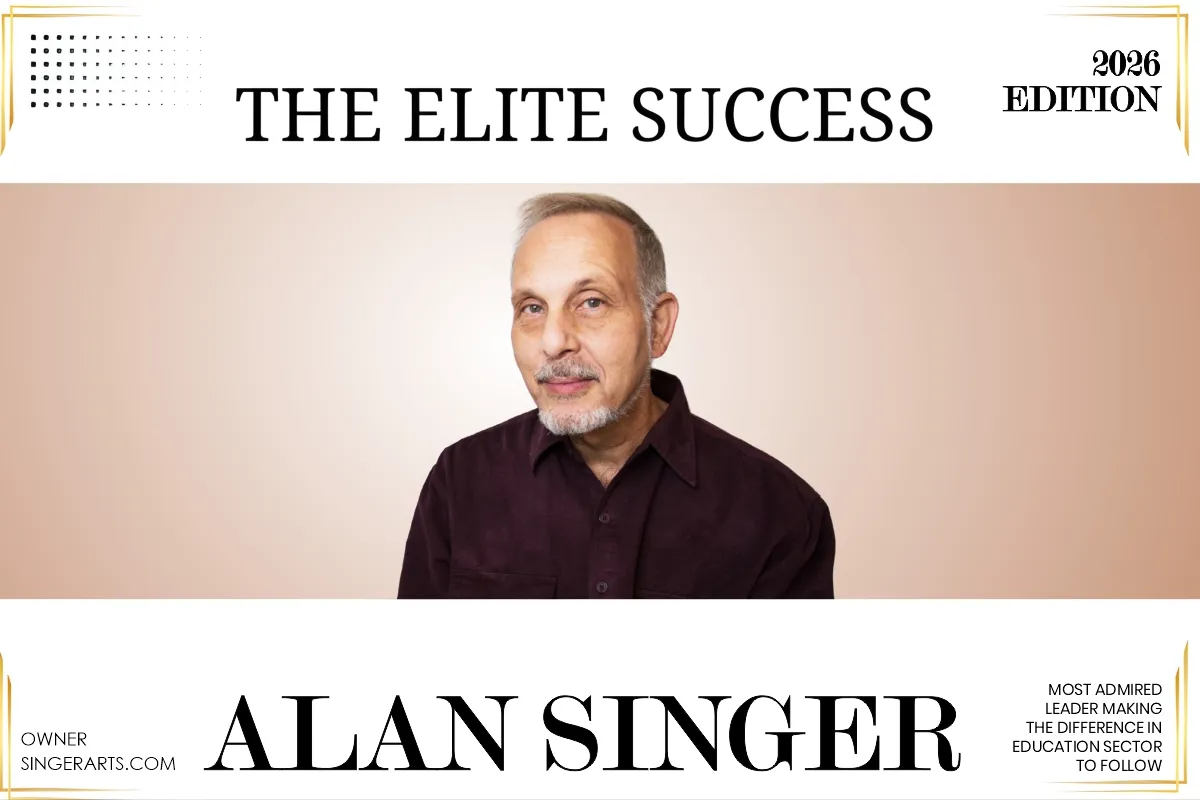
For centuries, the purpose of education has been debated, defined, and redefined. Yet, at its core, true learning has always been about awakening curiosity rather than depositing information. Alan Singer’s life and work embody this ancient idea with remarkable clarity. As an artist and educator, he does not merely teach techniques or theories; he helps students learn how to see, question, and imagine.
Rooted in the belief that creativity is central to human understanding, Singer’s journey spans the studio, the classroom, and the wider cultural landscape. As the owner of Singerarts.com and a lifelong teacher of fine art and design, he has consistently blurred the lines between making art and making meaning. His approach invites learners to slow down, observe deeply, and engage with complexity—skills that are increasingly rare, yet profoundly necessary in today’s fast-paced world.
What sets Alan Singer apart as an educational leader is his conviction that art is not an isolated discipline, but a way of thinking that strengthens every other form of learning. Through mentorship, writing, and decades of teaching, he has guided students to embrace experimentation, accept ambiguity, and trust the process of discovery. These are lessons that extend far beyond the canvas, shaping adaptable, thoughtful individuals prepared for a changing world.
In an era where education is often reduced to efficiency and outcomes, Singer’s work offers a timeless counterpoint. His leadership reminds us that the most enduring education does not tell students what to think—it teaches them how to think, see, and create.
A Lifetime Devoted to Art, Teaching, and Gratitude
After more than 32 years as a Professor in the School of Art at the Rochester Institute of Technology (RIT), New York, Alan Singer recently stepped into retirement, bringing to a close an extraordinary chapter defined by teaching, mentoring, and creative exploration. Over three decades, he taught painting, printmaking, design, and illustration to a richly diverse community of students from across the globe.
Looking back, he reflects on this journey with a deep sense of gratitude—toward his wife and family, and toward a remarkable group of colleagues at RIT who shaped an environment of shared curiosity and creative rigor. Teaching, for Singer, was never a separate pursuit from making art. It was an extension of the same impulse: to observe closely, think deeply, and communicate visually with clarity and purpose.
From the classroom to the studio, his career reflects a rare balance—one where professional practice and pedagogy continually informed one another, reinforcing his belief that education is most powerful when it remains rooted in lived experience and creative inquiry.
Growing Up Inside Art: Family, Curiosity, and Early Foundations
Alan Singer’s evolution as both an artist and educator began at home. He grew up in a household where art was not an extracurricular activity, but a way of life. Both of his parents were working artists in New York City. His father painted and illustrated books from a home studio, while his mother was a painter, book illustrator, draftsman, and teacher. Creativity was a shared family language—one his brother would later continue as a graphic designer and painter.
Most weekends during the late 1950s and early 1960s—an especially transformative period in the art world—his parents visited galleries in lower Manhattan, often bringing young Alan along. Those visits offered an early exposure to the excitement, community, and cultural significance surrounding contemporary art. Even as a child, he sensed that art mattered—not just aesthetically, but socially.
At home, his toys—cars, trucks, and trains—soon became subjects for drawing. Learning to render them accurately sparked an early understanding of detail, structure, and perspective, guided closely by his mother’s technical instruction. Before the age of ten, he had already written and illustrated his own books on trucks and earth movers. Some of this early work even found its way into corporate publications—an early hint of a professional path ahead.
His father, Arthur Singer, worked at Golden Books in New York City. Editors there noticed Alan’s drawings, leading to his first illustration contracts and opening doors into the publishing world while he was still young.
From Student to Professional: Craft, Collaboration, and Recognition
As a teenager, Singer’s education expanded well beyond public school classrooms. He studied at The Museum of Modern Art, C.W. Post on Long Island, and The Art Students League in Manhattan—environments where he flourished, gaining technical mastery and a deeper understanding of artistic discipline.
Following in his parents’ footsteps, he was admitted to The School of Art and Architecture at The Cooper Union in New York City. At the time, the institution was still tuition-free and filled with renowned artists as faculty. Studying there in the late 1960s proved to be a transformative experience—one marked by intellectual rigor, creative freedom, and constant exposure to influential thinkers. Years later, he would come to realize that the same classrooms that shaped him would foreshadow his own future as an educator.
He completed his graduate studies at Cornell University in Ithaca, New York, earning his Master’s degree while simultaneously illustrating a book on houseplants for Vineyard Books. Published in the mid-1970s, the book sold well and earned royalties, marking an important milestone in his professional development. His artistic practice during this period evolved around representational art, with a focus on people and science—subjects that demanded both observation and interpretation.
In 1975, Singer returned to New York City to exhibit his artwork and pursue freelance illustration. He supplemented his professional practice with post-graduate studies in graphic design at The School of Visual Arts, strengthening his design sensibilities. To support his growing career, he also worked closely with his father at Avocet, Inc. on Long Island for nearly nine years. Together, they collaborated on major publishing projects, combining design and illustration expertise.
Their most notable achievement came in 1982 with the release of 50 U.S. Postage Stamps honoring State Birds and Flowers, which sold in the hundreds of millions. Additional collaborations included first-day covers for the Unicover Corporation and new illustrations for the book State Birds, published by Lodestar Books. These projects not only brought commercial success, but also affirmed the impact of thoughtful, well-crafted visual storytelling.
Navigating Uncertainty: From Market Shifts to a New Calling
Being a working artist in New York City is challenging even in the best of times. “I learned early on that competition is constant, and that professional survival often depends as much on relationships and timing as it does on talent.” Economic disruptions—whether rising inflation or a sudden market downturn—can quickly destabilize the industries artists rely on.
Alan Singer encountered this reality firsthand in the late 1980s. Shifts in the economy and turbulence within the publishing world brought unexpected consequences. “I remember how abruptly things changed”, he reflects, when illustration contracts he held with the book division of National Geographic were cancelled without warning. What had once felt stable disappeared almost overnight.
Rather than resisting change, Singer used this period as an opportunity to reassess his direction. “That moment forced me to step back and think about where my skills could have the greatest long-term value.” As the publishing climate tightened, he accepted a position at Long Island University as a graphic designer, where he contributed to major institutional projects, including the design of the university’s logo.
At the same time, a new possibility began to take shape. Teaching had always been in the background for me, but now it felt like a natural next step. Drawing on years of experience as an illustrator and designer, Singer began sending out résumés to academic institutions. The response came sooner than expected. The Rochester Institute of Technology invited him to teach, recognizing the practical depth he could bring to the classroom.
“Accepting RIT’s offer felt like the right decision, Singer recalls.” His creative expertise was immediately put to use, and what began as a professional transition soon became a defining chapter. As the family gradually relocated upstate, a long-term commitment to education took root—one that would shape more than three decades of teaching, mentorship, and creative leadership.
Embracing Change: Technology, Teaching, and Transformation
Part of Alan Singer’s transition into academia unfolded alongside another powerful shift—the arrival of the personal computer. “When I began teaching, almost no one owned a computer, he recalls. All of my design and illustration work had been done by hand, with pencils, brushes, and traditional tools.” Yet at an institution rooted in innovation and technology, adaptation was not optional.
For a school like RIT, teaching digital tools was essential. Singer quickly immersed himself in learning the foundational software programs of the time. “I had to learn them fast—and that learning curve changed everything.” What initially felt like a necessity soon became a catalyst, expanding how he approached design, illustration, and instruction. The integration of technology into creative practice proved to be a true game changer, both for him and for his students.
As an educator, Singer brought with him a depth of practical experience that few classrooms could replicate. After nearly 15 years working with publishers in New York City, he entered RIT not just as a teacher, but as a practicing professional. With multiple published books to his name and a résumé that included significant museum and gallery exhibitions, he looked forward to engaging students in the studio with real-world insight. “I wanted those conversations to be honest—about art, about work, and about what it takes to sustain a creative life.”
Achieving tenure and later becoming a full professor marked a profound turning point. It offered not only professional stability, but creative freedom. Singer was now able to fully access RIT’s facilities while also carving out time for his own studio practice. Over the years, his teaching focus gradually shifted—from graphic design and illustration toward fine arts painting and printmaking—along with lectures on business practices for artists, an area he felt was often overlooked in formal education.
At the heart of his teaching was a simple goal: confidence. “I wanted my students to believe that a life in the arts was possible, he says.” By sharing both successes and setbacks, he aimed to prepare them for the realities of creative careers. The results became visible over time. Many former students went on to build strong professional paths, and some earned awards and recognition for their work—affirming the lasting impact of an educator who understood both the art and the life behind it.
Innovation Without Erasure: Art in the Age of Digital and AI
Innovation has never been abstract for Alan Singer—it has been personal, practical, and transformative. “Digital art is something that continues to propel me forward, he says.” Over the course of his career, he witnessed firsthand how the digital revolution reshaped the creative industries. What began as experimentation soon became an essential extension of his artistic and educational practice.
A pivotal moment came after a visit with mathematician and artist Richard Palais, whose website 3D-ExporMath opened new possibilities. It was a revelation, Singer recalls. Inspired, he learned to construct three-dimensional models on the computer, expanding the spatial and conceptual range of his work. Tools such as Adobe Photoshop and Illustrator quickly became central—not only to his own creative process, but also to his teaching, equipping students with skills relevant to an evolving professional landscape.
Today, the pace of change has accelerated even further. The rise of artificial intelligence now defines the next frontier. We are living through another profound shift, Singer reflects. “It’s exciting, but it also raises difficult questions.” As a practicing artist and copyright holder, he is deeply aware of the risks posed by AI systems that can absorb creative work without attribution or compensation. “I find myself wondering whether it’s time to seriously consider regulation—and whether our government is prepared to take that step.”
Yet Singer’s stance is neither dismissive nor alarmist. Instead, it is grounded in balance. He believes the future of art lies not in replacement, but in coexistence. “The blending of traditional art with emerging technology is a challenge we must face, he says. Our world is expansive, but that doesn’t mean one branch of art has to erase another.”
In the end, Singer maintains, the responsibility—and the power—rests with artists themselves. Technologies will continue to evolve, but tools do not define intent. “Artists must decide which tools to use to achieve the effects they want and need.” It is this thoughtful integration of tradition and innovation that, for him, will shape the most meaningful creative work of the future.
Speaking Across Generations: How Process Shapes Public Identity
Alan Singer’s work occupies a space where traditional artistry and emerging technology meet—and that intersection has played a defining role in how his work is perceived by the public. The response, he has observed, is rarely uniform. “Different audiences engage with the work in very different ways, he explains.”
An older audience, Singer notes, may respond instinctively to the imagery itself. They enjoy what they see, even if they have little sense of how the images are constructed. Younger viewers, by contrast, often bring a greater familiarity with digital tools and processes. Yet even then, questions remain. “They may understand parts of the technology, but they still want to know how the ideas come together.”
For Singer, this gap in understanding is not a barrier—it is an opportunity. “I see it as my responsibility to lay out the images and walk people through the process, he says, so that both audiences can understand the steps I’ve taken.” In doing so, he extends his role as an educator beyond the classroom, using exhibitions and conversations as spaces for learning and exchange.
This approach reflects what he describes as a form of conceptual artistry, where process and intention are as important as the finished work. Yet he remains clear about one essential truth. “No matter how conceptual the work may be, the images still have to be attractive at some level in order to be effective.” Visual engagement, he believes, is the entry point that invites deeper inquiry.
Ultimately, public response is shaped by relevance and resonance. Singer understands that appreciation becomes meaningful only when audiences feel that the work has impact—that it contributes something to their experience of the world. “If the art adds value to people’s lives, even in small ways, he reflects, then it has done its job.”
Purpose in Practice: What Drives the Vision Forward
After more than half a century in the studio, Alan Singer’s motivation remains strikingly undiminished. “Even now, I am driven by the discovery of new images, he says, by the need to satisfy that inner urge to be a creative spirit.” For him, art is not a completed chapter, but an ongoing pursuit—one shaped by curiosity, discipline, and the desire to contribute meaningfully to the cultural landscape.
Singer continues to create with the hope that his work will be seen, experienced, and collected. “I want people to encounter the things I’ve made, he reflects. If they choose to live with them, even better.” This impulse—to share rather than retreat—defines his entrepreneurial mindset. His contribution to the arts is not limited to exhibitions or institutions, but extends wherever engagement is possible.
Beyond the studio, Singer has also cultivated a parallel practice as a writer and commentator on visual art. Through his new book Wheelhouse, published by Art Voices, along with his long-running blog, The Visual ArtWorker, he engages critically and thoughtfully with the work of fellow artists. “Writing has become a regular part of my craft, he explains. There are many artists whose work deserves attention and support, especially those without access to corporate backing or consistent gallery representation.”
This advocacy is rooted in experience. Singer understands that most artists work independently, often without the structural support systems found in other professions. By writing about exhibitions and creative practice—both locally and globally—he extends visibility and validation to voices that might otherwise go unheard.
At the heart of his motivation, however, remains teaching. I believe there is an immense amount of creative spirit in people, Singer says. Looking back, he sees his role as having equipped students with the tools—technical, conceptual, and emotional—to express that creativity fully. The impact of that work continues to resonate. “Helping someone find their own visual voice is powerful, he reflects. That’s something that stays with you.”
In this stage of his journey, Alan Singer’s vision is less about reinvention and more about continuity—continuing to create, to support, and to give back to the artistic community that shaped him.