We live in an age of AI. Every ounce of data produced is stored and processed to enhance experiences. This unprecedented progression thus needs huge data centres. Several reports have cited that the global data center power demand is set to grow over 1000 GW by 2030. In this rising scenario, the cooling systems are said to account for 40% of the total energy consumption, especially in the high-performance environments.
Scaling data centres is a necessity, but one that comes with a plethora of challenges. One hurdle among is heat. Traditionally, cooling systems were air and water-based. However, these methods are struggling to keep up with the thermal loads of next-generation processors and AI accelerators. Consequently, this has led to increased operational costs, energy inefficiencies, and sustainability challenges for enterprises.
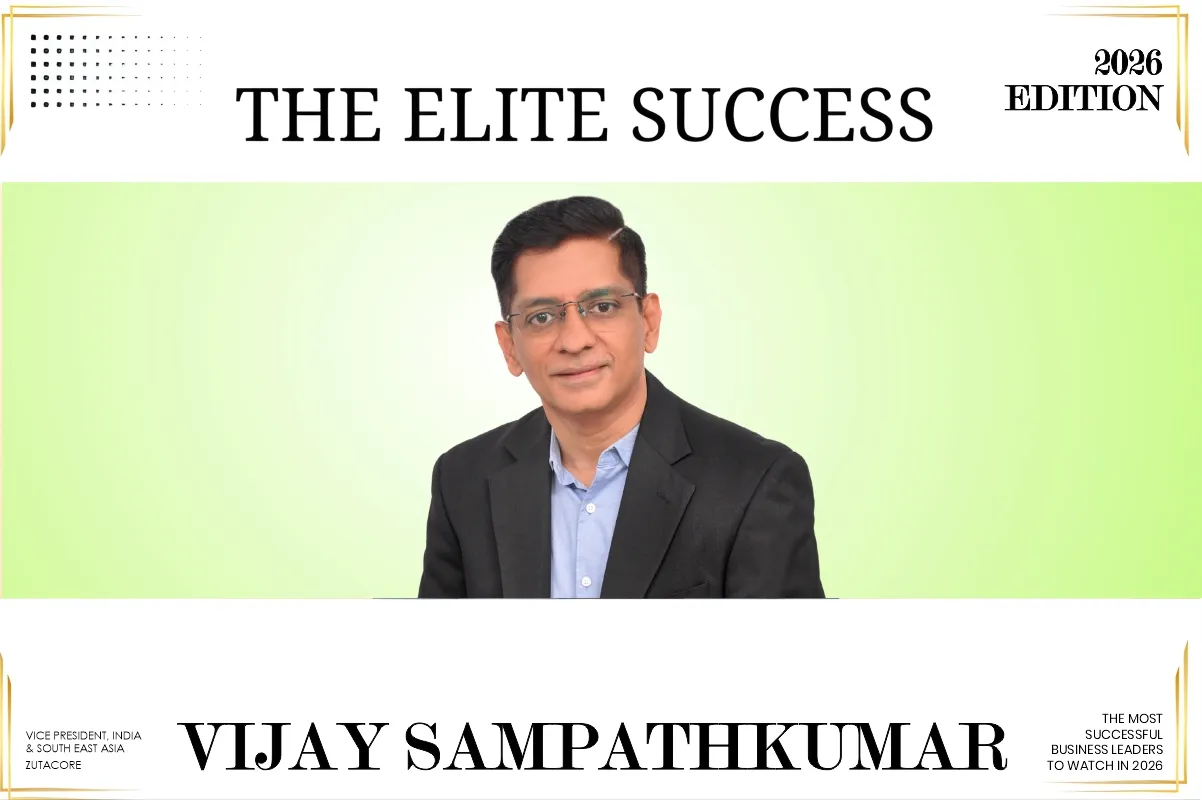
Stepping into a pivotal moment for global digital infrastructure is Vijay Sampathkumar, Vice President for India & South East Asia at ZutaCore, a company redefining how the world cools compute. Through its breakthrough HyperCool® waterless, direct-to-chip liquid cooling technology, ZutaCore delivers thermal solutions capable of removing up to 240 kW per rack—far surpassing conventional cooling limits while eliminating the environmental and operational risks associated with water-based systems. By addressing heat directly at its source, the technology enables double-digit gains in energy efficiency, supports higher compute densities, and reduces total cost of ownership for AI, machine learning, and high-performance computing (HPC) data centers.
As AI-driven workloads intensify, long-standing assumptions around data center design and operations are being fundamentally rethought. Cooling, once a background engineering function, has become central to performance, scalability, and long-term sustainability. This shift is unfolding globally as operators grapple with rising power densities, tightening energy availability, and mounting sustainability pressures.
For Vijay, years of working closely with customers, partners, and teams across diverse regions have reinforced a critical insight: progress in this space is not driven by technology alone. It is shaped by listening, understanding local context, and moving forward collaboratively. His leadership philosophy centers on empowering organizations to make informed, responsible decisions—balancing innovation with sustainability—rather than imposing change from the top down.
Under his leadership in the fast-growing APAC region, ZutaCore is scaling its impact, helping enterprises and hyperscalers align performance ambitions with the future of sustainable digital infrastructure.
Facilitating the Shift
Within the global data center and sustainability ecosystem, Vijay Sampathkumar is often referred to as the Liquid Cooling Man of India—a recognition that has emerged organically through years of advancing responsible liquid cooling adoption and sustainability-led infrastructure conversations. “That recognition evolved naturally,” Vijay reflects. “I’ve focused on explaining technology responsibly—sharing what works, what doesn’t, and why context matters.”
Rather than positioning liquid cooling as a standalone answer, Vijay has consistently framed conversations around the larger infrastructure challenge facing data centers today. His engagements with operators, partners, and ecosystem stakeholders span geographies and maturity levels, allowing him to connect advanced cooling technologies with real operational, regulatory, and sustainability realities. “Progress doesn’t come from pushing a solution,” he notes. “It comes from listening first and understanding what each environment actually needs.” This mindset reflects Vijay’s servant-leadership approach—where influence is earned through listening, context-building, and empowering stakeholders rather than directing outcomes.
Industry peers often point to this measured, transparent approach as the reason his voice carries weight. Vijay sees his role less as an advocate and more as a translator between innovation and implementation.
“My aim has always been to create clarity,” he says, “so organizations can make informed decisions that balance performance, energy efficiency, and long-term responsibility.”
Leading with Clarity, Trust, and Long-Term Commitment
With more than three decades of experience across technology and IT infrastructure, Vijay Sampathkumar’s leadership philosophy has steadily evolved toward simplicity and people-centricity. Early lessons taught him that effective leadership is not rooted in control, but in alignment, trust, and service. Underpinning this approach is a philosophy of servant leadership—one that prioritizes listening before leading, enabling teams and partners to succeed, and creating clarity so others can operate with confidence. For Vijay, leadership is not about authority or visibility, but about removing obstacles and aligning people around shared purpose. “Experience changes how you lead,” Vijay reflects. “Over time, you realize that your role is not to direct every outcome, but to create clarity so others can succeed with confidence.”
That clarity becomes especially critical in capital-intensive environments such as data centers, where decisions carry long-term financial, operational, and sustainability implications. Vijay believes confidence is earned through consistency and openness, not rhetoric. “You have to acknowledge uncertainty, set realistic expectations, and stay committed for the long haul,” he says. “That’s how trust is built—with customers, partners, and teams alike.”
Colleagues and stakeholders often point to this measured approach as a defining feature of his leadership. Rather than making bold promises, Vijay emphasizes steady progress and shared accountability. Vision, in his view, is not about dramatic declarations, but about aligning stakeholders around a clear direction and executing it responsibly over time.
By combining transparency with long-term thinking, Vijay has fostered relationships built on confidence, resilience, and a shared belief in sustainable growth—qualities essential for navigating complexity at scale.
These leadership principles do not exist in isolation. They are deeply reflected in the way ZutaCore approaches one of the most complex challenges in modern digital infrastructure. In an industry where rapid scale, rising power densities, and sustainability pressures leave little room for missteps, ZutaCore’s approach mirrors the same emphasis on clarity, consistency, and long-term commitment.
The company was built not to chase incremental improvements, but to rethink cooling at a structural level—anticipating the constraints that next-generation computing would place on energy, water, and thermal management. Known for his servant-leadership approach, widely recognized as the “Liquid Cooling Man of India,” and respected as a sustainability trailblazer in data center infrastructure, Vijay Sampathkumar represents a new generation of technology leadership—grounded, responsible, and impact-driven.
Why ZutaCore: Removing Constraints from the Future of Compute
ZutaCore was founded with a clear and focused mission: to remove thermal and power constraints as barriers to innovation in digital infrastructure. As AI, high-performance computing (HPC), and data-intensive workloads continue to drive unprecedented compute densities, cooling has shifted from a background utility to a strategic enabler of performance, efficiency, and sustainability. What was once an operational consideration is now a defining factor in how data centers scale, perform, and endure.
At the core of ZutaCore’s approach is a recognition that incremental upgrades to legacy cooling architectures are no longer sufficient. Traditional air and water-based systems were never designed for the heat loads generated by today’s GPU-dense environments. ZutaCore responded by rethinking cooling from first principles—focusing not on conditioning the surrounding environment, but on removing heat precisely where it is generated. This philosophy led to the development of HyperCool®, the company’s waterless, direct-to-chip, two-phase liquid cooling technology.
For Vijay Sampathkumar, this clarity of intent was central to his decision to join the company. “What drew me to ZutaCore was not just the technology itself,” he says, “but the philosophy behind it.” The focus has always been on enabling customers to deploy higher-density compute responsibly, without forcing disruptive changes to existing operating models.” In an industry defined by long asset lifecycles, reliability, and predictability, that balance between innovation and continuity is critical.
Sustainability, Vijay emphasizes, is not a checkbox or a passing trend. This conviction has positioned Vijay as a trailblazer for sustainability-led data center infrastructure, particularly in emerging markets where energy efficiency, water stewardship, and long-term viability are inseparable from growth. As AI-driven workloads reshape global energy consumption, responsible infrastructure design becomes a shared obligation—one that demands thoughtful engineering, water stewardship, and long-term thinking. By eliminating water from the cooling loop and enabling higher efficiency at scale, ZutaCore positions itself not merely as a cooling provider, but as a foundational enabler of sustainable digital infrastructure.
In a data center landscape increasingly constrained by heat, power, and environmental impact, ZutaCore’s mission is clear: to unlock performance without compromising responsibility—and to ensure the future of compute is as sustainable as it is powerful.
The Inflection Point for Scaled Adoption
For ZutaCore, significant growth and market acceptance emerged not from a single breakthrough moment, but from a clear industry shift. As AI workloads moved into the mainstream and rack densities began exceeding the limits of what air cooling could support efficiently, the conversation changed decisively. What had once been framed as a future consideration became an immediate operational necessity. “The question was no longer if liquid cooling would be required,” says Vijay Sampathkumar, “but how and when it should be deployed.”
This shift was reinforced by early deployments that delivered measurable results. Customers saw stable GPU performance under sustained load, seamless integration into existing environments, and tangible gains in energy efficiency. Just as critical was the operational confidence these deployments created—liquid cooling was no longer perceived as experimental, but as reliable and production-ready.
As adoption accelerated, advocacy emerged organically. Customers and ecosystem partners began sharing outcomes and lessons learned, accelerating market confidence far more effectively than traditional marketing efforts. From Vijay’s perspective, this validated a long-held belief: “Sustainable growth happens when the market pulls the solution, not when the vendor pushes it.”
That inflection point marked ZutaCore’s transition from early adoption to scaled deployment—positioning its technology as a practical enabler of high-density, AI-driven infrastructure rather than a niche innovation.
Purpose-Built Cooling for High-Density Compute
ZutaCore specializes in direct-to-chip liquid cooling solutions engineered for high-density, mission-critical data center environments. Designed with hyperscale and enterprise operators in mind, these solutions address a fundamental challenge facing modern infrastructure: removing heat efficiently and predictably as GPU power densities continue to rise.
At the heart of ZutaCore’s offering is a modular architecture that integrates seamlessly into existing data center designs. Rather than forcing disruptive changes to operating models, the company enables customers to adopt liquid cooling while preserving operational familiarity. “The goal has always been practical adoption,” says Vijay Sampathkumar. “Customers need solutions that fit into their environments—not the other way around.”
This approach allows organizations to transition toward liquid cooling at their own pace, supporting AI and HPC workloads while maintaining reliability, uptime, and long-term asset value.
Operational Gains Through Direct-to-Chip Efficiency
Direct-to-chip liquid cooling enables a more efficient and scalable operational experience by removing heat directly at the processor level, significantly reducing reliance on energy-intensive air-cooling systems. For customers, the benefits are tangible and immediate:
- Higher compute density within the same physical footprint
- Stable GPU performance under sustained AI and ML workloads
- Improved energy efficiency and lower cooling-related power consumption
- Greater flexibility to scale AI workloads without immediate cooling constraints
By addressing thermal challenges at the source, ZutaCore’s solutions create operational optionality—allowing data centers to grow performance without being limited by traditional cooling or power boundaries.
Redefining Data Center Design for the AI Era
Traditional air-cooling architectures were designed for predictable, lower-density workloads. AI, machine learning, and edge computing introduce sustained thermal loads where performance is directly linked to thermal stability. ZutaCore’s technology shifts heat removal closer to the compute, enabling more efficient and flexible thermal architectures.
This shift allows data center designers to rethink airflow, power utilization, and space planning. Importantly, ZutaCore does not position liquid cooling as a wholesale replacement for air. Instead, it redefines air’s role within hybrid cooling architectures, where liquid and air work together intelligently.
As Vijay notes, “The future of AI-ready data centers isn’t about choosing one approach—it’s about designing systems that balance efficiency, reliability, and scale.”
Building Momentum Through Partnerships and Grounded Innovation
Across India and Southeast Asia, ZutaCore’s most successful deployments and expansions have been shaped less by speed and more by collaboration. Rather than pursuing standalone implementations, the company has worked closely with system integrators, data center operators, and technology partners to ensure its solutions align with local execution models and operational realities. “In these markets, partnerships are essential,” says Vijay Sampathkumar. “They help translate global technology into something that works on the ground.”
Successful engagements, he notes, tend to share common characteristics: early involvement in design discussions, shared accountability across stakeholders, and patience. Direct-to-chip liquid cooling is positioned not as a replacement for existing infrastructure, but as an enabler within a broader strategy—one that evolves alongside customer readiness. In complex, high-stakes environments, progress is rarely linear, but it becomes sustainable when built on trust and transparency.
Staying innovative in such a rapidly evolving industry requires the same discipline. For Vijay, innovation is driven as much by listening as by engineering. Regulatory shifts, power availability, and varying risk tolerances continually reshape market expectations. By staying close to customers—especially during early planning stages—ZutaCore ensures its solutions remain grounded in real operational needs. Internally, feedback and skepticism are encouraged as tools for learning. Competitiveness, Vijay believes, ultimately comes from clarity: understanding which problems to solve—and having the focus to solve them well.
Building Impact That Endures
“If there is one lesson I would share with emerging leaders looking to build impact-driven careers at the intersection of technology, sustainability, and infrastructure, it is this: develop patience and curiosity in equal measure. Infrastructure decisions are not short-term bets. They shape societies, economies, and environments for decades, sometimes generations. Understanding that responsibility early changes how you approach leadership.
I have learned the importance of staying close to real-world constraints—whether they relate to power availability, operational risk, or environmental impact. Seek exposure beyond boardrooms and frameworks. Learn from diverse perspectives, challenge assumptions, and remain grounded in purpose rather than momentum. Innovation is most meaningful when it is informed by context and guided by responsibility.
As I look ahead, the legacy I hope to leave is not defined by technology alone, but by stewardship—by helping bridge innovation with accountability. More importantly, I hope to have enabled teams, partners, and ecosystems to grow stronger and more resilient over time. Sustainable impact, in my view, is not measured by visibility or scale, but by what continues to create value long after you step aside. Whether through advancing sustainable cooling technologies or shaping responsible infrastructure conversations, my work reflects a consistent commitment to stewardship over short-term momentum.”
Outside the Boardroom
“While technology and infrastructure are central to my professional life, staying grounded outside of work is equally important to me. Time with family helps me maintain perspective and balance, especially in an industry that often operates with a sense of constant urgency. Those moments are a reminder that the decisions we make at work carry real, long-term implications beyond immediate business outcomes.
I value simple routines—meditation, reading, and spending unstructured time with loved ones. Stepping away from work creates space for reflection and clarity. Many of my views on sustainability and responsible growth are shaped not in boardrooms, but in quieter moments, where the focus shifts from quarterly results to long-term impact.
This balance keeps me anchored. It helps me listen more deeply, remain measured in decision-making, and reinforces a leadership approach rooted in humility and responsibility.”