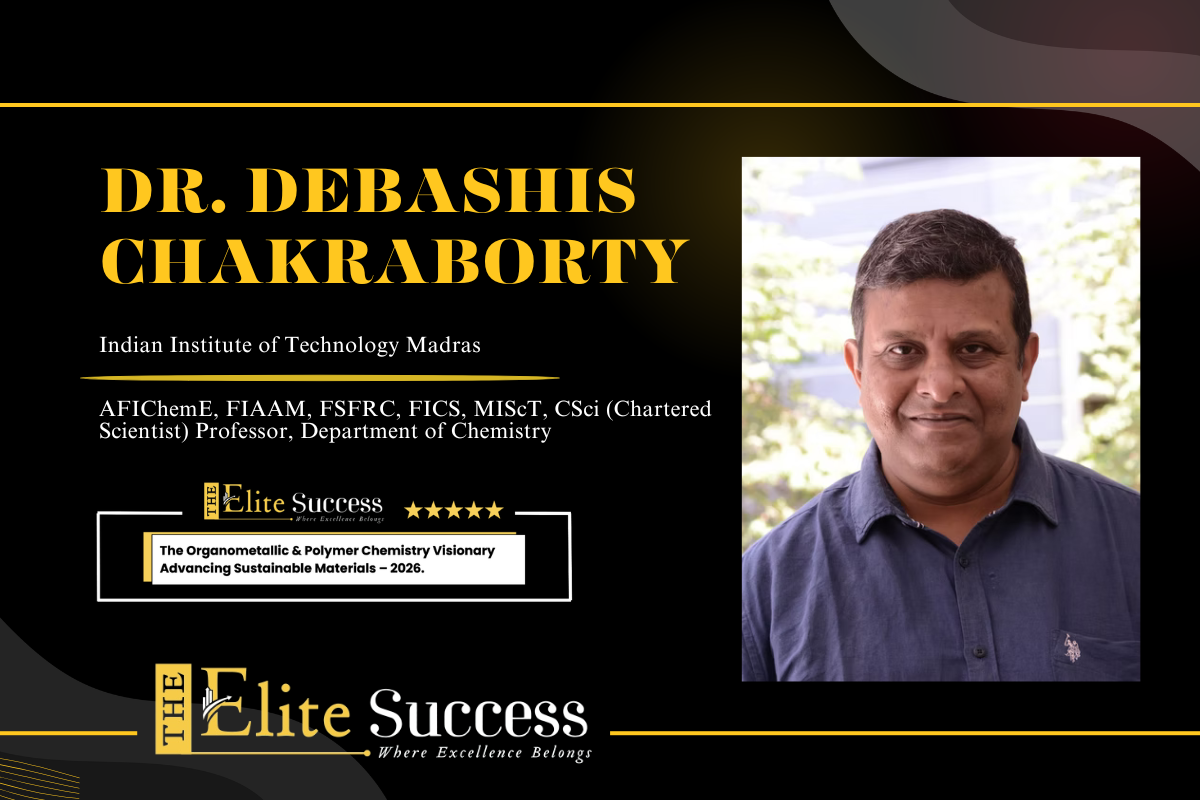
Dr. Debashis Chakraborty: Enabling a Circular Economy Through Polymer
Innovation
The global materials economy is undergoing a fundamental transformation as industries
increasingly prioritize sustainability, efficiency, and circularity. At the heart of this shift lies
polymer and organometallic chemistry — scientific domains that have quietly enabled
breakthroughs across sectors ranging from healthcare and electronics to energy,
infrastructure, and mobility. The global polymers market alone is projected to surpass USD
1.3 trillion by 2035, reflecting the expanding role of advanced materials in modern
manufacturing ecosystems. From lightweight automotive components and flexible
electronics to medical devices and high-performance packaging, polymers have become
indispensable due to their durability, adaptability, and cost efficiency.
Simultaneously, the increasing urgency of climate change and resource scarcity has
accelerated demand for sustainable alternatives, including bio-based and recyclable
polymers. The green polymer segment is expected to grow at nearly 9.8% CAGR,
highlighting the global push toward environmentally responsible material innovation.
Organometallic chemistry plays a crucial enabling role in this transition, particularly through
catalytic technologies that enhance reaction efficiency, reduce energy consumption, and
enable precision synthesis of next-generation materials. The organometallics market itself is
projected to reach USD 40.9 billion by 2035, driven largely by its applications in catalysis,
pharmaceuticals, and polymer production.
As industries move toward carbon neutrality and resource optimization, the convergence of
catalysis, polymer science, and green chemistry is shaping the future of advanced materials.
Researchers and innovators in this field are not only redefining chemical processes but also
laying the foundation for a more sustainable and technologically resilient global economy.
From Dual Worlds to a Unified Scientific Vision
Scientific leadership is often shaped by the environments that challenge and refine one’s
thinking. For Dr. Debashis Chakraborty, the journey across both academia and industry has
cultivated a leadership philosophy grounded in balance — between intellectual depth and
real-world applicability. Academic science rewards clarity of thought, originality, and
conceptual depth, while industry demands reliability, scalability, and adherence to
timelines. Together, these worlds shaped his ability to create a scientific vision that is not
only elegant but also resilient enough to withstand practical implementation challenges.
He believes that true leadership lies in distinguishing between ideas that are intellectually
appealing and those that can translate into viable, impactful solutions. In his words, the
experience helped him understand that “a scientific vision must ultimately integrate with
execution.” This perspective has allowed him to develop research frameworks that are both
exploratory and outcome-oriented, ensuring that innovation is not accidental but
systematic.
Dr. Chakraborty’s identity as a scientific leader has therefore emerged from an ability to
bridge theoretical rigor with applied relevance. His work reflects a deep commitment to
solving meaningful problems in organometallic and polymer chemistry while maintaining
the highest standards of scientific integrity. By combining analytical depth with
implementation awareness, he has positioned himself as a leader capable of navigating
complexity — a quality increasingly vital in advancing sustainable materials for a rapidly
evolving global landscape.
Purpose-Driven Transition from Industry to Academia
Dr. Debashis Chakraborty’s transition from corporate research leadership to academia was
not merely a professional shift but a reflection of evolving purpose. The move was driven by
an intellectual pull toward deeper scientific inquiry, along with a desire to expand the
societal impact of his work. While industry offered exposure to structured problem-solving
and outcome-driven innovation, academia provided the freedom to explore fundamental
questions that shape the future of materials science.
Bringing industry experience into academic research introduced distinctive strengths that
transformed the culture of his research group. He fostered a process-driven approach
where rigorous documentation, reproducibility, and safety became integral to scientific
practice. Such discipline not only enhances research quality but also prepares students for
professional scientific environments. His exposure to government and industry-sponsored
research also refined his ability to identify meaningful problems — polymerisations using
CO₂ feedstock to the design of organometallic catalysts and biodegradable materials
aligned with national priorities.
“I began to see research not just as a path to publication, but as a pathway to
implementation,” he reflects. Patents, processes, and collaborative partnerships became
natural extensions of academic inquiry. Equally central to his leadership philosophy is
mentorship — building teams where independent thinking, interdisciplinary collaboration,
and structured innovation are encouraged. Through this integration of scientific ambition
and social responsibility, Dr. Chakraborty continues to expand the relevance of chemistry
beyond laboratories toward solutions that benefit both society and the environment.
Building Global Thought Leadership Through Purposeful Science
Establishing thought leadership in organometallic and polymer chemistry requires more
than academic recognition; it demands the ability to influence the direction of scientific
discourse. Dr. Debashis Chakraborty’s global positioning stems from a strong scientific
foundation combined with a commitment to addressing emerging challenges in sustainable
materials. Rather than focusing solely on high-impact publications, his approach emphasizes
defining meaningful research problems, creating viable pathways for innovation, and
fostering collaborative scientific communities.
Recognition such as the Atal Achievement Award 2024 has further strengthened the
credibility of his work, reinforcing both authenticity and authority in his field. Yet, he views
awards not as endpoints but as encouragement to deepen scientific contribution.
Maintaining a strong personal brand while balancing teaching, research excellence, and
international collaborations demands discipline, perseverance, and a forward-looking
mindset. He describes this journey simply: one must remain a “go-getter,” driven by
curiosity and commitment.
His advice to emerging scientists reflects this philosophy — research must be seen as a tool
to solve contemporary challenges rather than merely a route to publication.
Interdisciplinary awareness, humility, and intellectual curiosity are essential in addressing
global sustainability concerns. Through patents, technology transfers, and collaborative
innovation, Dr. Chakraborty ensures that his work extends beyond academic knowledge to
create tangible environmental and societal impact, reinforcing the transformative power of
chemistry in shaping a responsible future.
Building a Research Ecosystem for Sustainable Chemistry
At Indian Institute of Technology Madras, Dr. Debashis Chakraborty leads a research group
positioned at the intersection of fundamental chemistry and real-world material innovation.
His work spans organometallic chemistry, catalysis, polymer synthesis, and CO₂ activation —
areas increasingly critical to building sustainable industrial systems.
He describes his laboratory not merely as a place for academic inquiry but as an ecosystem
where scientific curiosity meets structured execution. “We work at the interface of
mechanistic understanding and scalable chemical development,” he explains, reflecting a
philosophy shaped by both industrial rigor and academic freedom. The group’s research on
homogeneous and heterogeneous catalysis contributes to designing efficient catalyst
systems that enable controlled polymer growth and selective bond transformations, directly
influencing applications such as biodegradable plastics and energy-efficient materials.
From teaching undergraduate and postgraduate students to guiding interdisciplinary
collaborations, he continues to strengthen India’s position in sustainable catalysis research.
In third person, his role is often described as one that bridges deep theoretical chemistry
with translational outcomes; in first person, he emphasizes responsibility: “Science must
anticipate future material challenges and develop solutions before they become
constraints.” By integrating fundamental science with industrial relevance, Dr. Chakraborty
ensures that research remains both intellectually rigorous and societally meaningful.
Turning Challenges into Catalytic Momentum
Returning to India after international research experience presented both opportunity and
complexity. For Dr. Chakraborty, the early years involved rebuilding infrastructure, securing
funding, and cultivating a research culture aligned with global scientific standards. Yet these
challenges also strengthened his long-term vision. “Every scientific ecosystem evolves
differently, and adapting to local realities requires patience and persistence,” he reflects.
He navigated administrative processes, funding constraints, and the responsibility of
building a cohesive research team while maintaining ambition for high-impact work. In third
person, his trajectory illustrates resilience; in first person, he views challenges as catalysts
for innovation. Exposure to diverse scientific environments allowed him to design research
pathways that combine mechanistic chemistry with scalable applications.
His experience in catalysis and polymer science enabled strategic problem selection —
identifying themes aligned with national priorities such as sustainable materials and CO₂
utilization. This approach allowed his research group to develop a distinct identity within
India’s scientific ecosystem. Over time, the integration of global research exposure with
local scientific needs created a foundation for consistent academic productivity and
collaborative partnerships. The transition strengthened not only institutional integration but
also his conviction that meaningful research leadership requires balancing ambition with
realism.
Catalysing Recognition Through Biopolymer Innovation
A defining moment in the growth of Dr. Chakraborty’s research group emerged through
breakthroughs in indigenous biopolymer synthesis, particularly PLA and PPC derived
through CO₂-based polymerisation pathways. These innovations positioned the group within
India’s broader sustainability agenda, demonstrating how advanced catalysis can contribute
to biodegradable material development and circular economy strategies.
He observes that scientific visibility rarely results from a single achievement but rather from
the convergence of expertise, timing, and relevance. “Research becomes transformative
when fundamental chemistry aligns with societal need,” he notes. His deep grounding in
organometallic catalysis enabled the development of processes that are both scientifically
robust and nationally significant.
Recognition through honors such as the Atal Achievement Award 2024 further
strengthened the credibility of this work, highlighting its relevance beyond academic circles.
In third person, his contributions reflect the growing importance of catalyst-driven polymer
innovation; in first person, he frames the journey as cumulative: “Visibility follows
consistency.” The rise of his research group demonstrates how sustained expertise,
interdisciplinary thinking, and alignment with policy priorities can accelerate both scientific
recognition and industrial relevance.
Mentoring Future Scientists for Long-Term Impact
For Dr. Chakraborty, long-term academic success is rooted in clarity of scientific identity,
continuous renewal of research direction, and a strong mentoring philosophy. He believes
that impactful research groups evolve through intellectual continuity rather than constant
reinvention. “One must develop depth in a core domain and then expand outward without
losing coherence,” he explains.
His mentoring approach encourages students to think independently while maintaining
strong foundations in mechanistic chemistry, catalysis, and polymer synthesis. By
integrating industrial discipline such as documentation, reproducibility, and structured
experimentation, he creates a research culture where innovation is treated as a systematic
practice. Exposure to global scientific environments further enables students to connect
molecular-level understanding with scalable applications, strengthening their readiness for
interdisciplinary challenges.
In third person, his leadership reflects adaptability and intellectual humility; in first person,
he emphasises continuity: “Scientific progress is sustained when knowledge is transferred
effectively across generations.” Through collaborative learning environments, international
engagement, and problem-driven research themes, Dr. Chakraborty continues to shape
scientists capable of addressing material challenges that extend beyond laboratories toward
industry and society.
Designing Catalysts for Circular Materials
Building on his philosophy of translating fundamental chemistry into scalable solutions, Dr.
Debashis Chakraborty’s research continues to evolve at the intersection of organometallic
chemistry and polymer science. His work focuses on designing organometallic complexes —
derived from both main group and transition metals — that enable highly selective catalytic
transformations essential for next-generation materials. In third person, his research
trajectory reflects intellectual continuity; in first person, he describes the approach as
purpose-driven: “Catalyst design must begin with mechanistic clarity and end with real-
world applicability.”
Key research areas include ring-opening polymerization (ROP) and copolymerisation
processes that enable the synthesis of functional polymers with controlled architecture and
properties. Homogeneous catalysis plays a central role, allowing precise control over ligand
environments and metal–substrate interactions. The activation of small molecules such as
water and carbon dioxide further strengthens the sustainability dimension of his work,
reinforcing the shift toward environmentally conscious chemical processes. By exploring
cost-effective catalysts derived from simple metal salts, he also addresses the need for
accessibility and scalability in industrial applications.
Across these areas, a unifying theme emerges — the use of organometallic chemistry as a
tool to enable circular material systems. Understanding metal–ligand interactions and
stereochemical influences allows his group to design catalysts capable of improving polymer
selectivity, efficiency, and environmental compatibility. This continuity from earlier sections
highlights how his research philosophy integrates mechanistic depth with societal relevance,
ensuring that innovations contribute simultaneously to basic science and sustainable
materials engineering.
Catalysis as a Climate Innovation Platform
As discussed in earlier sections, Dr. Chakraborty views chemistry not merely as discovery but
as responsibility. His work in CO₂ utilization, homogeneous catalysis, and sustainable
polymer development reflects a broader conceptual shift in how materials are designed and
valued. “Waste must become feedstock,” he states, emphasizing the transformation of
carbon dioxide from an environmental challenge into a chemical resource. This perspective
positions catalysis as a climate innovation tool capable of influencing both industrial
chemistry and environmental strategy.
Advanced instrumentation has significantly accelerated progress in this domain. High-
resolution NMR spectroscopy, X-ray diffraction, chromatography systems, and mass
spectrometry allow precise characterization of catalytic intermediates and polymer
microstructures. These tools make it possible to detect subtle electronic and steric
variations that influence catalytic performance, enabling more efficient reaction pathways
and improved product selectivity. Such technological integration strengthens the predictive
power of theoretical models and enhances the reproducibility of experimental outcomes.
A notable recent breakthrough involves the development of a catalyst derived from bleach
for synthesizing biodegradable aliphatic polycarbonates. In third person, this innovation
reflects his long-standing commitment to sustainable polymer chemistry; in first person, he
attributes success to disciplined scientific reasoning: “Strong fundamentals allow
unconventional ideas to become viable solutions.” By designing materials for circularity from
the outset, Dr. Chakraborty continues to demonstrate how catalysis can redefine value
creation — transforming sustainability challenges into opportunities for scientific and
societal advancement.
A Legacy Rooted in Purposeful Science
“As a scientist, mentor, and innovator, the legacy I hope to leave behind is defined by
scientific depth, ethical leadership, and a commitment to purpose-driven innovation that
responds to societal and environmental challenges. For me, chemistry has never been
confined to laboratories or publications; it is a powerful medium through which meaningful
and lasting change can be created. My work in organometallic and polymer chemistry has
always been guided by the belief that scientific progress must contribute to the larger global
dialogue on sustainability, climate responsibility, and resource efficiency.
I aspire to be remembered not only for research contributions in catalysis and sustainable
materials but also for building a culture of inquiry where curiosity and responsibility coexist.
Mentorship has been central to this vision. I believe that the most enduring scientific impact
is created through people — students and researchers who carry forward the values of
intellectual rigor, interdisciplinary thinking, and ethical scientific practice. When young
scientists learn to connect molecular insight with real-world needs, they become innovators
capable of shaping the future of materials science.
Equally important is the integration of sustainability into the core philosophy of research.
Climate change and environmental degradation demand solutions that go beyond
incremental improvements. I see my role as contributing to scientific pathways that
transform carbon dioxide into valuable resources, enable biodegradable materials, and
promote circular chemical processes. Ultimately, I hope my work demonstrates that
chemistry, when guided by responsibility and vision, can help build technologies that benefit
both humanity and the planet.”