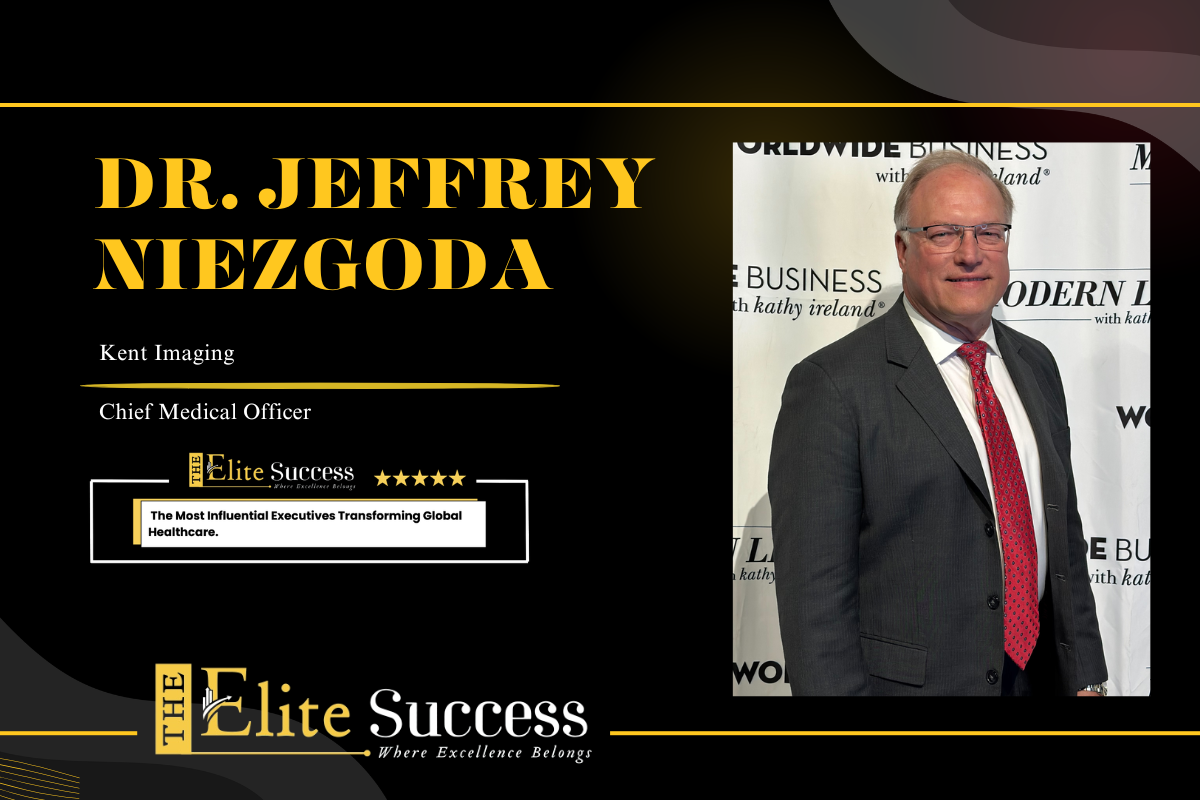
In a world where chronic wounds affect more than 8 million people annually in the United States alone, and where delayed intervention often leads to infection, hospitalization, or amputation, healthcare demands leaders who are willing to challenge convention. Advanced wound care represents a multi-billion-dollar global market, yet access to timely, specialized treatment remains uneven—costing patients not only financially, but physically and emotionally. It is in this critical space between innovation and access that Dr. Jeffrey Niezgoda, MD – Chief Medical Officer at Kent Imaging, has built his life’s work.
Often described as a “renegade” in hyperbaric medicine circles, Dr. Niezgoda wears the label with purpose. He has never been interested in preserving doctrine for doctrine’s sake. Instead, his focus has remained unwavering: better outcomes for patients. His career uniquely bridges clinical practice, research, education, entrepreneurship, medical business leadership, and professional society engagement—an uncommon blend that positions him not just as a physician, but as a physician-innovator-entrepreneur.
“I have always believed that pushing boundaries is necessary when patients’ lives and limbs are on the line,” he says. That belief has shaped a professional brand anchored in early intervention—ensuring patients gain access to skilled wound care before complications escalate. Dr. Niezgoda defines himself not by titles, but by translation: translating scientific discovery into practical clinical solutions that work in real-world settings.
For him, transformation in global healthcare is not theoretical. It is measurable—in reduced amputations, preserved mobility, and lives fundamentally changed.
Mission-Driven Leadership
For Dr. Jeffrey Niezgoda, leadership was never an abstract concept—it was forged early through discipline, service, and accountability. His formative years at the United States Air Force Academy and medical training at the Uniformed Services University of the Health Sciences shaped a philosophy grounded in integrity and mission-first thinking. The military environment demanded clarity under pressure and the courage to make difficult decisions—qualities that would later define his approach in both medicine and executive leadership.
“The military taught me that leadership is about responsibility, not rank,” he reflects. “You step forward when the mission demands it—and you question assumptions when the evidence demands it.” That intellectual courage surfaced early during his hyperbaric fellowship, where he challenged the accepted mechanism of action for hyperbaric oxygen therapy, prioritizing scientific inquiry over comfort with convention.
His subsequent academic appointments at the Medical College of Wisconsin and Rosalind Franklin University of Medicine and Science further reinforced the discipline of evidence-based practice and the responsibility to mentor the next generation of clinicians.
Combined with decades of direct patient care, these experiences shaped a leadership philosophy rooted in service, intellectual rigor, and accountability—principles that continue to guide his work transforming wound care and advancing patient access globally.
Evidence, Scale & Trust
For Dr. Jeffrey Niezgoda, innovation is never innovation for its own sake. It begins—and ends—with the patient. “Clinical excellence must always come first,” he says. “Innovation without evidence is merely speculation.” That philosophy has anchored his career as a thought leader in wound care and hyperbaric medicine, where he has served as principal investigator in numerous device and pharmaceutical trials to ensure that emerging technologies meet the highest evidentiary standards.
But excellence alone is not enough. The challenge in modern healthcare is scalability—how to translate validated science into widespread clinical impact. For Dr. Niezgoda, scale happens through both education and technology. Through global learning platforms like WebCME, clinical expertise can reach practitioners far beyond traditional academic centers. At Kent Imaging, near-infrared spectroscopy (NIRS) and bacterial autofluorescence (BAF) technologies bring advanced diagnostics directly to the point of care, reducing delays that often lead to complications. Meanwhile, AI-driven wound assessment tools developed through Auxillium Health AI extend specialist-level capabilities into underserved and resource-limited settings.
“Evidence first,” he emphasizes. “Then scale.”
Underlying this balance is credibility—arguably one of his most powerful assets. Dr. Niezgoda’s testimony and presentations before the Centers for Medicare & Medicaid Services, the U.S. Food and Drug Administration, the American Medical Association CPT Editorial Panel, and the Office of Inspector General carry weight because they are grounded in decades of clinical practice, more than 60 peer-reviewed publications, and multiple U.S. and international patents.
Trust, he believes, is earned through consistency—consistently prioritizing patient outcomes, contributing to scientific literature, and showing up in leadership roles across the profession. In a healthcare system driven by scrutiny and stakes, that credibility transforms ideas into policy—and innovation into standard practice.
Challenging the Status Quo
Every transformational career encounters resistance. For Dr. Jeffrey Niezgoda, the greatest obstacle was not technology or infrastructure—it was entrenched dogma. Early in his hyperbaric fellowship in the U.S. Air Force, he openly challenged the prevailing explanation for hyperbaric oxygen therapy (HBOT). Rather than accepting simple tissue hyperoxygenation as the primary mechanism, he argued that its true therapeutic value lay in mitigating ischemia-reperfusion injury. “When the evidence points in a different direction, you follow the evidence,” he says. That stance placed him at odds with mainstream thinking—but it also defined his professional identity.
His entrepreneurial ventures were equally unconventional. Through AZH, he helped develop one of the first non-hospital-based centers integrating wound care, hyperbaric therapy, and vascular services—an approach that challenged the assumption that advanced wound programs must exist within hospital walls. Similarly, launching WebCME meant persuading a skeptical medical community that online education could meet the same standards of rigor as traditional in-person training.
At Kent Imaging and New Horizon Medical Solutions, the challenge continues in a new form: clinician education and technology adoption. Even proven innovations require trust and understanding before they become standard practice. “I’ve spent decades navigating resistance to change,” Dr. Niezgoda reflects. “Those lessons now help accelerate adoption responsibly—without compromising scientific integrity.”
A Unified Mission
Today, Dr. Jeffrey Niezgoda’s leadership extends across a portfolio of organizations united by a single purpose: transforming wound care through evidence, access, and innovation. As Chief Medical Officer of Kent Imaging, a Calgary-based medical device company, he helps guide the clinical integration of advanced near-infrared spectroscopy (NIRS) wound imaging technologies—bringing objective, real-time tissue assessment to the point of care.
“When clinicians can see physiology instead of guessing at it, outcomes improve,” he notes.
He also serves as President and CMO of WebCME, an international web-based education platform dedicated to delivering rigorous wound care and hyperbaric training worldwide. By scaling knowledge digitally, WebCME ensures that geography is no longer a barrier to clinical excellence.
Beyond imaging and education, Dr. Niezgoda leads Auxillium Health, focused on artificial intelligence applications in medical imaging, and RxOS Medical, which produces a patented wound care hydrogel and is advancing Xtreme O2—a water-based therapy designed to enhance oxygen bioavailability. He also serves on the Medical and Scientific Advisory Board of New Horizon Medical Solutions.
A recent partnership between Kent Imaging and New Horizon Medical Solutions further aligns these missions. For Dr. Niezgoda, the collaboration represents more than corporate synergy—it is an opportunity to leverage decades of clinical experience to integrate technologies seamlessly, optimize adoption, and ultimately improve patient outcomes worldwide.
Defining Breakthrough Moments
Transformational growth rarely happens by accident—it follows bold decisions. For Dr. Jeffrey Niezgoda, one such pivotal moment came with WebCME. “When we launched the first-ever fully online Introductory Hyperbaric Medicine Training Course, we weren’t just creating content—we were changing access,” he recalls. At a time when specialized hyperbaric education was limited to select in-person programs, the move democratized learning, opening doors for clinicians worldwide who previously had no viable pathway into the field. What began as innovation in format became a catalyst for global knowledge dissemination.
At Kent Imaging, the breakthrough was conceptual rather than logistical. The realization that near-infrared spectroscopy and bacterial autofluorescence could allow clinicians to “see” tissue oxygenation, bacteria, and biofilm—elements previously invisible to the naked eye—shifted the paradigm of wound assessment. “Once you give clinicians objective physiological data at the bedside, decision-making changes,” he explains. That clarity translates directly into earlier interventions and improved outcomes.
Another defining moment traces back to his meeting with Eric Kindwall, widely regarded as the grandfather of modern hyperbaric medicine. That relationship opened the door to his medical directorship at St. Luke’s Medical Center, where he built one of the nation’s largest wound care programs. In hindsight, each breakthrough shared a common thread: expanding visibility—whether of knowledge, physiology, or opportunity—and turning it into measurable impact.
Built on Evidence, Sustained by Integrity
Long-standing success in a highly specialized field like wound care and hyperbaric medicine does not happen by chance. For Dr. Jeffrey Niezgoda, credibility has always been intentional—built methodically, protected fiercely, and earned through decades of disciplined work.
He points to several foundational pillars:
- Evidence as the Cornerstone
“If it isn’t evidence-based, it doesn’t belong in patient care,” he says. With more than 60 peer-reviewed publications, multiple textbook chapter contributions, and leadership roles in numerous device and pharmaceutical clinical trials, his work has consistently reinforced scientific rigor as the standard—not the exception.
- Leadership That Shapes Standards
Serving as Past President of the American Professional Wound Care Association and the American College of Hyperbaric Medicine allowed him to influence national standards of care. In these roles, he did not simply participate in the profession—he helped define its direction.
- Clinical Integrity Over Commercial Gain
Across every organization he leads, the principle remains unwavering: patient outcomes come before profitability. Innovation is pursued, but never at the expense of scientific validity.
- Strategic Synergy for Greater Impact
The collaboration between Kent Imaging and New Horizon Medical Solutions exemplifies this philosophy—integrating complementary technologies and expertise to elevate patient care standards globally.
In an evolving healthcare landscape, Dr. Niezgoda’s organizations endure because they balance innovation with accountability—continuously advancing, yet firmly anchored in clinical excellence.
Unifying Care, Accelerating Innovation
For Dr. Jeffrey Niezgoda, today’s healthcare challenges are interconnected—and so must be the solutions. Clinically, he believes the most urgent issue is simple yet profound: access. “If we can get patients into skilled wound care earlier—before infection, ischemia, or systemic complications take hold—we will save lives and limbs,” he says. Delayed intervention remains one of the most preventable drivers of amputation and long-term disability worldwide.
Technologically, the next frontier lies in responsibly integrating artificial intelligence and advanced imaging into everyday workflows. Tools such as near-infrared spectroscopy, bacterial imaging, and AI-driven wound assessment can dramatically improve decision-making—but only if they are validated rigorously and implemented thoughtfully. “Technology must serve clinicians, not overwhelm them,” he emphasizes. Evidence-based validation remains non-negotiable.
Systemically, however, he sees a deeper structural challenge: fragmentation within the wound care community itself. Multiple professional societies, competing agendas, and siloed education dilute both influence and resources. Dr. Niezgoda strongly advocates for greater unity through organizations such as the American Professional Wound Care Association, the American College of Hyperbaric Medicine, and the American Board of Wound Healing. Formal board certification and collaborative alignment, he argues, would strengthen standards and amplify collective impact. “Clinicians should work shoulder to shoulder—not in competition,” he notes. When wound care remains siloed, industry support fragments and, ultimately, patients pay the price.
Inside his own organizations, he cultivates a culture that mirrors this philosophy of unity and progress. Innovation begins with permission to question. “Challenge dogma,” he tells his teams, “but back your ideas with data.” Through WebCME, continuous programming such as Wound Rounds Live and the Near Infrared Spectroscopy Clinical Connection keeps clinicians engaged in active learning. For over a decade, he has directed comprehensive wound care and hyperbaric review courses through APWCA and ACHM, reinforcing standards while encouraging forward thinking.
By blending active clinical practice with ongoing AI research and deep learning development, Dr. Niezgoda ensures his teams do not merely adapt to change—they help shape it.
Advanced Clinical Solutions Portfolio
Across his leadership roles, Dr. Jeffrey Niezgoda oversees a portfolio of technologies and clinical solutions designed to transform wound assessment, preparation, and healing outcomes. Each innovation targets a critical variable in the wound care continuum.
- SnapshotNIR – Objective Tissue Oxygenation Assessment
Developed by Kent Imaging, SnapshotNIR utilizes near-infrared spectroscopy (NIRS) technology to provide non-invasive, real-time measurement of tissue oxygenation and perfusion. These metrics are essential for predicting wound healing potential and assessing vascular sufficiency—allowing clinicians to intervene earlier and more precisely.
- SnapshotGLO – Bacterial Autofluorescence Imaging
Also from Kent Imaging, SnapshotGLO employs bacterial autofluorescence (BAF) technology to detect the presence and relative quantity of bioburden in wounds and surrounding tissue. By visualizing bacterial load that would otherwise remain undetected, clinicians can make more informed debridement and antimicrobial decisions.
- Ultrasound Assisted Wound (UAW) Therapy
Through collaboration with New Horizon Medical Solutions, Dr. Niezgoda brings extensive experience in Ultrasound Assisted Wound therapy. UAW delivers cavitation and acoustic streaming, enabling highly effective wound bed preparation. This approach enhances debridement precision and optimizes the environment before applying advanced biologic therapies.
- Integration with CAMPs (Cellular, Acellular, and Matrix-like Products)
UAW technology, when paired with BAF imaging before and after debridement, creates a synergistic protocol for optimal wound bed preparation prior to the use of CAMPs. The integration of UAW, NIRS, and BAF provides a data-driven pathway for managing chronic and complex ulcers.
“Together, these technologies move us toward a new standard of care,” Dr. Niezgoda explains—one where objective imaging, precision debridement, and advanced biologics converge to improve healing outcomes.
Seeing the Invisible, Teaching Without Borders
For Dr. Jeffrey Niezgoda, advanced technology is not about novelty—it is about visibility, precision, and access. “For decades, clinicians treated wounds based largely on what we could see on the surface,” he explains. “Now we can see the physiology beneath.” That shift is transforming diagnostics, education, and treatment planning worldwide.
He highlights several disruptive advancements:
- Near-Infrared Spectroscopy (NIRS) Imaging
Through Kent Imaging, SnapshotNIR enables clinicians to visualize tissue oxygenation and perfusion in real time. This capability enhances wound management decisions, vascular assessment, and hyperbaric treatment planning. His research has further demonstrated that NIRS can replace the traditional ankle-brachial index for peripheral arterial disease screening through the development of the Plantar-Palmar Index (PPI)—a concept he proudly co-developed and published with his son. “Collaborating on the PPI was one of the most meaningful milestones of my career,” he reflects.
- Bacterial Autofluorescence (BAF) Imaging
SnapshotGLO allows clinicians to detect bacterial burden instantly at the point of care, offering a faster and more comprehensive alternative to older technologies such as transcutaneous oximetry and subjective visual assessment.
- AI-Driven Wound Assessment
At Auxillium Health, artificial intelligence applications—including fully automated wound segmentation using deep convolutional neural networks—are streamlining assessment, improving measurement accuracy, and enhancing treatment planning.
- Digital Medical Education
Through WebCME, he helped launch the first fully online Introductory Hyperbaric Medicine Training Course, fundamentally disrupting traditional models of clinical education. During COVID-19, when in-person programs halted, WebCME ensured uninterrupted global access to specialized training. “Previously, clinicians had to travel to us,” he says. “We brought the education to them.”
Together, these innovations redefine how clinicians learn, diagnose, and treat—making advanced wound care more accurate, timely, and globally accessible than ever before.
Staying Ahead of the Curve
In a field evolving as rapidly as medical technology and healthcare education, Dr. Jeffrey Niezgoda remains competitive by refusing to stand still. “Innovation is not a single event—it’s a continuous discipline,” he says. His strategy begins with active clinical research and deep collaboration with academic institutions, partnerships that have produced groundbreaking publications in AI-driven wound classification, deep learning–based wound segmentation, and even generative adversarial networks designed to predict wound prognosis.
Serving on the editorial boards of Advances in Skin & Wound Care, the Journal of Wound Care, and the International Journal of Tissue Repair keeps him closely connected to emerging science and global discourse. These roles allow him not only to evaluate cutting-edge research but also to help shape the direction of the field.
Equally important is his ability to operate across multiple domains simultaneously—imaging, artificial intelligence, digital education, and therapeutics. By maintaining leadership roles in each, he identifies synergies others might miss, cross-pollinating ideas between disciplines.
“We are living in an extraordinary era for wound care,” Dr. Niezgoda reflects. “Fields that were once stagnant are now exploding with innovation.” His approach ensures he remains not just a participant in that evolution—but a driving force behind it.
Purpose, Priorities & the Next Generation
For emerging physician-leaders and healthcare innovators, Dr. Jeffrey Niezgoda’s advice is both practical and deeply personal. “Find and live your passion,” he says. “If you don’t love what you’re doing, you won’t endure the resistance that comes with changing systems.” For more than three decades, he has been fortunate to transform vocation into calling—moving beyond simply working in medicine to actively shaping it.
He encourages young leaders to challenge dogma when evidence supports a better path, even at the risk of unpopularity. That intellectual courage, he believes, is essential to progress. Yet conviction alone is not enough.
“Never underestimate the power of empathy,” he adds.
He candidly reflects that early in his career, empathy did not come naturally. The birth of his son Geoffrey transformed his perspective, deepening his compassion and ultimately making him a better physician.
Grounded by strong personal principles—instilled early through his foundation as an Eagle Scout—Dr. Niezgoda emphasizes integrity and service as non-negotiables. His priorities keep him centered: family first, followed closely by profession. That clarity of order enables balance.
Every company he leads, every research initiative he undertakes, and every educational program he builds is measured against a single question: Will this improve patient outcomes? Whether advancing imaging technologies or developing innovations such as his patented topical hydrogel, the mission remains constant—reduce complications, accelerate healing, and expand access to better care worldwide.
A Legacy of Unity and Healing
“When I reflect on legacy, I do not think first of titles or accolades. I think about impact. If my life’s work has helped democratize wound care education through WebCME, transform diagnostics through Kent Imaging, pioneer integrated care models through AZH, and advance artificial intelligence and novel therapeutics—then I am proud to have contributed to a better environment for patient healing.
But perhaps more important than innovation is unity. I hope to see a fully unified wound care community, supported by formal board certification and recognized globally as a true medical specialty. A profession working shoulder to shoulder, aligned in standards and purpose, would elevate care for millions.
Beyond medicine, my legacy is also personal. Kathleen and I founded the Association for the Bladder Exstrophy Community to serve families navigating complex congenital conditions. That work reminds me that healthcare is ultimately about people, not systems.
They say success in life is reflected in the success of your children. I believe that deeply. Geoffrey, Jonathan, Laura, and Margaret are kind, disciplined, driven, and accomplished individuals. If I have been blessed with professional success, it is matched—and surpassed—by the blessing of family. That, above all, is the legacy I cherish most.”