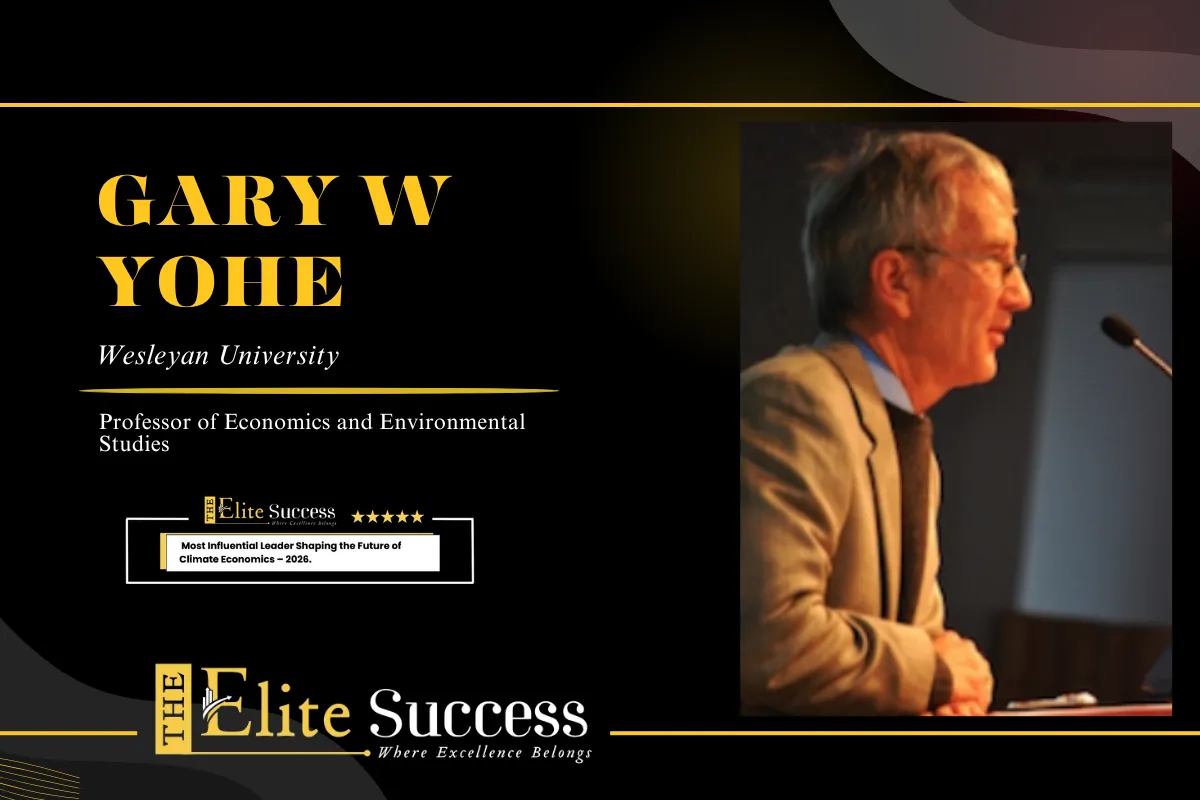
Some careers are carefully planned. Others unfold through moments of opportunity, timing, and the courage to step forward. The professional life of Gary W. Yohe belongs firmly in the second category. Over more than four decades, his work has shaped how the world understands climate exposure, economic accountability, and public decision-making. He has influenced scientific, economic, and policy thinking on climate issues. Yet timing alone does not explain his impact. What truly defines his journey is how he chose to act once those opportunities appeared.
From the early days of climate economics to the highest levels of global policy advising, Yohe has carried a deep sense of civic duty. Gratitude for his professional privilege became a driving force. It pushed him to continue working on climate issues long after formal milestones were reached. That sense of obligation grew stronger after 2007, when he and his colleagues at the Intergovernmental Panel on Climate Change were awarded the Nobel Peace Prize. The recognition did not signal an end point. Instead, it reinforced his commitment to explain climate evidence with precision and candor to policymakers, judges, and the public.
Today, as Huffington Foundation Professor of Economics and Environmental Studies, Emeritus, at Wesleyan University and as a long‑standing contributor to global climate institutions, Yohe’s voice remains calm, precise, and persistent. His work reflects a belief that climate change is not only a scientific issue or an economic challenge. It is a moral responsibility that requires clarity, courage, and sustained engagement.
From Open Questions to Global Recognition
Yohe’s academic journey began at a moment when climate change had not yet entered public consciousness. When he entered the field more than forty years ago, much of the underlying science was still taking shape. There was only partial understanding of what drove global warming, what consequences might follow, and how rapidly those consequences could appear.
His entry into the field can be attributed to one specific event. Economist William Nordhaus, a mentor during his years earning an economics PhD at Yale, called in 1980 to invite to join a sentinel National Academy of Sciences research panel on the changing climate. That call changed his life. It broadened his academic horizons and inspired him to devote his career to studying the economics of global climate change.
In those early years, the central challenge was not opposition but ambiguity. Progress depended on work that crossed disciplinary lines. Economics needed to engage with atmospheric science, ecology, geography, and political science. Yohe did not depend on large external funding streams. He worked through collaboration and by drawing on the expanding research produced by others. His contribution was often interpretive and synthetic. He translated emerging science into economic insight and policy relevance.
Public awareness at the time was uneven. Society had recently grappled with ideas such as global cooling and nuclear winter. Those theories either failed scientific review or belonged to separate conversations. Gradually, climate change emerged as a steadier and more troubling explanation of what was going on. Yohe’s scholarship developed in parallel with that recognition.
A decisive shift came in 1995, during his early involvement with the IPCC. The Second Assessment Report concluded that the balance of evidence pointed to a discernible human influence on the global climate. That conclusion altered the field. It also provoked organized resistance. Groups that had previously defended damaging products like tobacco and practices like smoking redirected their negative efforts toward climate science. Campaigns built on misinformation took hold. Disinformation followed. Personal attacks and threats became part of the professional terrain. Even so, Yohe remained actively involved. As the evidence sharpened, his commitment deepened.
An Institutional Home for Independent Thought
Wesleyan University has been the institutional anchor of Yohe’s professional life. For more than four decades, the university sustained his teaching, research, and public work. That support extended far beyond the limits of any formal job description. It gave him room to pursue interdisciplinary inquiry at a moment when such work was still viewed as unconventional. As well, it provided audiences of motivated and talented students who were more than happy to hear about his research and his travels – as long as he could explain why it mattered and how it displayed the value added of the first principles of economic thought.
Even after retirement, Wesleyan remains integral to his work. The university continues to offer both an intellectual footing, a safe academic home, and emotional support. President Michael Roth has played a key role in maintaining those connections. Roth has been active in mobilizing colleges and universities in defense of academic independence. Yohe and Roth are kindred spirits navigating a complex world, exchanging ideas, encouragement, and strategic thinking.
Yohe often describes Wesleyan as the institutional thread running through his professional life. It steadied his career, gave him the freedom to follow his curiosity, and made it possible for him to sustain his work by contributing to national and international institutions.
A Career of Public Duty Beyond Academia
Throughout his career, Yohe has worn many hats. As a professor, he taught economics and environmental studies, grounding his courses in evidence, precision, and relevance. He urged students to understand climate change as a lived, real-world problem, not a distant or abstract idea.
Beyond the classroom, Yohe took on a wide range of advisory and assessment roles. He contributed extensively to the Intergovernmental Panel on Climate Change, helping shape multiple assessment reports, including synthesis sections that informed global debates. He served as Vice Chair of the Third National Climate Assessment for President Barack Obama. And he also played a central role in innovative assessment work of the National Academies of Science, Engineering, and Medicine, the New York City Panel on Climate Change, and organizations like the Nature Conservancy and the Union of Concerned Scientists.
All of these positions demanded careful judgment. Yohe helped ensure that scientific findings were conveyed faithfully and with due care. Across these responsibilities, his purpose was steady: to link disciplined analysis with real decisions. None of these roles were mapped out in advance. They emerged from a career formed by preparation, unexpected opportunity, and a readiness to step into uncertainty.
When Preparation Met Opportunity
Yohe has spent a lifetime working at the junction of economics, climate science, and public duty. Looking back, he describes his professional path as a series of unlikely turns in which preparation met chance—from an unforeseen scholarship to the University of Pennsylvania, through demanding training at Yale, to a four-decade academic home at Wesleyan that gave him the freedom to pursue his growing interest in climate change.
Thanks to the pivotal phone call from Nobel economics laureate William Nordhaus mentioned above, the early 1980s drew Yohe into the emerging field of climate economics. From there, he became an early and influential contributor to integrated assessment modeling, uncertainty analysis, and climate risk management. His work helped shape major international efforts, including multiple Intergovernmental Panel on Climate Change (IPCC) assessments. There, he played key roles in defining “Reasons for Concern.” He also helped develop new and effective ways to organize thinking about climate action.
Beyond research and policy, Yohe has also remained deeply engaged in communication—teaching undergraduates, advising governments, and, more recently, writing for broader audiences to make climate impacts more understandable and actionable.
Mindful of the good fortune that marked his path, he does not frame his career as personal achievement, but as an obligation to keep moving the work forward even amid uncertainty and resistance. As Yohe’s reach widened, so too did powerful opposition to the science he helped establish. The challenges that followed were no longer technical alone.
The Changing Nature of Climate Opposition
The challenges Yohe faced shifted as his career progressed. In its early years, the central obstacle was simple ignorance. Researchers did not yet know enough to recommend policy action. That condition changed as evidence steadily accumulated. The challenge then moved beyond science and into the political and social arena.
After the 1995 IPCC discernible influence finding, resistance hardened. Well-funded campaigns set out to weaken the scientific consensus. Familiar tactics surfaced again. Data were selectively framed. Uncertainty was amplified beyond its bounds. Researchers became targets themselves. Yohe encountered these pressures firsthand and continues to contend with their effects.
In recent years, those pressures have grown sharper. Political interference has reached directly into scientific institutions. Official reports have been altered. Some government agencies have issued misleading summaries that exclude the role of human emissions. Such actions complicate the work of judges, policymakers, and leaders who depend on accurate evidence.
For Yohe, meeting these challenges demands persistence. It also calls for patience. He is clear-eyed about the limits of science. Genuine skepticism has its place, but the real threat to the climate emerges when distortion is dressed up as honest debate.
Leadership in an Age of Uncertainty
Yohe’s leadership philosophy is grounded in clear-eyed realism. One of his most influential contributions also came in 2007. He and two of his colleagues described climate response as “an iterative process of risk management that includes adaptation and mitigation” while weighing “costs, benefits, equity, uncertainty, and societal attitudes toward risk.” It introduced a practical framework that reshaped how policymakers approached the climate challenge.
Before that, climate policy was often treated as a giant global optimization problem under enormous and sometimes debilitating uncertainty. The revised framing accepted incomplete knowledge as part of decision-making. It recognized that decisions would need to be revisited as new knowledge emerged. Policymakers responded positively to this approach after it emerged as a highlighted consensus finding in the IPCC Synthesis Report for its Fourth Assessment.
The approach was later reinforced by a complementary organizing framework articulated by John Holdren when he was the Science Advisor to President Obama. Speaking for the President, he repeatedly remarked that humanity faces three choices in responding to climate change. We can abate. We can adapt. Or we can suffer. Abatement lowers the odds of extreme outcomes. Adaptation limits its consequences. Suffering occupies the unavoidable space left when neither suffices.
Managing Teams Through Intellectual Respect
Yohe’s approach to collaboration mirrors his larger outlook. He prefers networks to hierarchies. Many of his closest partners are fellow IPCC colleagues who are bound by a shared duty.
Together, six of them now produce essays that scrutinize policy claims and public statements. Since 2019, six of them have produced more than one hundred essays scrutinizing policy claims and weighing the strengths and weaknesses of climate science and policy. Its purpose is to communicate what science knows, what is still uncertain, and how to cope.
That collective work gave rise to climatecafe.substack.com in 2025. The site lets the group publish often and speak to a wide readership. It also functions as a teaching ground. Early-career scholars and communicators can watch, in real time, how complicated ideas are handled with care and respect. Other readers can consume honest descriptions of the state of the science to support or question their own perspectives.
A Record of Trust, Reach, and Credibility
The achievements of Yohe’s career have been wide ranging and deeply influential. For nearly three decades, his work on assessment reports has helped shape international climate policy. Governments and institutions have drawn on this research to grasp risk, responsibility, and long-term consequences.
Equally significant is his role as a communicator. Yohe has written for platforms such as The Hill, Project Syndicate, Scientific American, and The Conversation. These venues have allowed him to reach well beyond academic and other wonky audiences. His writing links the technical language of climate economics to the practical decisions faced by policymakers and the public alike.
Climatecafe represents another important chapter in this work. The platform now reaches hundreds of regular readers each week. Individual essays often attract tens of thousands of readers across multiple continents. These figures matter not simply for their scale, but because they reflect sustained attention from readers who return for the care, precision, and honesty of the message.
Advancing Informed Climate Decision-Making
Retirement, in the customary sense, holds little meaning for him. He sees his work as ongoing rather than concluded. His attention remains on how information is communicated and used. He believes knowledge matters only when it is communicated with discipline and accessibility. He plans to continue working with longtime colleagues. Together, they aim to confront misinformation and support “informed decision making.” For Yohe, this effort reflects a broader obligation to the public. In his view, it represents a continuation of work spanning decades.
He has also begun to focus on another opportunity to make a difference. The judiciary now confronts a growing number of climate-related cases, and judges must assess evidence that is complex and contested when they decide what to allow and what to exempt. In such settings, a sound scientific context is essential. Yohe knows these demands well, and he wants judges to feel rightfully confident in their decisions when science enters the courtroom.
Why Research Must Speak Beyond the Academy
Yohe’s advice to emerging economists and climate scientists is practical and drawn directly from experience. In his view, strong research carries an obligation to be understood by many. Writing only for peers, he argues, falls short in a world shaped by public choices and policy debate. Scholars, in his view, must step beyond academic boundaries and speak to the society that their work ultimately serves.
He urges young researchers to dedicate time to public explanation. That means writing plainly and speaking to non-experts without diluting substance. Researchers cannot retreat behind dense terminology. Instead, they should try to help people see why their work matters in daily life and public decision-making.
Yohe also stresses the importance of purpose. Every abstract and every project, he says, should answer a basic question: “So what?” as well as the follow-up queries: “What will I learn from this piece that I already know?” Answering these questions directly and clearly forces discipline and direction. It sharpens the work itself while widening the audience it can reach.
Clear communication, Yohe maintains, is not an optional add-on to scientific work. It is central to careful, credible, responsible, and engaging scholarship.
The Discipline of Sustained Commitment
Yohe makes no claim to certainty or perfection. Instead, he values steady effort, shaped by evidence, a concern for fairness, and a sense of hope that does not necessarily require optimism.
Climate change, as he sees it, is an existential threat in a probabilistic sense. Someone somewhere will die from a climate change impact before you finish reading this essay. That risk is real, even if specific outcomes are unclear; it calls for engagement and not withdrawal.
As he continues his work, Yohe looks for balance. He remains conscious of his professional good fortune and personal blessings. His legacy rests not only in the frameworks he helped establish, but also in demonstrating sustained responsibility when absolute certainty is impossible.
Lessons from a Career Built on Judgment and Risk
- Gratitude trumps fear: Yohe sees this as a corollary of an insight from Vaclav Havel when he was creating the Czech Republic: Hope is not prognostication and is not the same thing as optimism.
- Opportunity Matters, Action Matters More: Yohe’s career shows that being in the right place is only the beginning. True impact comes from how one responds to opportunity, with consistency, courage, and a sense of duty.
- Climate Change Is a Moral Imperative: For Yohe, climate change is not only a scientific or economic issue. It is an ethical challenge that demands honesty, fairness, and sustained public engagement.
- Clarity Is a Form of Leadership: Translating complex science into language that policymakers, judges, and the public can understand is central to Yohe’s work. Communication that is precise and accessible is not optional. It is fundamental.
- Risk Must Be Managed, Not Denied: Yohe helped reshape climate policy by framing it as an iterative risk management process. Uncertainty is unavoidable. Leadership lies in adapting decisions as knowledge evolves.
- Persistence Outlasts Opposition: From misinformation campaigns to political pressure, Yohe’s career reflects steady resistance to distortion. Progress comes from patience, evidence, and refusing to disengage.
- Scholarship Carries Public Responsibility: Research does not end in journals. Yohe’s legacy emphasizes that scholars must engage beyond academia, helping society make informed decisions in moments that matter.