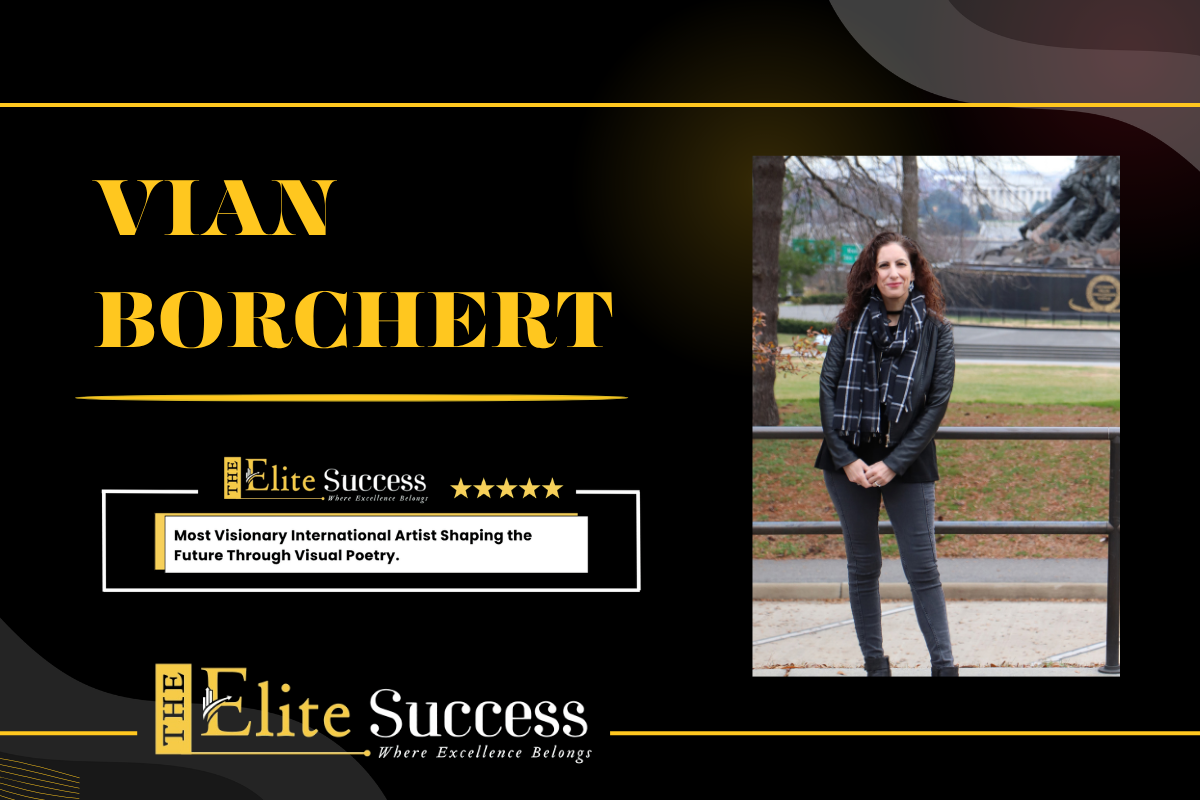
Vian Borchert: Painting the Poetry of Hope, Identity, and Inner Renewal
Art can describe the world, but some artists use it to ask us to look beyond what is visible. For internationally acclaimed contemporary artist Vian Borchert, painting is an invitation into that deeper space, where color becomes emotion, abstraction becomes language, and a canvas becomes a place for reflection. Her artistic journey has unfolded across decades of painting, writing, teaching, research, travel, and cultural exchange, resulting in a distinctive expressionist practice she describes as “visual poetry.”
With more than 100 exhibitions across international venues and cultural capitals including New York City, Washington, DC, Paris, London, Madrid, Milan, Tokyo, and Venice, Borchert has built a career rooted in both discipline and imagination. Her work has appeared in museums, galleries, embassies, Times Square on Broadway, and the Carrousel du Louvre in Paris. Yet behind the international visibility is an artist whose motivation remains deeply personal: to explore emotion, identity, memory, nature, and the subconscious while creating moments of hope, rejuvenation, and wonder for those who encounter her work.
The journey began long before the international exhibitions. Borchert grew up in an art-filled household where creativity was part of everyday life. Her mother painted and created constantly, while her father, an art lover and collector, introduced her to artists and styles from around the world. The family attended lectures and exhibitions, welcomed artists into their home, and lived surrounded by art and antiques. Teachers recognized Borchert’s natural ability as a child and encouraged her to develop it.
What began as an innate attraction to art gradually became a deliberate artistic language. Her studies at the Corcoran College of Art and Design at The George Washington University became particularly formative. There, renowned professors recognized her potential and supported her development, including through scholarships. Among the mentors who left a lasting impression were the late William Christenberry and the late Tom Green.
Borchert recalls being a shy and quiet student when Christenberry once stopped at her work during a figurative painting class, called other students over, and encouraged them to observe what she was doing. His prediction that she would go far remained with her, providing confidence at a formative moment.
That encouragement became part of a much larger evolution. Borchert’s expressionism grew naturally from her need to translate vision and emotion into form. Her paintings are characterized by bold brushstrokes, expressive colors, and an atmosphere intended to evoke serenity, hope, and rejuvenation. She believes that the soul of an artist ultimately appears on the canvas, while the practice of creating continually refines that expression.
THE LANGUAGE OF VISUAL POETRY
Borchert’s artistic identity cannot be separated from her relationship with words. Since childhood, she has written poetry alongside making art. She sees a natural connection between the two disciplines. Poetry can suggest rather than explain, bringing together words, lines, and sentences that hint at something larger, mysterious, and intellectual. Her paintings operate in much the same way.
This relationship gave rise decades ago to her concept of “visual poems.” Rather than simply describing a recognizable subject, her paintings allow images, colors, gestures, and forms to suggest meanings that viewers can discover for themselves. Seascapes and skyscapes, memories, emotional impressions, and elements of nature are transformed into lyrical abstractions. The resulting works do not demand one fixed interpretation. Instead, they create an opening through which viewers can encounter both their own emotions and something of the artist’s inner world.
This is central to Borchert’s philosophy of art. She does not seek merely to produce something beautiful. She wants the viewer to experience the painting on a deeper, more personal level. Her central themes include hope, rejuvenation, inner renewal, reflection, and the possibility of stepping away from the noise and complexity of everyday life. In that sense, the canvas becomes more than an object. It becomes a temporary refuge.
Nature is one of the most enduring sources of that refuge. Borchert has loved nature since childhood and describes it as a place of solace, reflection, grounding, and inspiration. A walk outdoors, a drive with the window down, birdsong, a breeze moving through leaves, sunlight falling across a landscape, or the changing colors of a sunset can become material for visual storytelling. Ripples on a lake or the sea reflecting light, unfamiliar landscapes encountered through travel, different skies and terrains, and fleeting sensory impressions accumulate in memory before resurfacing intuitively in the studio.
Her creative process therefore begins long before the first brushstroke. Experiences settle into the subconscious and later return as composition, color, movement, and form. Once in the studio, she works intensely with paints, brushes, and tools, translating remembered sensations into an abstracted visual language. Music can accompany the process, particularly classical music, although silence is equally valuable when she wants to enter a deeper state of concentration and contemplation.
THE COURAGE TO KEEP CREATING
Behind the beauty and recognition of an international art career lies another reality: the persistence required to remain committed to a creative vision. Borchert has encountered negativity, doubt, rejection, closed doors, missed opportunities, skeptics, setbacks, and unexpected obstacles. Establishing herself internationally was not a straightforward ascent. Each difficult experience tested not only her confidence but also her ability to remain focused on the deeper purpose behind her work.
Her response was not to allow those experiences to define her direction. She learned to keep moving forward, to recover emotionally after difficult moments, and to avoid giving excessive power to negativity. Letting go became part of her artistic resilience. Rather than allowing rejection to determine the value of her work, she continued refining her practice and trusting the vision that had guided her from the beginning. She understood that every setback could become an opportunity to strengthen her perspective, sharpen her skills, and return to her creative work with renewed clarity.
That determination has become one of the foundations of her longevity. For Borchert, remaining true to one’s vision does not mean that the journey will always be comfortable. It means developing the strength to continue evolving even when external validation is uncertain. Her career demonstrates that artistic identity is not created in a single defining moment. It develops through years of work, experimentation, reflection, and the willingness to return to the studio again and again. Through that consistency, she has built not only an enduring artistic practice but also the confidence to keep exploring where her vision can lead next.
THE SYMBOLISM WITHIN THE CANVAS
Borchert’s paintings often contain symbols that emerge from a lifetime of observation and experience. Shapes may suggest gateways or thresholds, while ancient columns suspended in open spaces can evoke belonging, passage, memory, and travel. These elements are not isolated decorative choices. They carry fragments of experience, imagination, and memory into the composition.
After approximately three decades of creating art and more than two decades of professional teaching, Borchert sees the act of creation as inseparable from her identity. The artist, the experiences, the memories, the questions, and the imagination converge intuitively within a painting. Once completed, however, the work becomes its own entity, carrying her journey while leaving room for each viewer to discover a personal meaning.
Her desired emotional effect is closely connected to renewal. She compares the experience to watching a sunrise, when colors and changing hues signal a new day filled with possibility. In the same way, she hopes her paintings can create a moment of wonder and offer viewers a sense of hope and new beginnings.
For Borchert, this is also why art can function as a universal language. Like music, art does not require everyone to speak the same verbal language in order to be felt. From ancient monuments such as the Colosseum to Leonardo da Vinci’s Mona Lisa and contemporary museums, art has connected cultures and generations. It enriches lives, binds communities, and elevates the human experience.
AN INTERNATIONAL ARTISTIC FOOTPRINT
Borchert’s international journey has been shaped by both exhibition opportunities and a lifelong openness to different cultures. Having lived with her family across multiple countries and states in the United States, Europe, and beyond, she describes herself as a global artist. Travel and encounters with people from different backgrounds have broadened her perspective and enriched her artistic outlook.
New York played an important role in establishing her identity as an expressionist artist, particularly within abstraction. Her work has been exhibited and represented by a Manhattan gallery. In the Washington, DC area, she has built relationships with galleries and cultural institutions including Watergate Gallery and the historic Arts Club of Washington DC, where she has both taught fine art classes and exhibited her work.
International gallery representation expanded that reach further. London-based Opulent Gallery, with additional locations in Milan and Amsterdam, has connected her work with a wider global audience. The gallery also presented an exclusive solo exhibition of her work on Artsy, extending her practice into a leading global art platform and marketplace.
Among her most meaningful milestones is her invitation to exhibit at the Louvre museum in Paris during the vernissage at the Carrousel du Louvre. Having received the invitation several years ago and again in the current year, Borchert regards the experience as extraordinary and deeply significant. Seeing her paintings presented in such a historically important setting has brought immense joy and gratitude while marking another step in the international trajectory of her career.
Other experiences have added further dimensions to that trajectory. Exhibiting in connection with the Venice Biennale fulfilled a dream, while vernissages in Paris, Madrid, and Tokyo and recognition through the International Prize of “The New Great Masters of New York” contributed to her expanding artistic footprint. Each exhibition, in her view, feeds into the next, creating new opportunities and extending the story of her work across cultures and artistic communities.
CREATING THROUGH CONNECTION AND EDUCATION
International exposure has not only expanded Borchert’s audience. It has changed the way she sees. Her adventurous nature draws her toward new places, environments, and cultural perspectives, and those experiences continue to enrich both her life and her art.
Teaching has become another important dimension of that exchange. Borchert’s studio practice and educational work continually intersect. She enjoys connecting with students and considers their enthusiasm and love of art an important source of energy. The classroom becomes a communal practice where ideas flow between teacher, students, and the wider community.
Her approach to art education goes beyond teaching technical skills. She views art education as foundational to creativity, critical thinking, expression, and self-discovery. The right teacher can encourage students to look carefully, question assumptions, understand their subjects, and use art as a means of expressing themselves. Drawing and painting thus become cognitive experiences rather than merely exercises in technique.
Her broader roles as an art writer, critic, curator, and contributor to the art community reinforce this multidimensional perspective. For Borchert, being an artist means drawing knowledge from art history and philosophy as well as psychology, which she has also studied. These disciplines enrich her understanding of people and creative practice and broaden her contribution beyond the studio.
AUTHENTICITY AS ARTISTIC LEADERSHIP
In an art world where visibility can sometimes encourage imitation, Borchert places authenticity at the center of her identity. She describes herself as a unique artist with original and singular ideas, a pioneer of abstract styles, and an artist guided by a keen way of seeing and interpreting the world.
Maintaining that authenticity, however, does not mean remaining static. Her creative evolution is tied to an ongoing process of self-discovery. She describes her artistic life as a soul-searching journey into the self and the subconscious, through which she gains a deeper understanding of who she is and the power within her to create. Exploring subjects that genuinely interest her allows her to grow as a person, which naturally contributes to her development as an artist.
This is also how she approaches personal branding. Rather than constructing an external image disconnected from the work, she allows the art to reveal layers of herself. Years of dedicated work, strong art education, and commitment to her path have created the multifaceted identity she carries today as an artist, educator, writer, curator, and poet.
Her advice to emerging artists follows the same principle. Stay true to yourself. Invest in art education. Build a strong foundation and discover your own artistic voice. Be ethical. Do not imitate established artists simply to achieve quick recognition or sales. Explore what genuinely inspires you and allow a distinctive style to develop through an honest artistic journey.
ART AS A CONTINUING LEGACY
Borchert approaches the future with an existentialist sensibility, focusing on what can be created in the present rather than trying to control what comes next. She believes her contribution to contemporary expressionist art can create ripple effects that continue beyond her own career. Digital platforms have strengthened that possibility by allowing artists to take their voices and visions far beyond the physical walls of a studio.
Yet technology does not replace the human experience at the heart of her practice. Her vision remains centered on emotional connection, contemplation, and the enduring power of art to change lives.
Her ambitions for her legacy are equally expansive. Borchert hopes her work will eventually become part of art history and be studied and remembered alongside influential movements such as French Impressionism. More importantly, she wants future generations to return to her work as a source of solace, inspiration, and renewal. She hopes her singular creative vision and innovative ideas will have contributed to reshaping art while making the world a more thoughtful and inspired place.
That aspiration is consistent with the purpose that has guided her work from the beginning. Borchert does not see art as an endpoint. It is a continuing dialogue between artist and viewer, memory and imagination, nature and the subconscious, experience and possibility.
After decades of painting, teaching, writing, exhibiting, and evolving, Vian Borchert continues to create from a place of curiosity and inner conviction. Her international recognition may be visible in galleries, museums, cultural institutions, and major art events, but the deeper measure of her work lies elsewhere: in the moment a viewer pauses before a painting and feels something difficult to name.
That moment is the essence of her “visual poetry.” It is where abstraction becomes emotion, where symbolism becomes personal, and where art becomes a quiet invitation to look inward.
For Borchert, the canvas is ultimately a place where life can be transformed into meaning. Her enduring hope is that those who encounter her work will find not only beauty, but a moment of reflection, a renewed sense of possibility, and perhaps a little more light for whatever lies ahead.