Dr. Alison Gajadhar-Foster: Building Purpose-Driven Ecosystems Through Leadership
What really determines whether an organisation succeeds over time? Is it strategy, leadership,
or something deeper that we often ignore?
Today’s business world is changing fast. Companies and institutions face constant pressure.
Technology keeps evolving. Markets shift quickly. People expect transparency and
accountability at every level. Many organisations invest in strong strategies and capable
leaders. Yet, results often fall short.
The real issue runs deeper. Many organisations operate with systems that do not align with
the organisation’s core purpose. Teams work in silos. Decisions-making processes lack
clarity and consistency, while many other processes fail or struggle to support organizational
goals. Even the best strategies struggle when the system behind them does not support
execution. This gap has become a defining challenge across industries.
Organizations do not just need more leaders in the traditional sense that society has viewed
strong leadership in the past. They need leaders who understand systems. Leaders who can
connect purpose with structure. Leaders who can bring alignment across governance,
operations, and people. This shift in leadership has become essential for organisations that
want to sustain success.
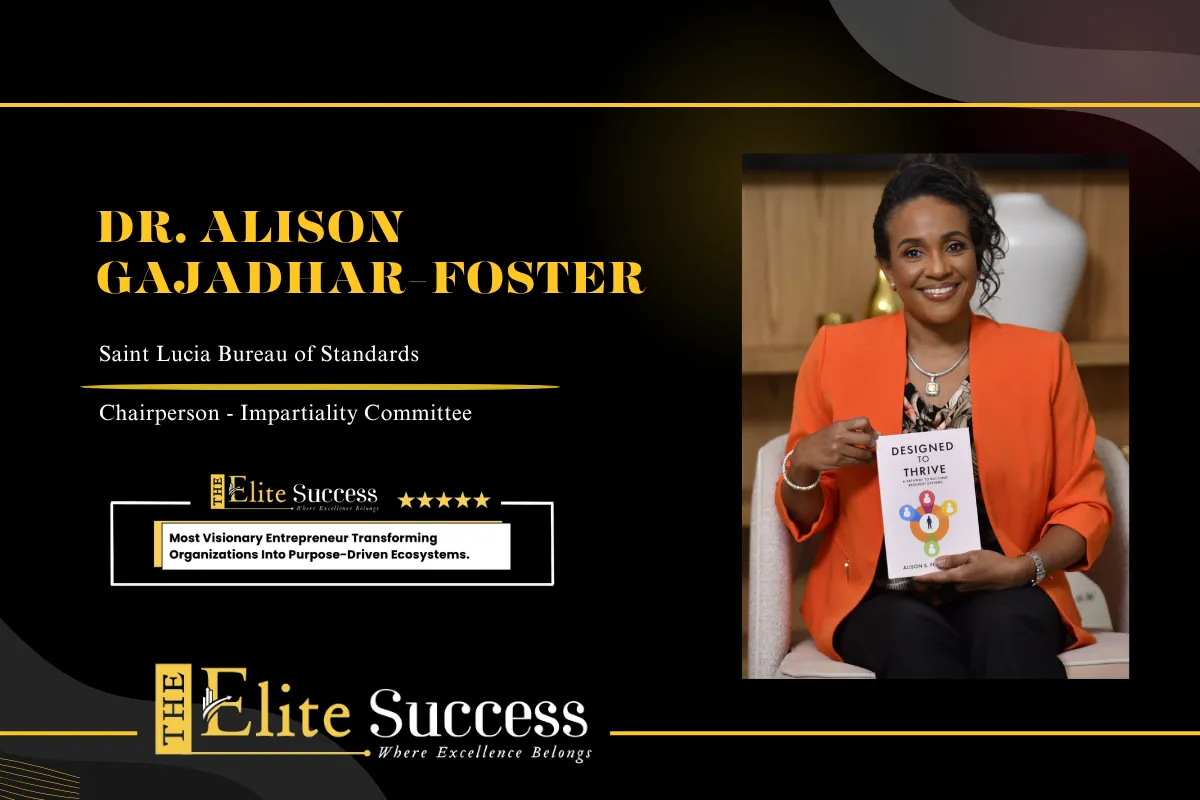
Dr. Alison Gajadhar-Foster, Chairperson – Impartiality Committee at the Saint Lucia Bureau
of Standards and former Chairperson of the National Accreditation Council in Saint Lucia,
represents this new kind of leadership. She brings a systems-driven approach to
organisational challenges. She focuses on building alignment rather than applying quick
fixes. Her work reflects a deep commitment to designing environments in which
organisations can perform with clarity and purpose.
For her vision, impact, and commitment to transforming organisations into purpose-driven
ecosystems, Dr. Alison Gajadhar-Foster is being featured by The Elite Success Magazine in
its edition, Most Visionary Entrepreneur Transforming Organizations Into Purpose-Driven
Ecosystems.
From Observation to Systemic Transformation
Dr. Alison’s professional journey is defined by a systems-oriented lens shaped by her
multidisciplinary background in science, governance, public policy, and administration. From
the early stages of her career, she demonstrated a natural inclination toward understanding
not just outcomes, but the underlying structures and mechanisms that produced them. Rather
than viewing organisational challenges as isolated events, she approached them as
interconnected issues rooted in systemic design.
Her early exposure to organisational environments revealed a recurring and often overlooked
pattern: strategies frequently failed not because of poor leadership or lack of ambition, but
due to fragmented and misaligned systems. Plans were often well-conceived, yet execution
faltered because governance structures, operational processes, and human behaviours were
not synchronised to support strategic intent. This insight became a defining moment in her
thinking, shifting her focus from surface-level problem-solving to deeper systemic
transformation.
Motivated by this realisation, Dr. Alison founded KMA Consulting Services. The firm was
built on a foundational belief that sustainable organisational success cannot be achieved
through isolated interventions or short-term fixes. Instead, it requires the intentional design of
systems that reinforce purpose, align decision-making, and enable consistent performance
over time.
A critical turning point in her journey emerged through repeated consulting engagements
across various sectors. In each case, she observed a persistent gaps between what
organisations intended to achieve and what they were able to deliver. These experiences
provided not only validation of her systems-based perspective but also the practical insights
needed to refine her methodologies.
It was through this iterative process of observation, application, and refinement that she
developed the C 2 TS 3 framework. This integrated model became a cornerstone of her
consulting practice, offering a structured approach to aligning clarity, context, teams,
strategy, structure, and systems. More importantly, it provides organisations with a practical
pathway to move from fragmentation to coherence.
Her journey continues to be guided by a broader vision of a world in which individuals and
organisations operate in environments that support human dignity, purpose, and long-term
flourishing. This vision is not aspirational alone; it is embedded in the way she designs
systems, engages with leaders, and measures impact.
A Systems Thinking Approach to Sustainable Success
KMA Consulting Services was established to address a critical and often misunderstood gap
in organisational performance: the misalignment between purpose and systems. While many
organisations invest heavily in strategy development, far fewer dedicate the same level of
attention to ensuring that their systems are designed to implement and, when necessary, pivot
from those strategies over time.
The company operates on a clear and disciplined premise that organisations do not fail due to
lack of effort, intelligence, or even resources. Instead, failure often occurs because the
systems within which people operate are not structured to support the intended outcomes.
Misaligned incentives, unclear governance, fragmented processes, and inconsistent decision-
making frameworks collectively undermine even the most well-intentioned initiatives.
KMA Consulting Services works across public, private, and industry sectors, supporting
organisations in transitioning from reactive, fragmented operating models to integrated,
purpose-driven ecosystems. Its approach goes beyond conventional consulting by addressing
not just what organisations do, but how and why they do it.
Central to the firm’s methodology is the alignment of governance, management, and
operational systems. This ensures that strategy is not treated as a standalone exercise but is
embedded within the structures and behaviours that drive day-to-day operations. By creating
coherence across these layers, organisations are better positioned to execute consistently,
adapt to change, and sustain performance over the long term.
The company’s philosophy is deeply rooted in systems thinking, which views organisations
as dynamic, living systems rather than static entities. This perspective recognises that
organisations are composed of interdependent elements – people, processes, structures, and
cultures – that must function in harmony to achieve desired outcomes.
Through these lens, KMA Consulting Services helps organisations build resilience, enhance
adaptability, and create environments where both internal stakeholders and external
communities can thrive.
Driving Transformation Through Systems Leadership
As Founder and Principal Consultant, Dr. Alison plays a central role in guiding organisations
through complex transformation processes. Her work is highly collaborative, involving close
engagement with leadership teams to diagnose systemic challenges and design integrated
solutions.
Her responsibilities extend beyond traditional advisory roles. She works directly with
leadership teams to align governance frameworks, management practices, and operational
systems, ensuring that each component supports the organisation’s overarching purpose. This
involves a combination of strategic analysis, systems design, and practical implementation.
A key aspect of her role is identifying inefficiencies and misalignments within organisational
systems. Rather than addressing symptoms, she focuses on uncovering root causes and
designing interventions that create sustainable improvements. This requires a deep
understanding of organisational dynamics, as well as the ability to translate complex concepts
into actionable strategies.
In addition to her consulting work, Dr. Alison contributes at the governance level through
leadership roles on various boards and committees. Her involvement in these capacities
reflects her commitment to embedding principles of accountability, transparency, and
stewardship within organisational structures.
Having served in positions such as Chairperson of governing bodies and committees,
including the Impartiality Committee at the Saint Lucia Bureau of Standards and the National
Accreditation Council, she brings a systems perspective to governance itself. These roles
reinforce her belief that governance should not be treated as a compliance function, but as a
strategic enabler of organisational performance and integrity.
Overcoming Resistance to Integrated Governance
One of the most significant challenges in Dr. Alison’s work has been facilitating a shift in
mindset among leaders. Many organisations operate within linear, siloed frameworks that
prioritise short-term outputs over long-term systemic health. Transitioning to a systems-based
perspective requires leaders to rethink how they understand complexity, interdependence, and
causality.
This shift is not always intuitive. Systems thinking demands that leaders consider feedback
loops, unintended consequences, and the cumulative impact of decisions over time. It
requires moving beyond immediate problem-solving to designing structures that prevent
problems from arising in the first place.
Another persistent challenge has been redefining the role of governance. In many
organisations, governance is viewed narrowly as a compliance requirement rather than a
strategic function. This perception limits its potential to influence decision-making, align
priorities, and ensure accountability.
Resistance often arises when organisations are asked to integrate governance more deeply
into their performance frameworks. Leaders may be hesitant to adopt new structures or
processes, particularly if they perceive them as adding complexity rather than clarity.
Overcoming this resistance requires not only technical expertise but also the ability to build
trust and demonstrate value.
The broader context in which organisations operate has also become increasingly complex.
Rapid technological advancements, evolving societal expectations, and heightened awareness
of systemic risks have created an environment where traditional approaches are no longer
sufficient.
Despite these external pressures, the core issue remains internal fragmentation. Organisations
frequently attempt to respond to external challenges without addressing the lack of coherence
within their own systems. This disconnect limits their ability to adapt effectively and sustain
performance over time.
Leadership as a Responsibility to Design Effective Systems
Dr. Alison’s leadership philosophy is grounded in the principles of systems thinking and
purpose-driven design. She views leadership not as a position of authority, but as a
responsibility to create environments where systems function effectively and people can
contribute meaningfully.
At the core of her philosophy is the belief that organisations must be anchored in a clear and
authentic purpose. This purpose serves as a guiding reference point for decision-making,
ensuring that actions are aligned with long-term objectives rather than short-term pressures.
She emphasises the importance of designing systems that are both aligned and self-
correcting. In her view, effective systems should not only support current operations, but also
adapt to changing conditions and continuously improve over time. This requires integrating
feedback mechanisms, fostering learning, and encouraging innovation.
Her approach also incorporates human-centred design and principles of diversity, equity, and
inclusion (DEI). She recognises that all organisations are fundamentally human systems, and
their success depends on the extent to which they are inclusive, transparent, and responsive to
the needs of diverse stakeholders.
Trust plays a central role in her leadership philosophy. However, she distinguishes between
trust as an interpersonal quality and trust as a systemic outcome. While individual actions are
important, sustainable trust is built through consistent, transparent, and well-designed
systems that reinforce integrity and accountability.
Empowering Teams for Sustainable Transformation
Dr. Alison’s approach to team management is focused on building capacity and ensuring
long-term sustainability. Rather than creating dependency on external expertise, she
prioritises empowering leadership teams with the knowledge and tools needed to sustain
transformation independently.
Her methodology emphasises collaboration, encouraging cross-functional engagement and
breaking down silos that hinder organisational effectiveness. By fostering environments
where open dialogue and critical thinking are encouraged, she enables teams to address
challenges more holistically.
A key element of her approach is the integration of feedback loops into organisational
systems. These mechanisms allow teams to monitor performance, identify areas for
improvement, and adapt their strategies in real time. This creates a culture of continuous
learning, where failure is viewed as an opportunity for growth rather than a setback.
Mentorship, in this context, extends beyond individual development to include the cultivation
of organisational capabilities. She works closely with leaders to develop adaptive thinking,
helping them navigate complexity with clarity and confidence.
By modelling these behaviours herself, she sets a standard for leadership that is both practical
and aspirational, encouraging others to adopt similar approaches within their own teams.
Delivering Tangible Results Across Sectors
Among Dr. Alison’s most notable achievements is the development of the C 2 TS 3 framework.
This model provides a comprehensive approach to aligning key organisational elements,
including clarity, context, teams, strategy, structure, and systems. It serves as both a
diagnostic tool and a roadmap for transformation.
Her consulting practice has delivered measurable results across a range of sectors, including
government institutions and private enterprises. These engagements have demonstrated the
practical value of systems thinking in addressing complex organisational challenges.
One particularly significant implementation involved the redesign of governance and
management systems for a public sector department. By applying ISO 37000 principles
alongside the C 2 TS 3 framework, the project achieved substantial improvements in decision-
making processes, accountability structures, and overall institutional resilience.
In addition to her consulting work, her book Designed to Thrive has extended her impact
beyond individual organisations. The publication provides a platform for sharing her insights
on systems thinking, governance, and resilience with a global audience, contributing to
broader conversations on organisational design and leadership.
Expanding the Reach of Systems Thinking Globally
Looking ahead, Dr. Alison aims to expand the reach and influence of her work across
multiple levels. Her focus is on advancing conversations around purpose-driven and resilient
systems at local, national, regional, and global scales.
Through continued consulting, thought leadership, and knowledge sharing, she seeks to
deepen the adoption of systems thinking across sectors. This includes refining her
frameworks, developing new methodologies, and engaging with diverse audiences to promote
more integrated approaches to organisational design.
Her long-term vision involves shaping ecosystems where organisations are not only effective
in achieving their goals, but importantly, contribute positively to the well-being of people,
and the broader social and economic landscape.
Building Systems that Learn and Adapt
Dr. Alison advises leaders to move beyond addressing problems in isolation and instead focus
on designing systems that are self-correcting and prevent the same issues from recurring. This
requires a shift from reactive management to proactive design.
She encourages organisations to re-anchor themselves in a clear sense of purpose and to
ensure alignment across governance, strategy, and operations. Without this alignment, even
the most well-intentioned initiatives are likely to fall short.
Additionally, she emphasises the importance of building adaptive systems that support
continuous learning through effective and efficient governing processes. In an environment
characterised by constant change, the ability to evolve and improve is essential for long-term
success.
Leaving Behind Frameworks that Sustain Success
Dr. Alison’s legacy is centred on creating enduring impact through ideas, frameworks, and
organisations that continue to thrive beyond her direct involvement.
She seeks to leave behind systems that enable human flourishing, support dignity, and
promote long-term well-being. Her work is not only about improving organisational
performance but also about contributing to a broader vision of sustainable and inclusive
development.
Through her contributions, she aims to ensure that organisations play a meaningful role in
shaping societies where individuals and communities can prosper with purpose and integrity.
5 Key Takeaways from Dr. Alison Gajadhar-Foster’s Leadership Journey
- Systems drive success, not strategy alone
Organisations succeed when governance, operations, and people are aligned to execute
strategy effectively. - Leadership is system design
Effective leaders create structures and environments that enable clarity, coordination, and
purposeful action. - Governance enables performance
Governance should actively strengthen accountability and decision-making, not just ensure
compliance.
- Focus on root causes, not symptoms
Lasting improvement comes from fixing structural issues rather than repeatedly addressing
surface-level problems. - Build internal capability for sustainability
Empowering teams ensures organisations can sustain and evolve transformation
independently over time.