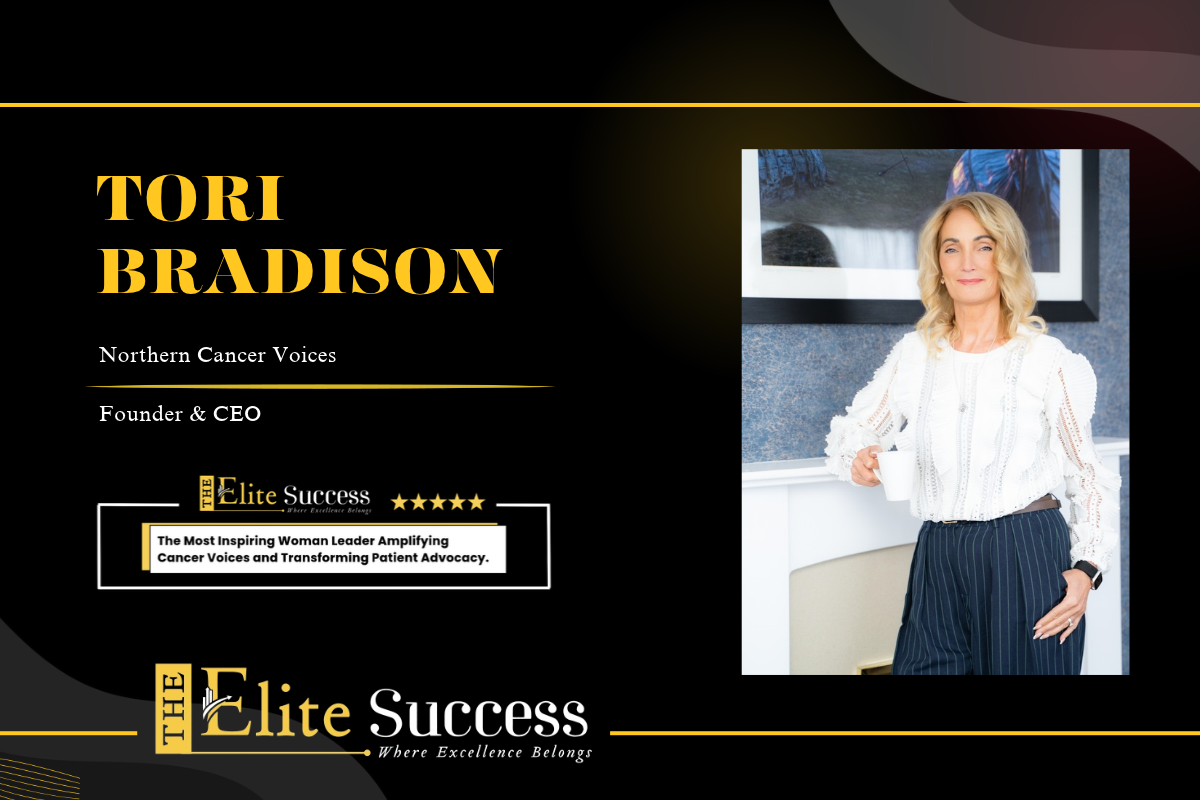
Tori Bradison: Turning Lived Experience into a Force for Change
A story of how a leader is amplifying patient voices and transforming lived experience into meaningful change
Intro:
Cancer is often measured through statistics: diagnosis rates, survival figures, treatment outcomes and access to care. Yet behind every number is a person, a family and an experience that cannot always be captured in a report.
For Tori Bradison, Founder & CEO of Northern Cancer Voices, this understanding is deeply personal.
Cancer first touched her life in the 1990s when she lost her uncle while she was working full-time and raising a young child. A few years later, she lost her aunt, who was like another mother to her. In 2016, one of her closest friends received a terminal cancer diagnosis, giving Tori a decade-long view of how the disease affects not just a patient, but their partner and family.
Then, in August 2019, cancer became even more personal. Her mother was diagnosed while Tori was still working full-time and, at times, overseas. Within days, their roles changed. Tori became her mother’s carer. Four weeks later, in September, her mother passed away.
Those weeks changed how she viewed healthcare.
They showed her that healthcare is not only about treatment. It is also about compassion, dignity, communication and support. More importantly, they strengthened her belief that patients, carers and families possess knowledge that can help improve services for others.
That belief became Northern Cancer Voices.
From Lived Experience to Community Intelligence
Northern Cancer Voices was not created because Tori set out to start a charity. It grew from years of seeing the distance between those designing healthcare services and those experiencing them.
Patients understood barriers that statistics could not explain. Carers encountered challenges that reports did not always capture. Communities could identify inequalities that systems sometimes overlooked.
Tori wanted to close that gap by creating a genuinely patient-led organisation where lived experience could be recognised as expertise and where patients, carers, survivors and bereaved families could influence meaningful change alongside the people capable of making it happen.
The early journey was challenging. Tori came from a corporate background and had no established network within cancer services. Credibility had to be earned, particularly when convincing organisations that patient engagement could be more than consultation.
Funding was another hurdle. Like many grassroots organisations, Northern Cancer Voices began with ambitious goals and limited resources. Tori remains grateful to the first person who believed in the idea and gave her a chance, even when the path ahead was not completely clear.
Trust within communities took time as well. Many people had previously participated in surveys and consultations without seeing tangible outcomes. Northern Cancer Voices therefore made three things central to its approach: listening, feeding back and demonstrating impact.
Gradually, that changed the organisation’s position.
Patients began encouraging others to participate. Healthcare organisations recognised the value of community insight. Partnerships developed. Northern Cancer Voices moved from being seen as a group collecting stories to being recognised as a source of community intelligence.
Community intelligence has become one of the organisation’s defining strengths, combining lived experience, engagement insight and real-world community perspectives to help organisations make more informed decisions.
Today, the organisation works with NHS organisations, Cancer Alliances, researchers, charities, local authorities and voluntary sector partners, bringing community perspectives into conversations around cancer services, research, patient involvement and healthcare transformation.
Understanding What the Data Cannot Say
A central part of Northern Cancer Voices’ work is addressing health inequalities.
Through community engagement, the organisation hears about barriers involving geography, deprivation, culture, language, digital exclusion and access to services.
Tori puts the distinction simply: “Data tells us where inequalities exist. Communities tell us why they exist.”
That philosophy shapes how the organisation works. Rather than relying only on formal research or existing systems, Northern Cancer Voices builds relationships with grassroots organisations, community leaders and trusted local networks to reach people who may not engage with conventional healthcare structures.
The objective is not simply to collect experiences.
It is to translate them into action.
“Stories are powerful, but stories alone do not create change,” Tori explains.
Patients and carers, she believes, should not be treated merely as beneficiaries of healthcare. They are experts through experience. Their insights can help shape service design, communications, engagement strategies and healthcare improvement.
One of Northern Cancer Voices’ greatest strengths is its ability to provide community intelligence. By identifying themes and patterns across hundreds of conversations, the organisation helps healthcare leaders understand not only what people are experiencing, but why those experiences occur and what practical improvements could make the greatest difference.
That approach has also informed Tori’s work as a Patient and Public Voice Partner with the NHS, as well as her involvement with regional and national cancer programmes, Cancer Alliances, NHS leadership groups, strategic partnerships and cancer boards.
Her role increasingly extends beyond community engagement into the wider conversations shaping cancer care. Through involvement in cancer programme teams, Cancer Alliances and NHS leadership forums, Tori advocates for patient and community voices to inform discussions around prevention, early diagnosis, reducing inequalities and the future of cancer services.
Whilst cancer remains one of the UK’s biggest health challenges, progress has been remarkable. Today, around half of people diagnosed with cancer will survive for ten years or more, compared with approximately one in four in the early 1970s, demonstrating the impact of advances in research, treatment and earlier diagnosis.
Tori’s work focuses on ensuring that these advances are accompanied by an equally strong understanding of the people and communities affected by cancer.
Her philosophy can be summed up in the words of a cancer survivor from North East England:
“Don’t do it to me, or for me. Do it with me.”
For Tori, patient advocacy works best when patients are partners in shaping healthcare rather than passive recipients of it.
When Listening Becomes Action
One of Northern Cancer Voices’ most compelling examples is the Treat, Heat or Eat programme, sponsored by Northern Gas Networks.
Through conversations with cancer patients and communities, the organisation repeatedly heard about people being forced to make impossible choices between attending appointments, heating their homes and feeding their families.
Some could not afford travel costs upfront and therefore missed appointments. Others were struggling with rising energy bills while undergoing treatment. Many felt uncomfortable asking for assistance.
The conversations revealed something important: financial hardship and health inequality could directly affect a person’s ability to access healthcare and manage their cancer journey.
Instead of simply documenting the problem, Northern Cancer Voices worked with partners to develop a practical response. Treat, Heat or Eat provides support, information, signposting and access to services that can help reduce some of the pressures faced by people living with cancer and other long-term conditions.
For Tori, the programme represents the organisation’s approach in its clearest form.
People shared what was happening in their lives. The organisation listened. Partners came together. Community insight became a practical response.
Another important area of work has been strengthening public involvement in health and care research across the North East. Working with voluntary organisations, researchers, community groups and people with lived experience, Northern Cancer Voices helped develop a collaborative approach designed to remove barriers to participation and give underrepresented communities greater influence over research priorities and design.
The aim was to move beyond consultation. People affected by cancer and other health conditions were able to contribute their experiences from the outset, while researchers gained insight into community priorities.
The result was a stronger understanding that communities can be partners in shaping research, not simply participants within it.
Giving Communities Their Own Platform
That same philosophy is evident in a current project with Digital Voices, funded by Macmillan Cancer Support.
The project focuses on three areas of the cancer pathway: the experiences of people from Black, Asian and Minority Ethnic communities, shared decision-making, and the relationship between dementia and cancer.
Northern Cancer Voices is coordinating engagement with community groups, support organisations, healthcare services and people with lived experience. Through workshops and conversations, participants are sharing their experiences and recommendations around the challenges they have faced and the improvements they want to see.
Those conversations will become digital stories and films hosted by Northern Cancer Voices. The content will be used to raise awareness, educate professionals and encourage system leaders to respond to community insight.
The project includes engagement with peer support groups around shared decision-making, work with people affected by both dementia and cancer, and partnerships with trusted community organisations to explore cultural barriers and accessibility within cancer services.
For Tori, the value is not simply in producing the films. It is in the conversations they can create and the action they can encourage.
Rather than assuming what communities need, the project gives them an opportunity to explain it themselves.
A Leadership Style Built on Trust
Before founding Northern Cancer Voices, Tori spent many years at BT in customer experience, transformation, engagement and leadership roles.
That experience taught her how to lead large-scale transformation programmes, manage stakeholders with different priorities and use customer insight to improve services. One lesson, however, remained particularly important: organisations achieve better outcomes when they genuinely listen to the people they serve.
She describes her leadership style as authentic, inventive and collaborative.
Authenticity, for Tori, means being consistent between what she says, what she does and what she stands for. Inventiveness means looking beyond limitations and finding different ways to connect people and solve problems. Collaboration means recognising that meaningful change rarely comes from one individual or organisation.
“I have never believed that leadership is about having all the answers,” she says. “Instead, I believe leadership is about creating environments where others feel empowered to contribute.”
Tori is also quick to emphasise that Northern Cancer Voices is far bigger than any one individual. Whilst she founded the organisation, its success is driven by a remarkable team of staff, volunteers and trustees who bring passion, expertise and commitment to the mission every day.
She is particularly proud of Director of Operations, Lorna Joisce, whose leadership, professionalism and relentless commitment to delivering impact have been instrumental in transforming a vision into a thriving organisation. Working alongside a dedicated team of Community Engagement Officers and support colleagues, Lorna has helped establish the systems, partnerships and foundations that enable Northern Cancer Voices to make a difference across communities throughout the region.
Equally important are the charity’s volunteers, many of whom have their own lived experience of cancer. They freely give their time, skills and expertise to support others, influence services and strengthen communities. Their contribution is impossible to quantify but central to everything Northern Cancer Voices achieves.
The Board of Trustees also plays a vital role in guiding the charity’s growth, bringing strategic expertise, governance and challenge whilst remaining committed to the values on which the organisation was built.
What excites Tori most is the calibre of people who continue to be drawn to the organisation. From healthcare professionals and senior leaders to community advocates and people with lived experience, Northern Cancer Voices consistently attracts talented, purpose-driven individuals who share a common belief that patient voices should shape the future of cancer care.
“The quality of people who want to be involved continually inspires me,” she says. “Any success we have achieved belongs to all of them.”
Northern Cancer Voices has also received recognition through community and voluntary sector awards, reflecting both its grassroots impact and growing influence within the wider healthcare landscape.
For Tori, however, recognition matters less than what happens because people have shared their experiences.
A Woman Who Did Not Wait for Permission
Tori’s journey also offers a clear message to women who are considering whether their experience or perspective is valuable enough to act upon.
“Speak up, be confident in your expertise and recognise that your experiences have value,” she advises.
Her own career illustrates that principle. She entered cancer advocacy without coming from the healthcare sector, built credibility through relationships and results, and developed partnerships spanning grassroots communities, NHS organisations, charities, researchers and policymakers.
She believes women should not be afraid to test ideas. They may work. They may not. If they fail, the answer is to learn, adapt and try again.
Her leadership is also grounded in a strong sense of personal authenticity. Whether speaking with a patient in a community setting, presenting at a national conference or contributing to policy discussions, she aims to bring the same values into every room.
“I am not good at admiring problems,” she says. “I like to think I can bring solutions.”
It is an attitude that captures much of what Northern Cancer Voices represents.
The Next Chapter
Tori’s vision for Northern Cancer Voices is to become one of the UK’s leading patient-led cancer engagement and advocacy organisations, with an even greater role in reducing inequalities, amplifying underrepresented voices and ensuring lived experience influences cancer services, research and policy.
But her ambition is not growth for its own sake.
As Northern Cancer Voices enters its next phase of growth, the organisation is keen to build new relationships with funders, corporate sponsors, strategic partners, researchers and organisations that share its commitment to reducing inequalities and improving outcomes for people affected by cancer. Tori believes that the challenges facing cancer communities are too significant for any one organisation to solve alone and sees collaboration as essential to achieving lasting change.
Today, Northern Cancer Voices works with NHS organisations, Cancer Alliances, researchers, charities, local authorities and voluntary sector partners. Tori wants to deepen that role by ensuring that patient and community voices are present not only in engagement exercises, but in the discussions that shape prevention, early diagnosis, reducing inequalities and the future design of cancer services.
Through her involvement in cancer programme teams, Cancer Alliances and NHS leadership forums, she continues to bring community insight into strategic conversations, connecting what people experience locally with the decisions being made at system level.
She wants Northern Cancer Voices to be recognised not simply as an organisation that gathers stories, but as one that transforms stories into action and lived experience into meaningful system change.
That means embedding lived experience into healthcare decision-making at every level.
It means ensuring that future patients, carers and families understand that their experiences have value.
And it means creating a healthcare system in which the people affected by decisions have a genuine opportunity to influence them.
For Tori, success will therefore not be measured primarily through organisational growth or personal recognition.
It will be measured by whether people affected by cancer have a stronger voice, better support and greater influence over the services designed to support them.
The Power of Being Heard
Tori Bradison’s journey from corporate leadership to patient advocacy was shaped by experiences she could never have planned. The loss of family members, the long-term impact of a friend’s diagnosis and the final weeks spent caring for her mother all changed her understanding of what healthcare means.
But she did not leave those experiences as memories.
She turned them into a mission.
Northern Cancer Voices now provides a platform through which patients, carers, survivors and communities can move from being consulted to being involved, from sharing experiences to influencing decisions.
Its work demonstrates that effective advocacy is not necessarily about speaking for people. It is about creating the conditions in which people can speak for themselves and ensuring that decision-makers listen.
Tori’s most important leadership lesson remains simple: people closest to the challenges are often closest to the solutions.
Her legacy, therefore, is unlikely to be defined simply by the organisation she founded. It will be defined by the voices that became stronger because Northern Cancer Voices gave them space, the decisions that became better because communities were involved, and the services that became more responsive because somebody took the time to listen.
As Tori puts it, “Behind every diagnosis is a person. Behind every person is a family. And behind every family is a story that deserves the power to create change.”
For her, that is not simply a closing thought.
It is the reason Northern Cancer Voices exists.