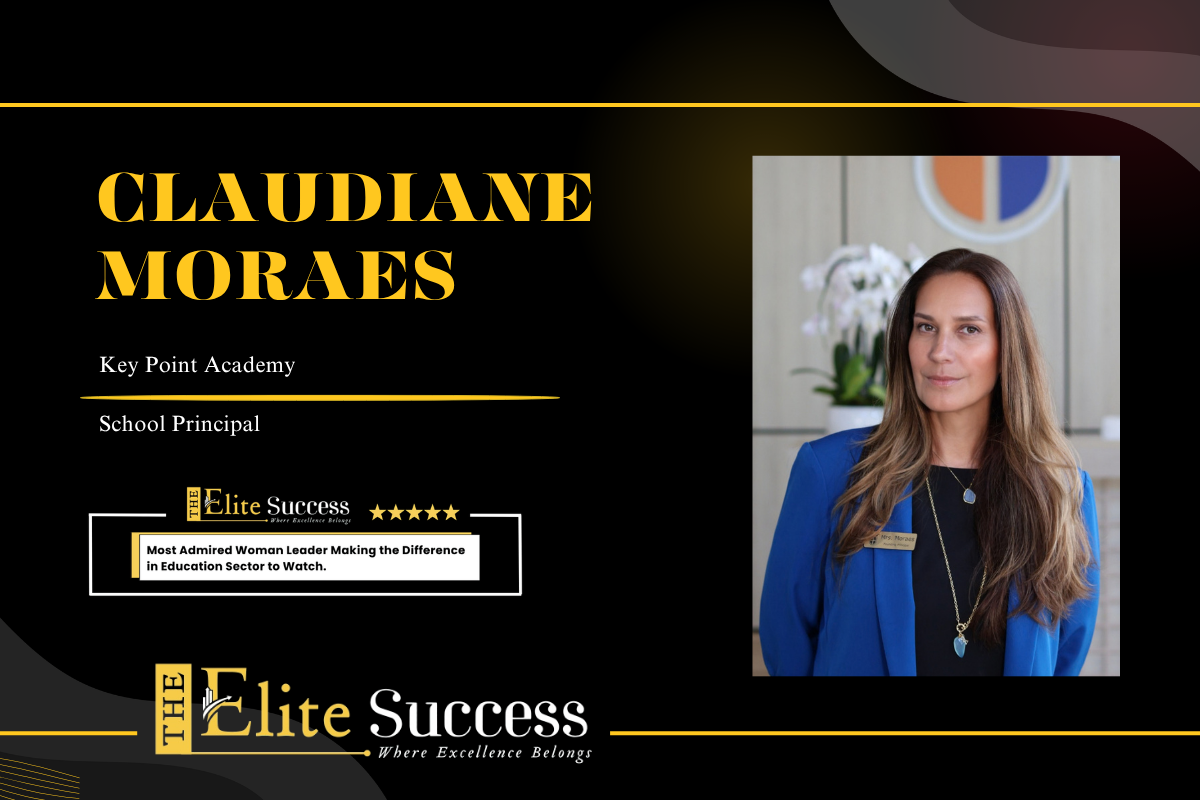
Claudiane Moraes: Leading Education Beyond Classrooms at Key Point
Academy
Education today is demanding more than just textbook learning and teaching. Schools and
institutions today must see beyond the curriculum and embed more sustainable values of
emotional resilience, critical thinking, global awareness, and moral grounding. With these
pillars forming a strong foundation, the role of a school leader has become even more
eminent, and consequential. Globally, teachers are struggling with post-pandemic learning
gaps, the rising mental health issues, and rapidly evolving technologies.
It is within this demanding landscape that Claudiane Moraes, Principal of Key Point
Academy, has emerged as a leader redefining what effective school leadership looks like
today. At a time when standardized systems often overlook individuality, Moraes champions
an education model rooted in personalized learning, character development, and
community values, one that prepares students not merely for exams, but for life.
At Key Point Academy, learning is designed to be intentional and student-centered, blending
academic rigor with emotional intelligence, faith-based values, and real-world readiness.
Moraes’ leadership philosophy recognizes that children thrive when they are seen, heard,
and guided with consistency and care. Her approach reflects a deep understanding that
education is as much about shaping confident, compassionate individuals as it is about
delivering curriculum.
As schools worldwide navigate uncertainty and transformation, Claudiane Moraes stands
out for her ability to lead with clarity, conviction, and compassion. Her work at Key Point
Academy serves as a compelling example of how thoughtful leadership can turn today’s
educational challenges into opportunities for lasting impact.
“Education, at its best, is an act of courage. It requires vision, patience, and a deep belief in
human potential. At Key Point Academy, we have built a learning community rooted in those
principles, one that honors childhood while preparing students to thrive in a complex,
interconnected world.”
A Child-Centered Vision for Learning in a Global Age
Founded with intention and clarity of purpose, Key Point Academy was envisioned as a
learning environment where children are genuinely acknowledged; where their voices
matter, their curiosity is nurtured, and their potential is meaningfully challenged. At the
heart of the school’s philosophy lies a simple yet powerful belief: academic achievement
and emotional intelligence must grow together. “We do not see them as parallel pursuits,
but as interconnected pillars of a well-rounded education.”
Under this philosophy, learning extends far beyond textbooks and assessments. The school
integrates rigorous academics with social-emotional development, mindfulness practices,
and a strong sense of global responsibility. Inquiry-based learning encourages students to
ask questions, explore ideas, and engage deeply with the world around them. From an early
age, emphasis is placed on multilingual education, multicultural awareness, and the
development of executive functioning skills, helping children learn not just what to think,
but how to think, collaborate, and reflect.
As a school rooted in Miami, one of the world’s most culturally dynamic cities, Key Point
Academy naturally reflects a global mindset. Its classrooms are diverse, multilingual, and
intellectually stimulating; mirroring the realities students will face beyond school walls. “We
prepare our learners to thrive in an ever-changing world,” equipping them with adaptability,
empathy, and critical thinking, while anchoring them in strong values and a clear sense of
purpose. Through this balanced approach, the school seeks to shape confident,
compassionate, and capable global citizens.
Laying the Foundations: Early Challenges and Lessons Learned
The journey of building Key Point Academy from the ground up was as inspiring as it was
demanding. Establishing a school is never just about infrastructure or curriculum, it is about
transforming an educational vision into a living, breathing reality. One of the earliest
challenges lay in bridging aspiration with execution. While the philosophy was clear,
translating it into daily classroom practice required intentional hiring, continuous
professional development, and operational systems designed to enable creativity rather
than restrict it. “We learned early on that innovation must be supported by structure if it is
to succeed.”
Beyond internal operations, trust emerged as a defining challenge. For families, choosing a
school is an act of faith, and as a new institution, Key Point Academy had to earn that
confidence step by step. Transparency, consistency, and visible outcomes became essential.
“We were committed to ensuring that what we promised families was reflected
authentically in every classroom interaction, every policy, and every learning experience.”
The school also navigated the wider realities facing the education sector. Regulatory
frameworks, staffing shortages, and pressures to conform to conventional educational
models tested the institution’s resolve. Yet, remaining aligned with the school’s mission
required both resilience and clarity of purpose. Rather than compromising its core values,
the leadership chose to adapt thoughtfully, meeting compliance requirements while
preserving a child-centered, future-focused approach. These early challenges ultimately
shaped a stronger institution, grounded in purpose and prepared to evolve with integrity.
The Growth Moment: Building Excellence Through Trust and Culture
The pivotal moment in Key Point Academy’s journey did not come from rapid expansion or
external recognition, but from a deliberate inward focus. Leadership made a conscious
decision to invest deeply in what truly defines a school; its people and its culture. Rather
than growing prematurely, the emphasis was placed on academic excellence, thoughtful
curriculum design, continuous faculty development, and meaningful engagement with
families. “We believed that if quality was prioritized at every level, growth would follow
naturally.”
That belief soon proved true. As students began to thrive academically, socially, and
emotionally, families witnessed tangible outcomes that extended beyond report cards.
Confidence grew, curiosity deepened, and children felt supported in their learning journeys.
Word-of-mouth emerged as the school’s most powerful form of recognition, rooted in
authentic relationships and shared values rather than marketing or scale. This phase
reinforced a core principle: in education, sustainable growth is driven by excellence, not
numbers.
Trust became the foundation upon which this growth rested. At Key Point Academy,
alignment is intentional between vision and practice, communication and action, promise
and experience. “We engage openly with families, listen with care, and view parents as true
partners in education.” Over time, this consistency has fostered long-standing confidence
and loyalty within the community.
The school’s success lies in its commitment to educating the whole child. Families recognize
that students are being prepared not just for the next academic year, but for life itself an
approach that continues to strengthen bonds, deepen trust, and sustain meaningful growth.
Purpose-Driven Programs and Innovation in Practice
At Key Point Academy, educational programs are intentionally crafted to support children
during their most formative years. The school specializes in early childhood and elementary
education, grounded in inquiry-based learning, multilingual development, and social-
emotional growth. We believe learning should be engaging, meaningful, and responsive to
each child’s development.
Key Academic and Developmental Focus Areas include:
Literacy and Numeracy: Building strong foundational skills through age-appropriate,
concept-driven instruction
STEAM Education: Encouraging problem-solving, creativity, and interdisciplinary
thinking
Global Awareness: Fostering cultural understanding and multilingual competence
Arts and Physical Education: Supporting creative expression, physical well-being,
and balance
Technology plays a supportive role in the learning environment. Adaptive platforms
personalize instruction, while digital portfolios and parent communication tools ensure
transparency and continuity between school and home. Technology is used intentionally,
enhancing learning without replacing human connection.
The school’s child-centered approach challenges traditional models by prioritizing curiosity
over compliance and mastery over memorization. Learning is active, collaborative, and
joyful.
Innovation at Key Point Academy is guided by:
Ongoing listening to families and students
Data-informed instructional decisions
Alignment with global education research and best practices
A recent milestone includes the expansion of project-based and interdisciplinary learning,
made possible through strong teacher collaboration, thoughtful planning, and a clear
commitment to the school’s mission.
Cultivating a Culture of Innovation, Mindfulness, and Growth
At Key Point Academy, innovation is rooted not in rapid change, but in trust and
psychological safety. The leadership has intentionally created an environment where
educators are encouraged to explore new ideas, take thoughtful risks, and reflect openly,
without fear of failure. This sense of safety allows creativity to flourish in the classroom and
ensures that innovation is purposeful rather than performative. “We believe that when
teachers feel supported, they are empowered to do their best work.”
Professional development is treated as an ongoing journey rather than a periodic
requirement. Learning opportunities are personalized, aligning institutional priorities with
individual strengths and passions. Teachers are encouraged to grow as practitioners and as
people, reinforcing the belief that effective education begins with engaged, reflective
educators.
Mindfulness is seamlessly woven into the school’s daily rhythm, not as a separate initiative,
but as a foundational practice. From classroom routines to leadership meetings, moments
of reflection, intentional decision-making, and emotional regulation are actively modelled.
This approach creates a calm, focused learning environment and reinforces the social-
emotional skills the school seeks to cultivate in its students. “When adults model
mindfulness, children learn to practice it naturally.”
Continuous learning is viewed as a shared responsibility across the community. Educators
see themselves not only as instructors, but as learners alongside their students. This
mindset fosters curiosity, adaptability, and resilience; qualities essential in today’s evolving
educational landscape. By embracing learning as a lifelong process, Key Point Academy
nurtures a culture where growth is collective, intentional, and deeply embedded in everyday
practice.
A Personal Vision and Enduring Legacy
Claudiane Moraes’ leadership journey is deeply personal, shaped by her roots in Brazil and
the influence of her mother, who believed unwaveringly in education as a force for
transformation. That early example instilled in her a lifelong understanding that true
leadership is grounded in service, integrity, and love. These values continue to guide her
work today, informing not only how she leads, but why she leads.
As a woman leader in education, Moraes is known for a leadership style defined by
empathy, clarity, and courage. She leads with conviction, yet remains deeply collaborative,
recognizing that meaningful progress is never achieved alone. “I see leadership as a shared
responsibility, she reflects, one that thrives on trust, dialogue, and mutual respect.” This
belief shapes her approach to decision-making, team-building, and community engagement.
Mindfulness and core values serve as her compass, particularly in moments of uncertainty.
When challenges arise, she returns to a simple but powerful question: what best serves the
child? This clarity of purpose brings consistency to her leadership and reinforces a culture of
intentionality across the school.
Strong communication between parents and teachers remains central to her philosophy.
Moraes champions open dialogue, shared accountability, and respectful partnerships,
believing that education flourishes when families and educators work in alignment.
Balancing administrative responsibilities with her passion for child development requires
deliberate effort. She remains closely connected to classrooms, students, and families,
ensuring leadership stays grounded in lived experience rather than distant oversight. For
Moraes, success is measured by impact, confident children, empowered educators, and
families who feel supported. The legacy she hopes to leave is one of humanity in education,
where excellence and kindness coexist, and schools prepare children not just for the future,
but for life.Academy
Education today is demanding more than just textbook learning and teaching. Schools and
institutions today must see beyond the curriculum and embed more sustainable values of
emotional resilience, critical thinking, global awareness, and moral grounding. With these
pillars forming a strong foundation, the role of a school leader has become even more
eminent, and consequential. Globally, teachers are struggling with post-pandemic learning
gaps, the rising mental health issues, and rapidly evolving technologies.
It is within this demanding landscape that Claudiane Moraes, Principal of Key Point
Academy, has emerged as a leader redefining what effective school leadership looks like
today. At a time when standardized systems often overlook individuality, Moraes champions
an education model rooted in personalized learning, character development, and
community values, one that prepares students not merely for exams, but for life.
At Key Point Academy, learning is designed to be intentional and student-centered, blending
academic rigor with emotional intelligence, faith-based values, and real-world readiness.
Moraes’ leadership philosophy recognizes that children thrive when they are seen, heard,
and guided with consistency and care. Her approach reflects a deep understanding that
education is as much about shaping confident, compassionate individuals as it is about
delivering curriculum.
As schools worldwide navigate uncertainty and transformation, Claudiane Moraes stands
out for her ability to lead with clarity, conviction, and compassion. Her work at Key Point
Academy serves as a compelling example of how thoughtful leadership can turn today’s
educational challenges into opportunities for lasting impact.
“Education, at its best, is an act of courage. It requires vision, patience, and a deep belief in
human potential. At Key Point Academy, we have built a learning community rooted in those
principles, one that honors childhood while preparing students to thrive in a complex,
interconnected world.”
A Child-Centered Vision for Learning in a Global Age
Founded with intention and clarity of purpose, Key Point Academy was envisioned as a
learning environment where children are genuinely acknowledged; where their voices
matter, their curiosity is nurtured, and their potential is meaningfully challenged. At the
heart of the school’s philosophy lies a simple yet powerful belief: academic achievement
and emotional intelligence must grow together. “We do not see them as parallel pursuits,
but as interconnected pillars of a well-rounded education.”
Under this philosophy, learning extends far beyond textbooks and assessments. The school
integrates rigorous academics with social-emotional development, mindfulness practices,
and a strong sense of global responsibility. Inquiry-based learning encourages students to
ask questions, explore ideas, and engage deeply with the world around them. From an early
age, emphasis is placed on multilingual education, multicultural awareness, and the
development of executive functioning skills, helping children learn not just what to think,
but how to think, collaborate, and reflect.
As a school rooted in Miami, one of the world’s most culturally dynamic cities, Key Point
Academy naturally reflects a global mindset. Its classrooms are diverse, multilingual, and
intellectually stimulating; mirroring the realities students will face beyond school walls. “We
prepare our learners to thrive in an ever-changing world,” equipping them with adaptability,
empathy, and critical thinking, while anchoring them in strong values and a clear sense of
purpose. Through this balanced approach, the school seeks to shape confident,
compassionate, and capable global citizens.
Laying the Foundations: Early Challenges and Lessons Learned
The journey of building Key Point Academy from the ground up was as inspiring as it was
demanding. Establishing a school is never just about infrastructure or curriculum, it is about
transforming an educational vision into a living, breathing reality. One of the earliest
challenges lay in bridging aspiration with execution. While the philosophy was clear,
translating it into daily classroom practice required intentional hiring, continuous
professional development, and operational systems designed to enable creativity rather
than restrict it. “We learned early on that innovation must be supported by structure if it is
to succeed.”
Beyond internal operations, trust emerged as a defining challenge. For families, choosing a
school is an act of faith, and as a new institution, Key Point Academy had to earn that
confidence step by step. Transparency, consistency, and visible outcomes became essential.
“We were committed to ensuring that what we promised families was reflected
authentically in every classroom interaction, every policy, and every learning experience.”
The school also navigated the wider realities facing the education sector. Regulatory
frameworks, staffing shortages, and pressures to conform to conventional educational
models tested the institution’s resolve. Yet, remaining aligned with the school’s mission
required both resilience and clarity of purpose. Rather than compromising its core values,
the leadership chose to adapt thoughtfully, meeting compliance requirements while
preserving a child-centered, future-focused approach. These early challenges ultimately
shaped a stronger institution, grounded in purpose and prepared to evolve with integrity.
The Growth Moment: Building Excellence Through Trust and Culture
The pivotal moment in Key Point Academy’s journey did not come from rapid expansion or
external recognition, but from a deliberate inward focus. Leadership made a conscious
decision to invest deeply in what truly defines a school; its people and its culture. Rather
than growing prematurely, the emphasis was placed on academic excellence, thoughtful
curriculum design, continuous faculty development, and meaningful engagement with
families. “We believed that if quality was prioritized at every level, growth would follow
naturally.”
That belief soon proved true. As students began to thrive academically, socially, and
emotionally, families witnessed tangible outcomes that extended beyond report cards.
Confidence grew, curiosity deepened, and children felt supported in their learning journeys.
Word-of-mouth emerged as the school’s most powerful form of recognition, rooted in
authentic relationships and shared values rather than marketing or scale. This phase
reinforced a core principle: in education, sustainable growth is driven by excellence, not
numbers.
Trust became the foundation upon which this growth rested. At Key Point Academy,
alignment is intentional between vision and practice, communication and action, promise
and experience. “We engage openly with families, listen with care, and view parents as true
partners in education.” Over time, this consistency has fostered long-standing confidence
and loyalty within the community.
The school’s success lies in its commitment to educating the whole child. Families recognize
that students are being prepared not just for the next academic year, but for life itself an
approach that continues to strengthen bonds, deepen trust, and sustain meaningful growth.
Purpose-Driven Programs and Innovation in Practice
At Key Point Academy, educational programs are intentionally crafted to support children
during their most formative years. The school specializes in early childhood and elementary
education, grounded in inquiry-based learning, multilingual development, and social-
emotional growth. We believe learning should be engaging, meaningful, and responsive to
each child’s development.
Key Academic and Developmental Focus Areas include:
Literacy and Numeracy: Building strong foundational skills through age-appropriate,
concept-driven instruction
STEAM Education: Encouraging problem-solving, creativity, and interdisciplinary
thinking
Global Awareness: Fostering cultural understanding and multilingual competence
Arts and Physical Education: Supporting creative expression, physical well-being,
and balance
Technology plays a supportive role in the learning environment. Adaptive platforms
personalize instruction, while digital portfolios and parent communication tools ensure
transparency and continuity between school and home. Technology is used intentionally,
enhancing learning without replacing human connection.
The school’s child-centered approach challenges traditional models by prioritizing curiosity
over compliance and mastery over memorization. Learning is active, collaborative, and
joyful.
Innovation at Key Point Academy is guided by:
Ongoing listening to families and students
Data-informed instructional decisions
Alignment with global education research and best practices
A recent milestone includes the expansion of project-based and interdisciplinary learning,
made possible through strong teacher collaboration, thoughtful planning, and a clear
commitment to the school’s mission.
Cultivating a Culture of Innovation, Mindfulness, and Growth
At Key Point Academy, innovation is rooted not in rapid change, but in trust and
psychological safety. The leadership has intentionally created an environment where
educators are encouraged to explore new ideas, take thoughtful risks, and reflect openly,
without fear of failure. This sense of safety allows creativity to flourish in the classroom and
ensures that innovation is purposeful rather than performative. “We believe that when
teachers feel supported, they are empowered to do their best work.”
Professional development is treated as an ongoing journey rather than a periodic
requirement. Learning opportunities are personalized, aligning institutional priorities with
individual strengths and passions. Teachers are encouraged to grow as practitioners and as
people, reinforcing the belief that effective education begins with engaged, reflective
educators.
Mindfulness is seamlessly woven into the school’s daily rhythm, not as a separate initiative,
but as a foundational practice. From classroom routines to leadership meetings, moments
of reflection, intentional decision-making, and emotional regulation are actively modelled.
This approach creates a calm, focused learning environment and reinforces the social-
emotional skills the school seeks to cultivate in its students. “When adults model
mindfulness, children learn to practice it naturally.”
Continuous learning is viewed as a shared responsibility across the community. Educators
see themselves not only as instructors, but as learners alongside their students. This
mindset fosters curiosity, adaptability, and resilience; qualities essential in today’s evolving
educational landscape. By embracing learning as a lifelong process, Key Point Academy
nurtures a culture where growth is collective, intentional, and deeply embedded in everyday
practice.
A Personal Vision and Enduring Legacy
Claudiane Moraes’ leadership journey is deeply personal, shaped by her roots in Brazil and
the influence of her mother, who believed unwaveringly in education as a force for
transformation. That early example instilled in her a lifelong understanding that true
leadership is grounded in service, integrity, and love. These values continue to guide her
work today, informing not only how she leads, but why she leads.
As a woman leader in education, Moraes is known for a leadership style defined by
empathy, clarity, and courage. She leads with conviction, yet remains deeply collaborative,
recognizing that meaningful progress is never achieved alone. “I see leadership as a shared
responsibility, she reflects, one that thrives on trust, dialogue, and mutual respect.” This
belief shapes her approach to decision-making, team-building, and community engagement.
Mindfulness and core values serve as her compass, particularly in moments of uncertainty.
When challenges arise, she returns to a simple but powerful question: what best serves the
child? This clarity of purpose brings consistency to her leadership and reinforces a culture of
intentionality across the school.
Strong communication between parents and teachers remains central to her philosophy.
Moraes champions open dialogue, shared accountability, and respectful partnerships,
believing that education flourishes when families and educators work in alignment.
Balancing administrative responsibilities with her passion for child development requires
deliberate effort. She remains closely connected to classrooms, students, and families,
ensuring leadership stays grounded in lived experience rather than distant oversight. For
Moraes, success is measured by impact, confident children, empowered educators, and
families who feel supported. The legacy she hopes to leave is one of humanity in education,
where excellence and kindness coexist, and schools prepare children not just for the future,
but for life.