
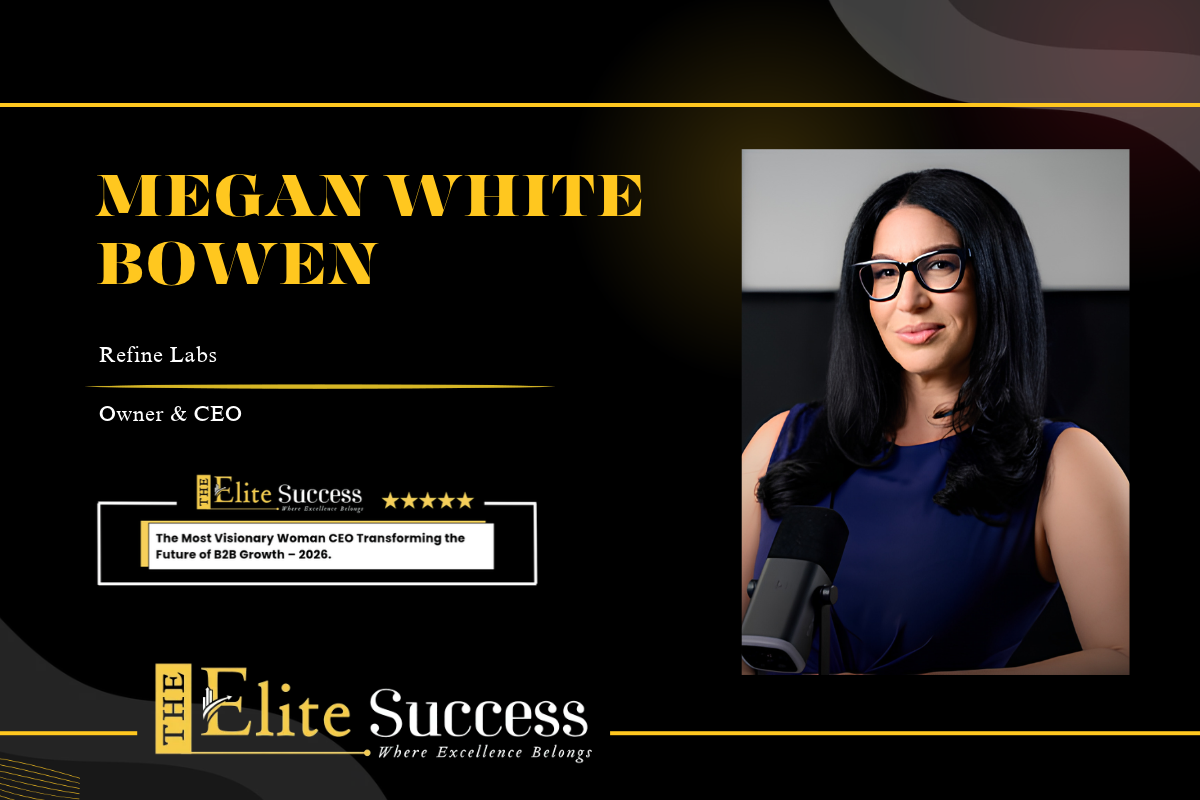
Megan White Bowen: The Woman Redefining How B2B Growth Works
A journey challenging fragmented strategies and building a more connected model for what comes next.
Intro:
There is a peculiar comfort in a number.
A lead count can look impressive. A conversion rate can look reassuring. A dashboard can turn weeks of marketing activity into percentages and charts. But measurement alone does not mean a business understands what is happening.
Megan White Bowen has spent much of her career questioning that assumption.
As Owner and CEO of Refine Labs, Megan helps B2B companies look beyond marketing activity and understand the larger system producing growth. A business can generate thousands of leads and still struggle to create meaningful revenue. Marketing can hit its targets while sales misses theirs. Acquisition can be efficient while retention and expansion remain weak.
The problem may not be the next campaign. It may be the system behind it.
Megan’s approach comes from more than two decades across customer success, revenue, operations, growth, acquisitions and leadership. Her philosophy is practical: understand the business from the customer backward, identify the constraint, and give capable people the clarity and autonomy to solve it.
Looking at Business from the Customer Backward
Megan’s career began in customer-facing roles across support, account management and customer success before moving into broader revenue and operating responsibilities.
At eChalk, Zocdoc, Grubhub/Seamless, Managed by Q, and Platterz, she experienced businesses at different stages of growth and from different operational perspectives. At Zocdoc, she helped build an early post-sale function. At Grubhub, she helped build and lead account management during a significant period of growth. At Managed by Q, she led revenue and customer teams and eventually became COO.
The common thread was the customer.
“I had spent a lot of time looking at businesses from the customer backward,” Megan says.
By the time she joined Refine Labs in 2020, she had repeatedly seen marketing, sales and customer teams working hard toward different definitions of success. Refine Labs gave her an opportunity to challenge that fragmentation.
Challenging the Rules Everyone Had Stopped Questioning
Refine Labs gained momentum by addressing a problem many B2B marketers recognised: companies were generating large numbers of leads without always understanding their contribution to pipeline or revenue.
The company questioned conventional thinking around demand generation, attribution, buyer behaviour and measurement. Instead of treating lead generation as the end goal, it asked what happened after conversion.
Was the lead valuable? Did sales want it? Did it contribute to pipeline? Did the experience promised before the sale match the experience delivered afterwards?
Refine Labs also shared its thinking openly through content, research, podcasts, events and community. Prospective clients could understand how the company approached problems before entering a sales conversation.
For Megan, thought leadership works best when it comes from experience rather than performance.
From Demand Generation to a Complete Growth System
Markets change, and Megan does not believe Refine Labs should remain attached to the ideas that made it successful five years ago.
Buyer behaviour, technology and economic conditions have changed. AI is also giving buyers more ways to research companies, compare alternatives and form opinions before speaking with sales.
Refine Labs has therefore expanded beyond demand generation into strategy, paid media, creative, analytics and measurement, positioning, customer growth and broader go-to-market challenges.
At the centre of that evolution is its Brand. Demand. Expand. approach.
Brand is how a company is understood, trusted and preferred.
Demand is how it creates and captures buying intent and turns that intent into qualified pipeline and revenue.
Expand focuses on the customers already earned through retention, advocacy, cross-sell and expansion.
For Megan, these are not separate marketing activities. They are connected parts of one growth system.
The question is not simply how to acquire another customer. It is how the business creates and compounds value across the customer journey.
Find the Constraint Before You Fix the Channel
After working across more than 300 B2B organisations, Refine Labs developed extensive pattern recognition.
Megan had seen companies increase acquisition investment when the real problem was positioning. She had seen teams optimise campaigns when measurement was the deeper issue. She had also seen strong demand generation coexist with weaker brand or customer expansion.
The Marketing Maturity Model was developed to make those observations actionable.
Its foundation is practitioner experience. Refine Labs combines the pattern recognition of experienced marketers and strategists with its research, methodology and data. AI then helps practitioners interpret those inputs, surface patterns and reach stronger recommendations faster.
That distinction matters.
The model is not designed to replace the person making the recommendation. It helps experienced practitioners work through more information, identify relevant patterns and make their intelligence more accessible and scalable.
The objective is not simply to receive a score. It is to understand where growth is getting stuck and what deserves attention next.
Since its Q3 launch, the sales team identified eight inbound opportunities where the Marketing Maturity Model played a role in the buying conversation. Four had closed and four remained in the advanced pipeline. The closed opportunities moved through the sales process in 30 days or less, compared with a historical average of approximately 85 days, while the recurring wins represented more than $1 million in annualised revenue.
Megan is careful not to attribute those outcomes solely to the model.
“I wouldn’t say the Marketing Maturity Model caused those outcomes,” she explains.
What matters is how it changes the starting point of the conversation. Instead of immediately discussing a channel or service, Refine Labs can begin with the client’s business, maturity, gaps and likely constraints.
The technology supports that process. Practitioner judgment remains central to it.
When More Data Creates Less Certainty
Modern marketers have access to more information than ever. That can create its own problem: false certainty.
“Not everything that’s measurable is important, and not everything that’s important is perfectly measurable.”
A B2B buyer may discover a company through someone they follow, consume its content for months, ask peers for recommendations, listen to a podcast, use AI to research alternatives, visit review sites and only later request a demo.
A last-click report can identify the final interaction without explaining everything that influenced the decision.
Megan therefore advocates combining attribution and performance data with customer research, self-reported attribution, CRM information, qualitative insight and actual revenue outcomes.
Technology can help practitioners bring these inputs together and identify patterns, but more data does not automatically produce better decisions. Experienced marketers still need to determine what matters, what is missing and what the business should do next.
Find the Problem Before You Find the Tactic
There are more channels, tools, data sources, AI applications and content formats than ever.
That abundance can become a distraction.
Megan has seen strong marketers, salespeople and products struggle because teams were working toward different goals. Her answer is to clarify the business problem before choosing the tactic.
Perhaps there is no lead problem.
Perhaps the issue is positioning. Perhaps demand exists but is not converting. Perhaps acquisition is healthy while retention is weak. Or perhaps teams simply disagree on what success means.
“Stop chasing tactics. Understand the constraint first.”
The same principle shapes Refine Labs’ culture. Employees are given clarity around outcomes and autonomy over how to achieve them. Megan wants people to challenge assumptions, including her own.
Autonomy comes with accountability. People own outcomes, problems should be raised early, and failure should be understood rather than hidden.
For Megan, innovation comes from curious people who understand customers, understand the problem and have enough room to question how the work is being done.
Building People Who Can Build the Business
“People Success = Customer Success = Company Success.”
The phrase captures Megan’s leadership philosophy.
If people lack clarity, context, support and accountability, consistent performance becomes difficult. Customers eventually experience the consequences, and the business follows.
Megan does not see leadership as making every decision herself. Her responsibility is to create the conditions in which capable people can make good decisions.
She applies the same principle to clients.
Refine Labs should not create dependency. Clients should understand the strategy, know why decisions are being made and become more capable through the engagement.
Knowledge transfer is therefore part of the value.
The Leadership Skill Megan Learned by Letting Go
Over more than 20 years, Megan’s understanding of leadership has changed.
Earlier in her career, she believed strong leadership meant having the answer. Now she is more comfortable not knowing.
Complex problems rarely have obvious answers. What matters is asking the right questions, listening to people who know more, making a decision and adjusting when new information appears.
That evolution has also been personal. Megan acknowledges being a people pleaser, tying too much of her identity to work and pushing herself hard. Becoming a better leader has meant gaining greater clarity around what she values, what she needs and what she can let go.
“Hold on tightly, let go lightly.”
Know what matters. Let go of the rest.
A Voice Built on Experience
Megan does not spend much time thinking about her personal brand. She thinks about whether she is being useful.
Her perspective comes from building teams, working with customers, navigating growth, managing acquisitions, making mistakes and trying to build better companies.
That experience influences what she chooses to share. She is less interested in ideas that sound impressive in theory than in whether they work inside a real company with real customers, budgets, people and competing priorities.
Refine Labs was built partly on that principle. The company shared what it was seeing, testing and learning through content, research, podcasts, events and community.
For Megan, sharing creates conversation, and disagreement can be as valuable as agreement.
What Comes After the Playbook
As Refine Labs looks toward 2027, Megan sees the company becoming a more complete growth partner built around Brand. Demand. Expand.
That evolution reflects a changing buyer. AI is helping people research companies, understand categories, compare alternatives and form opinions before speaking with sales.
Marketing has to respond to that independence.
The Marketing Maturity Model is part of that future. Years of practitioner experience across hundreds of B2B organisations can be combined with research, data, methodology, technology and AI to make that intelligence more accessible and actionable.
But Megan does not see technology replacing expertise.
A strategist understands context. A creative professional understands nuance. A media buyer recognises meaningful signals. An analyst knows which questions to ask when the numbers do not tell the whole story.
AI can help each of them move faster. It can accelerate research, surface patterns, reduce manual work and connect information across larger datasets. What it cannot replace is the judgment developed through experience.
That is the opportunity Megan sees: technology strengthening expertise rather than substituting for it.
Building a Company Worth Growing
There is a temptation to measure a CEO’s legacy through revenue, growth rates or market position.
Megan’s definition is broader.
She wants Refine Labs to become a place where talented people can do some of the best work of their careers and become better leaders along the way.
Her leadership philosophy remains consistent: understand the business, know the financials, spend time with customers and understand how sales, marketing, customer success, finance and operations connect.
She also has a direct message for women pursuing executive leadership:
Advocate for yourself.
Hard work does not always automatically create opportunity. Sometimes you have to ask. Sometimes you have to leave an environment that does not recognise what you can contribute.
The objective is to keep learning, do meaningful work and create impact.
Growth is Not a Channel. It is a System
The story of Megan White Bowen and Refine Labs is not about replacing one marketing tactic with another. It is about asking better questions before choosing one.
What is the actual constraint? Where is growth getting stuck? What does the buyer experience really look like? Are the people responsible for growth working toward the same outcome?
Those questions have followed Megan from customer-facing roles to revenue leadership, COO and now CEO.
As Refine Labs enters its next chapter, she is not interested in simply repeating what worked before.
The ambition is to build better intelligence, develop better practitioners, give clients better answers and use technology to help experienced people get there faster.
“If we build great people, those people do great work for customers. When our customers succeed, our company succeeds.”
People success. Customer success. Company success.
A connected system.