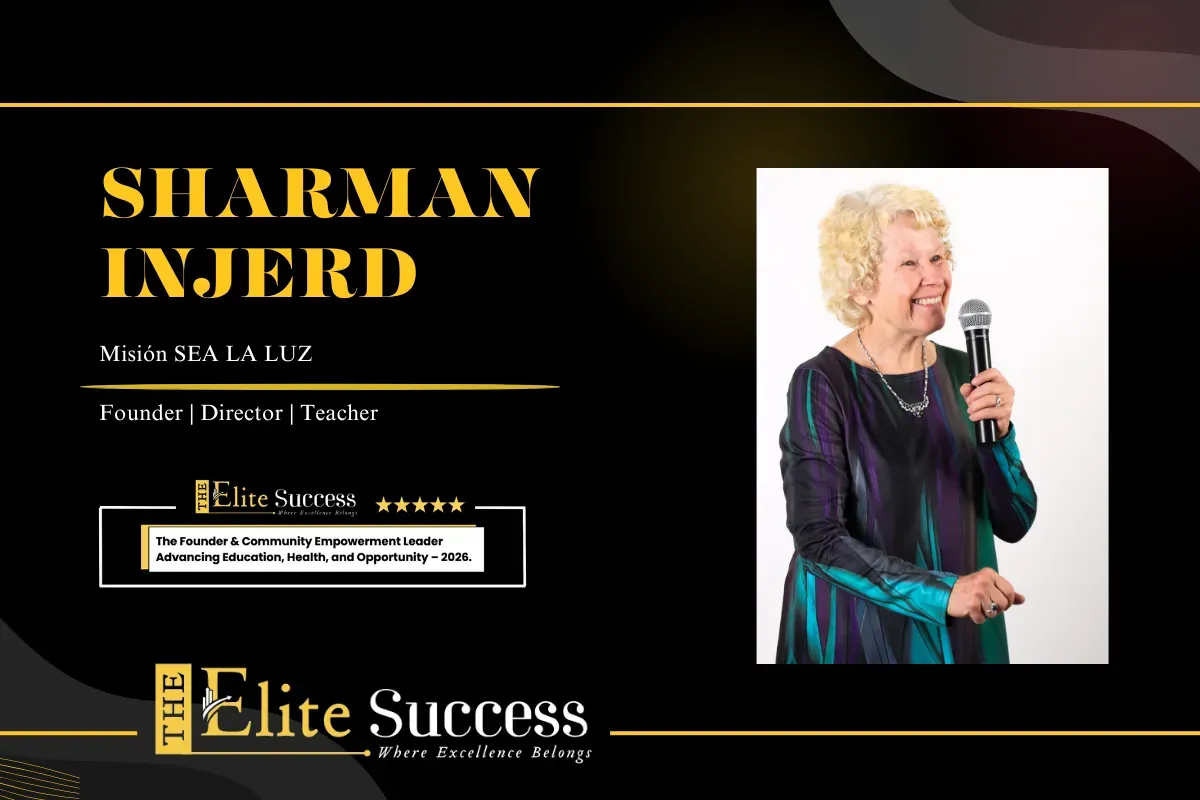
Sharman Injerd: Redefining Education Access Through Community-Centred Leadership
Why do so many education systems still struggle to reach rural
and indigenous communities even after years of reform and
investment? In many regions, children still face limited access to
quality learning, weak foundations in core subjects, and teaching
methods that do not reflect local realities. Policy often moves
faster than implementation, and classrooms continue to reflect
deep inequality. These challenges call for leaders who can build
practical models that adapt to community needs and deliver
consistent learning outcomes on the ground.
Sharman Injerd, Founder, Director, and Educator of Misión
SEA LA LUZ, leads one such model through her work in rural
education. She focuses on building learning systems that serve
underserved communities through a structured, faith-based, and
community-driven approach. Her work connects academic
learning with local culture and daily life while aiming to strengthen
both educational access and long-term student development.
For her continued contribution to education and community
empowerment, she is being featured as “The Founder &
Community Empowerment Leader Advancing Education, Health,
and Opportunity – 2026” in the new edition of Elite Success
Magazine.
Reframing Education Through Motherhood
Sharman built her journey on purpose from a very young age. At
the age of 10, she felt a strong calling to become a teacher and a
missionary. She held on to this vision and shaped her early path
around it. She stepped into the classroom, teaching and giving
her time to students with commitment and care. In the 1980s, life
took a new direction as she chose to focus on her family. She
supported her husband, who worked as a nuclear power plant
engineer and supervisor, and embraced motherhood with full
attention.
Motherhood changed the way she saw education. She did not
step away from her calling. Instead, she reshaped it. She became
part of a Washington State pilot program and helped demonstrate
that homeschooling could be a strong and valid form of education.
She played a key role in presenting this model to the State
Congress. Her work helped open doors for families who wanted a
different path for their children.
She created a service that helped evaluate students and guide
them toward the right curriculum. She also supported parents and
showed them how to teach with confidence. For more than 12
years, she administered the ITBS to around 500 students every
year. This experience gave her a deep understanding of how
children learn and how teaching methods can shape outcomes.
In 1998, her journey expanded beyond borders. She moved with
her family to Ecuador even though she had very little knowledge
of Spanish. She saw the reality of rural education and felt a strong
need to act. She did not wait. She started to work with what she
had. By 2003, she had founded a private primary school in the
high Andes. She served communities that lived in difficult
conditions, including descendants of former indigenous slaves.
She built the school step by step. She created teaching materials
every day and learned Spanish along the way. She started with
just 20 children. Over time, her work grew into something much
larger. She built not just a school but a strong foundation for
change. Today, as the Founder, Director, and teacher at Misión
SEA LA LUZ, she continues to guide, teach, and uplift
communities through education.
Hybrid Homeschool Approach for Accessibility
Misión SEA LA LUZ stands as a purpose-driven initiative shaped
by a clear vision and strong leadership from Sharman. The
organization focuses on expanding access to meaningful
education for underserved rural and indigenous communities. It
builds its work on faith-based values and a commitment to long-
term impact.
The organization adopts a hybrid homeschool model that brings
learning closer to the community. Small groups of students learn
in familiar environments such as homes. This approach creates
comfort and trust while strengthening community bonds. It also
allows families to take an active role in the education process.
Sharman encourages this involvement and sees it as essential for
lasting change.
Misión SEA LA LUZ has developed a complete Spanish language
curriculum that covers kindergarten through sixth grade. The
curriculum reflects a biblical worldview and follows strong
academic foundations. The content focuses on reading,
mathematics and science and builds essential skills step by step.
The organization also uses recorded lessons to reach remote
regions where consistent teaching support may not exist.
The mission extends across diverse regions, including Amazonian
and Andean communities. Sharman ensures that the organization
respects each culture it serves. The team does not impose
outside ideas. Instead, it listens and learns from the community.
This approach builds trust and protects cultural identity. Education
becomes a tool for growth without loss of heritage.
Misión SEA LA LUZ integrates academic learning with spiritual
development. It helps students understand their identity and
purpose while gaining knowledge. This balanced approach
prepares them for both personal and social progress.
Engagement With Policy and Leadership Forums
Sharman anchors both the vision and daily execution of the
organization, ensuring that purpose and impact remain central to
every initiative. Her work begins with shaping learning direction,
where she designs educational curricula grounded in real
community needs. She also refines assessment systems so they
adapt to different cultural contexts and learning levels.
A significant part of her role focuses on people development.
Local educators are identified through community networks and
prepared to step into teaching roles with confidence. Parents and
community members receive structured training, supported
through hands-on guidance and continuous mentorship. She
reinforces alignment with the organization’s mission by
maintaining consistent engagement and feedback loops.
In establishing new learning centers, she works directly with
community leaders to build trust and ensure local ownership.
Student progress is tracked through regular evaluations,
supported by digital tools that help maintain continuity across
locations. She also conducts on-site visits to mentor educators
and demonstrate effective teaching practices in real time.
Beyond field operations, Sharman, with her daughter Kjersti,
established a World-Class life and business coaching team aimed
at policymakers and national stakeholders. Through these
engagements they come alongside leaders to draw-out innate
abilities and divine understanding to succeed in their personal
lives and occupations. The results of these coaching interactions
grant broader awareness and conversations for education reform.
Adapting to Remote and Multicultural Environments
Building Misión SEA LA LUZ in Ecuador required Sharman to
operate within some of the most complex conditions in global
education. She entered a new cultural and linguistic environment
where adaptation was not optional but constant, and where
remote high-altitude communities faced entrenched poverty and
limited infrastructure. Establishing continuity in such settings
demanded resilience and long-term commitment.
The work also exposed deep structural gaps in the education
system. With an underperforming national curriculum, she took on
the responsibility of developing original learning materials aligned
with real developmental needs. At the same time, she navigated
institutional resistance from authorities who often perceived
independent success as a challenge to existing public
frameworks, requiring steady execution amid shifting policy
environments.
Her engagement with indigenous communities added another
layer of complexity. Each community carried distinct traditions,
expectations, and learning styles, requiring a highly adaptive
approach to build trust and ensure meaningful educational
delivery. This commitment to inclusion extended further with the
integration of autistic learners, which necessitated new
instructional methods and continuous capacity-building within her
team.
Purpose Driven Approach to Education
Sharman leads Misión SEA LA LUZ with a grounded, purpose-
driven vision that integrates faith, identity, and educational
purpose into a unified leadership approach. Her philosophy is
anchored in the belief that every individual carries an inherent
purpose, and that this purpose unfolds through spiritual guidance
and intentional action. This conviction directs the way she leads,
decides, and builds.
Her approach to education prioritizes foundational academic
strength, particularly in reading and mathematics, while also
emphasizing moral development and spiritual awareness as
essential dimensions of learning. In her model, education is not
limited to knowledge acquisition but extends to character
formation and inner growth.
Cultural respect remains central to her leadership ethos. Rather
than replacing or reshaping local identity, she positions education
as a means of strengthening it. Her work supports communities in
preserving their traditions while expanding their capacity for
growth, ensuring that learning reinforces rather than displaces
cultural roots.
She maintains a strong sense of direction, guided by the belief
that purpose-driven action can transform perceived limitations.
Through Misión SEA LA LUZ, she cultivates an environment
where individuals are encouraged to grow in faith, develop
knowledge, and gain a deeper understanding of their personal
calling and potential.
Native Language Based Teaching Approach
At Misión SEA LA LUZ, Sharman develops teams through a
community-anchored, decentralized model that puts local
ownership first and supports long-term sustainability. Her
approach integrates educators directly from within the
communities they serve, often engaging parents as active
contributors to the learning process. These educators are then
immersed in intensive training at the organization’s central school
in the small community of Tambo, where instructional capacity
and pedagogical alignment are strengthened.
Her classroom model is intentionally small-scale and relationship-
driven, with each teacher guiding groups of no more than six
students. Instruction is delivered in native languages to ensure
comprehension and cultural resonance. Spanish language
resources are used for academic access and linguistic
development. This dual-language approach reinforces both clarity
of learning and cultural continuity. It also ensures that the
indigenous are educationally equipped to defend their
communities and hertiage.
Mentorship is sustained through a structured system of
engagement that includes periodic site visits, continuous digital
communication, and real-time review of student progress. Rather
than operating as a top-down oversight mechanism, this
framework builds local teaching capacity and encourages
ownership at the community level. It also ensures that educational
delivery remains closely aligned with evolving learner needs.
A culture of continuous feedback underpins the entire system.
Teachers are supported in refining their methods through ongoing
dialogue, while stronger connections between educators, families,
and leadership reinforce trust and shared accountability. This
integrated approach positions mentorship as a core driver of
instructional quality and community cohesion.
Expanding Access to Rural Education
Sharman has positioned Misión SEA LA LUZ as a purpose-driven
initiative focused on transforming education access in
underserved rural and indigenous communities. The organization
reflects a sustained commitment to expanding meaningful
learning opportunities where structural barriers have historically
limited progress.
Under her leadership, the initiative has supported students from
highly marginalized backgrounds in reaching and succeeding in
university education. These learners often continue their studies
with strong academic independence, many self-financing their
education while demonstrating resilience, discipline, and long-
term ambition. Their progression reflects both individual
transformation and the strength of the educational foundation they
receive.
The impact of Misión SEA LA LUZ extends beyond academic
outcomes. Communities connected to the program experience
broader social upliftment, including improved cohesion and
financial prosperity due to diligence and a higher work ethic.
Sharman’s earlier experience in the United States, particularly in
alternative education and homeschooling frameworks, contributes
to the adaptability of the model. Her background in curriculum
development and standardized assessment further strengthens
the system’s ability to respond to diverse learning needs with
structure and flexibility.
Through continuous refinement of curricula and learning
frameworks, Sharman has helped shape Misión SEA LA LUZ into
a scalable and evolving education model. Its growth reflects a
sustained focus on outcomes that extend beyond classrooms,
strengthening both individual trajectories and community
potential.
Promoting Literacy and Numeracy Excellence
At Misión SEA LA LUZ, Sharman drives long-term educational
transformation by strengthening systems that improve learning
outcomes and support human development in a sustained way.
Her work consistently centers on building pathways for
foundational learning while advancing broader educational reform.
Looking ahead, she envisions Misión SEA LA LUZ evolving as a
catalyst for systemic improvement in education. Her focus
remains on influencing decision-makers and strengthening
leadership capacity across contexts where access and quality
remain uneven. She continues to advocate for education models
grounded in strong literacy and numeracy foundations, supported
by practical understanding and real-world application.
Her guidance to educators and emerging leaders emphasizes
clarity of purpose and disciplined practice. She reinforces the
importance of foundational skills and ethical responsibility in
shaping learners who think critically and act with intention. In her
view, education must resist distraction from superficial priorities
and remain anchored in meaningful development.
Sharman consistently frames education as the integrated
development of character and intellect. She encourages
continuous learning, disciplined execution, and accountability in
leadership. Through this lens, she positions Misión SEA LA LUZ
as both an educational initiative and a long-term platform for
societal development.
Her approach to leadership also extends into building strategic
partnerships that expand access to learning resources and
strengthen teacher development. She supports collaborative
models that prioritize integrity, discipline, and sustainable thinking,
ensuring that educational progress remains steady and scalable.
Shaping Long Term Social and Academic Impact
Sharman Injerd’s legacy is defined through her work with Misión
SEA LA LUZ, where she leads with clarity of purpose and a
sustained commitment to educational transformation in
underserved communities. Her leadership centers on building
systems that connect learning with dignity, opportunity, and long-
term community development.
She has established a faith-informed education model that
empowers children, families, and teachers while reinforcing
cultural identity and local values. Rather than replacing
community foundations, her approach strengthens them,
equipping individuals with the skills and confidence needed for
self-reliance and leadership skills.
Her influence extends into leadership development, where she
mentors emerging leaders and helps shape structures designed
to endure across generations. Through this work, she contributes
to building educational systems that are not dependent on
individuals alone but capable of continuing and evolving within
communities over time.
Sharman’s legacy is also reflected in the trust she builds through
consistent action and a clear, steady vision. Misión SEA LA LUZ
stands as an expression of her broader philosophy that education
can serve as a pathway to both personal transformation and
collective advancement.
Across the communities she serves, her impact continues to
expand as individuals carry forward the values and principles
embedded in the mission. Through education, leadership, and
faith-driven purpose, her work continues to shape long-term
change that extends beyond immediate outcomes into future
generations.
To connect with the non-profit foundation Misión SEA LA LUZ,
please contact: misionsealaluz@sealaluz.org
For more information about the life-changing coaching package of
Revelation Coaching, please contact: coaching@sealaluz.net