How Roberto Tribuno is Redefining Healthcare Real Estate Through Innovation, Investment and Human-Centered Senior Living
In a rapidly aging Europe, the future of healthcare is being shaped not only by medicine and technology, but also by the environments in which people live, recover, receive assistance, and grow older. As demographic change accelerates demand for specialized care, the healthcare real estate sector faces a defining challenge: how can the industry create financially sustainable, technically advanced and socially meaningful spaces that genuinely improve people’s quality of life?
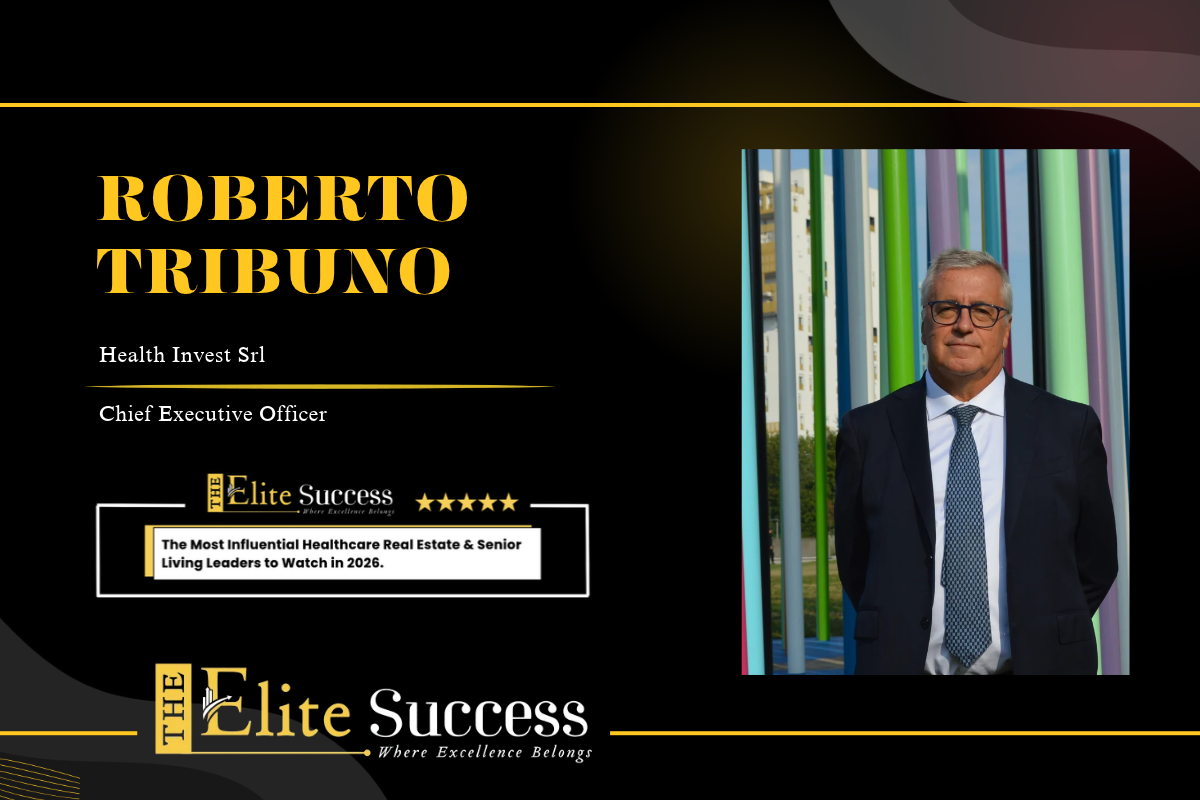
Roberto Tribuno, Chief Executive of Health Invest Srl and Rodevita Spa, has spent more than two decades working at the intersection of healthcare, finance, real estate and social welfare. His career has given him an unusually broad perspective on an industry where bricks and mortar cannot be separated from the people they are designed to serve.
Through Health Invest and Rodevita, Roberto Tribuno has developed a vision that goes beyond traditional real estate development. His approach integrates financial strategy, investment, technical expertise, architectural planning, healthcare management and social responsibility into one long-term model.
For Roberto Tribuno, a healthcare facility is never simply a building. It is a living environment, a service ecosystem and, ultimately, a place designed around human needs.
From Healthcare Experience to an Integrated Real Estate Vision
The origins of Rodevita and Health Invest can be traced to Roberto Tribuno’s extensive experience in the health and social-health sector. After developing expertise in the development and management of healthcare facilities, he recognized an opportunity to apply his entrepreneurial, financial and managerial knowledge to a specialized area of real estate.
Rodevita was founded in 2017, followed by Health Invest in 2018, as the natural evolution of this professional journey. The companies were conceived around a complementary model in which healthcare expertise and real estate development could work together rather than operate in isolation.
The opportunity was clear. Europe, and Italy in particular, is experiencing profound demographic transformation. An aging population is increasing demand for qualified care, while much of the existing housing stock requires modernization. At the same time, older people are increasingly looking for alternatives to traditional institutional care.
Rodevita focuses on three principal areas: Residential Healthcare Facilities, Rehabilitation Clinics and Senior Housing. The objective is not simply to increase the number of available facilities, but to create projects that combine economic sustainability, architectural quality and a strong focus on the individual.
Health Invest, meanwhile, works across the broader socio-health real estate development process, providing strategic consulting, M&A support, research and opportunity analysis, design, development and implementation of healthcare and social-health facilities. Rodevita concentrates more specifically on the real estate and financial side, from identifying opportunities to structuring investment operations.
Together, the businesses reflect Roberto Tribuno’s belief that successful healthcare real estate requires an integrated understanding of both capital and care.
Understanding That Healthcare Real Estate Is Different
One of the earliest challenges Roberto Tribuno encountered was convincing stakeholders that social-health real estate cannot be approached like conventional property development.
A healthcare or residential care facility is a complex service-production environment. It must satisfy strict health, technical, organizational and regulatory requirements while simultaneously responding to the needs of patients, residents, families, employees, healthcare professionals, investors and institutions.
The complexity begins long before construction. Finding appropriate properties, navigating authorizations, assessing urban and technical feasibility, developing financially sustainable investment structures and managing construction projects all require specialized knowledge.
Senior Housing presents an additional challenge—one that is cultural as much as commercial.
In Italy, remaining in one’s own home remains deeply rooted in the mindset of older generations. Moving into a different environment can therefore be perceived as a loss of independence. Roberto Tribuno believes the answer is not to challenge this desire for autonomy, but to design housing models that reinforce it.
Modern Senior Housing can provide independent apartments, security, shared services, socialization opportunities and technological support while allowing residents to retain a strong sense of personal freedom.
This represents a fundamental shift from viewing senior living primarily through the lens of assistance to understanding it as a broader quality-of-life proposition.
The Experience That Shaped the Entrepreneur
A defining milestone in Roberto Tribuno Tribuno’s career came in 2003, when he joined Orpea Group and subsequently assumed responsibility for strategy, development and management of Italian and international activities.
The experience exposed him to the inner workings of a major international organization and provided direct experience in acquisitions, real estate development, corporate organization and operational management.
It also taught him that healthcare cannot be understood exclusively through financial or property metrics.
Managing healthcare organizations requires constant interaction with staff, residents, families, institutions, investors and suppliers, each with different expectations and priorities. The ability to harmonize these interests became one of the most important lessons of Roberto Tribuno’s career.
His earlier experience in auditing, international consulting, taxation, corporate governance and finance had already developed his analytical and financial perspective. His work through Bridge Kennedy International and Euro BKI further exposed him to different economic, tax and corporate systems.
Together, these experiences created the multidisciplinary foundation behind his current leadership philosophy.
Roberto Tribuno does not believe that one international model can simply be transferred from one market to another. Every country has its own regulatory framework, culture, demographics and social expectations.
His approach is therefore to combine international best practices with detailed knowledge of local markets.
A New Generation of Healthcare Real Estate
Roberto Tribuno sees the healthcare real estate sector entering a period of significant transformation.
Demographic aging is increasing demand for care, but at the same time, healthcare operators and investors are facing pressure around costs, qualified personnel, operational efficiency and long-term financial sustainability.
The solution, in his view, must be multidisciplinary.
Facilities need to become more efficient. Technology must be integrated intelligently. Service organizations need to evolve. Existing buildings need to be upgraded, while new housing models must emerge to address different stages of aging.
One of the most important opportunities lies between independent living at home and traditional residential care.
Senior Housing can serve people who remain autonomous but want greater security, accessibility, services and social interaction. This intermediate model could become increasingly important as longevity changes the way society thinks about housing.
Roberto Tribuno believes that real estate will need to accompany people through different stages of life, rather than offering only a limited choice between private housing and institutional care.
Technology With a Human Purpose
Data and technology are becoming increasingly important throughout the healthcare real estate lifecycle.
At the earliest stage of a project, demographic, territorial and economic data can help developers understand demand, identify opportunities and assess investment feasibility. During design and construction, digital technologies can improve coordination among professionals, optimize spaces and construction techniques, control costs and identify potential issues earlier.
Once a building becomes operational, home automation and monitoring systems can improve energy efficiency, safety and comfort.
In Senior Housing, technology can be particularly valuable in supporting independence.
Yet Roberto Tribuno emphasizes an important principle: technology should remain at the service of people.
Digital systems should not replace human relationships. Instead, they should make services safer, more efficient and more responsive, allowing people to focus on what technology cannot replicate the human dimension of care.
Building Projects Around People and Performance
Property selection is another area where Roberto Tribuno’s integrated methodology becomes particularly important.
A potential site cannot be judged simply by its price or physical characteristics. Health Invest and Rodevita consider location, accessibility, proximity to services, demographic characteristics, potential demand and the overall needs of the surrounding territory.
Urban, technical and economic feasibility are then evaluated, including the possibility of constructing or converting an existing building.
Financial sustainability remains critical. The total cost of development must be compatible with expected revenues and the intended management model.
But the assessment does not end with financial calculations.
The quality of life of future residents must also be considered. Factors such as natural light, accessibility, spatial adequacy and the ability to maintain connections with the surrounding community can significantly influence the success of a project.
This is where Roberto Tribuno’s multidisciplinary approach becomes particularly valuable: the investment, building, operational and human dimensions are considered simultaneously.
Projects That Turn Vision Into Reality
Among Roberto Tribuno Tribuno’s most significant projects is the Rodevita San Celso RSA in Milan’s San Siro district, a development that demanded precise urban planning, financial structuring and technical expertise during a period of rising construction costs. Through strong coordination among the professionals involved, the project successfully balanced complexity, quality and long-term sustainability. Its achievement of LEED Gold certification reflects Roberto Tribuno’s commitment to modern design and environmental responsibility.
Another major initiative is the transformation of the former Alitalia headquarters in Milan Sesto into a self-sufficient elderly facility, supporting the expansion of the Rodevita Home Senior Housing chain. Both projects demonstrate Roberto Tribuno’s belief that successful healthcare real estate depends on collaboration, shared objectives and disciplined execution. By bringing together investment, technical knowledge, management expertise and social purpose, he continues to develop healthcare environments designed not only for operational efficiency, but for dignity, independence and quality of life.
Leadership Built on Transparency and Accountability
Roberto Tribuno Tribuno’s leadership philosophy has been shaped by decades of experience across finance, auditing, taxation, corporate governance, healthcare and real estate. At its core are three principles: transparency, accountability and collaboration. His economic background and consulting experience strengthened his analytical approach, while international leadership roles developed his strategic and decision-making capabilities.
For Roberto Tribuno, leadership is not about making decisions from the top; it is about creating an environment where people can contribute their expertise, understand shared objectives and take responsibility for outcomes. This philosophy is reflected in Rodevita’s multidisciplinary approach, bringing together financial, technical, architectural, managerial and commercial professionals.
He also views continuous learning as essential to progress. Engagement with international operators, investors and industry experts provides opportunities to exchange perspectives, challenge established thinking and identify new possibilities. For Roberto Tribuno, innovation is not a single breakthrough—it is a continuous process embedded throughout every stage, from conception and design to construction and management.
The Balance Between Return and Responsibility
One of the most important questions facing healthcare real estate is how to reconcile investment returns with social responsibility.
Roberto Tribuno rejects the idea that these objectives must necessarily conflict.
Economic sustainability is essential to maintaining quality services and ensuring continuity of care. At the same time, an investment that ignores the needs of the people who occupy a facility risks failing in its social purpose.
The answer lies in careful financial planning, efficient design and appropriate operating models.
Private capital, he believes, can play an increasingly important role in meeting Europe’s growing demand for healthcare and social-care infrastructure. Public resources alone are unlikely to address every future need.
Private investment can help finance new facilities and regenerate existing assets, particularly in urban areas where infrastructure and services are already available.
But this opportunity must be accompanied by social responsibility and effective public-private collaboration.
Partnerships as a Foundation for Long-Term Success
Complex healthcare projects rarely succeed through the efforts of one organization alone.
Investors, healthcare operators, developers, architects, technical professionals and institutions all bring different capabilities and expectations.
For Roberto Tribuno, the first requirement for a successful partnership is a shared goal.
Partners must be selected not only according to financial strength, but also according to their technical, managerial and organizational capabilities. Roles, responsibilities and objectives must be transparent from the beginning.
Equally important is maintaining dialogue throughout the entire lifecycle of a project.
The objective is not simply to complete a transaction. It is to create an initiative capable of generating economic and social value over time.
This philosophy also informs Roberto Tribuno’s approach to M&A and strategic investments. Market conditions, property quality, operator strength, business models and financial sustainability all matter, but organizational and strategic considerations can be equally decisive.
A technically excellent property can underperform without a capable operator. Conversely, strong partnerships can unlock the potential of an otherwise complex opportunity.
A Personal Brand Built on Integration
After decades across multiple professional environments and international markets, Roberto Tribuno’s identity has become closely associated with integration.
He sees himself as an entrepreneur and professional capable of connecting finance, real estate and personal assistance within a single vision.
Rather than focusing on one stage of a property’s lifecycle, his approach considers the entire journey—from investment analysis and design to construction, management and long-term performance.
His international network, professional relationships, conferences and industry engagements have also allowed him to contribute to discussions surrounding the future of healthcare real estate and senior living.
For Roberto Tribuno, sharing knowledge is essential to advancing the sector. The aging population is not simply a demographic statistic; it is a transformation that requires new thinking about housing, care, investment and urban development.
Looking Ahead: Designing for Longevity
Over the next five to ten years, Roberto Tribuno expects healthcare real estate to undergo profound change.
The growth of intermediate housing solutions, the expansion of Senior Housing, greater integration of healthcare and residential services, digital technologies, new financial models and stronger public-private partnerships are likely to reshape the sector.
But beneath these changes lies a larger transformation: people are living longer.
Longevity is redefining the relationship between housing, healthcare and quality of life.
Roberto Tribuno’s ambition through Health Invest and Rodevita is therefore not simply to build more facilities. It is to contribute to a business model demonstrating that economic development, innovation and social responsibility can coexist.
His particular focus on Senior Housing reflects a belief that older people should have more choices—choices that provide security without sacrificing independence, community without sacrificing privacy, and support without sacrificing dignity.
A Legacy Beyond Real Estate
Ultimately, Roberto Tribuno Tribuno’s vision extends beyond buildings, investment structures and corporate growth.
He wants to demonstrate that healthcare real estate can become a powerful instrument for social progress when financial discipline and human-centered thinking are brought together.
His career—from auditing and international consulting to Orpea, from the creation of Rodevita and Health Invest to complex healthcare and Senior Housing developments—has consistently moved toward the same principle: sustainable value is created when different worlds are connected.
The future of senior living will require more than additional beds or new buildings. It will require environments that understand the changing expectations of older people, technologies that support rather than replace human interaction, investors willing to take a long-term view, operators capable of delivering quality services, and institutions prepared to work collaboratively with private expertise.
Roberto Tribuno’s leadership sits at this intersection.
His legacy, ultimately, may not be measured solely by the projects completed or investments structured, but by whether those projects help redefine what aging can look like.
Through Health Invest and Rodevita, he is pursuing a future in which healthcare real estate is not simply about property—but about creating places where people can live with greater security, independence, dignity and quality of life.
That is the real opportunity behind the transformation of healthcare real estate: to build not only for an aging population, but for a better experience of longevity itself.