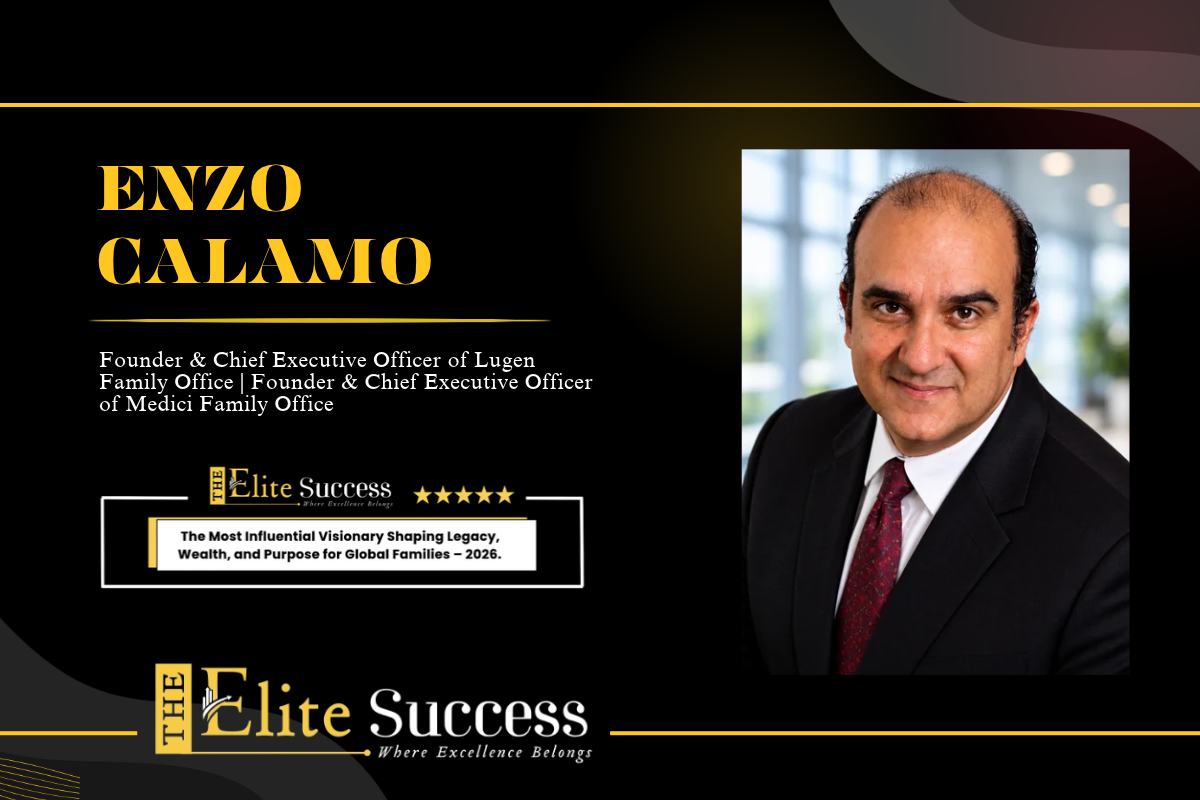
Enzo Calamo: A Visionary Approach to Wealth, Legacy, and Purpose
Wealth can secure a future. But can it prepare a family to live that future well?
For families whose fortunes span businesses, investments, real estate, natural resources, and generations, wealth management is rarely just about returns. The more consequential questions are often human: Who should lead next? What should the family preserve? What should it allow to change? How should the next generation be prepared for responsibility without being denied the freedom to create a life of its own?
These questions sit at the centre of the work of Enzo Calamo, Founder and CEO of Lugen Family Office and Founder and CEO of Medici Family Office.
His philosophy begins with a simple conviction: “Money can buy security, but it cannot buy a legacy.”
For Enzo, lasting legacy is built through relationships, shared values, responsible leadership, knowledge, and the ability to prepare people for what comes after the present generation. His work therefore looks beyond the conventional boundaries of wealth management, bringing together capital, governance, succession, education, philanthropy, family dynamics, and purpose.
Lugen Family Office and Medici Family Office reflect this philosophy in complementary ways.
Lugen is a values-based private family office focused on developing projects and strategic partnerships with institutions, other family offices, family businesses, and governments. It brings together people, capital, expertise, and relationships to create enduring value.
Medici Family Office works directly with affluent and ultra-high-net-worth families, helping them navigate legacy planning, family governance, business and ownership succession, wealth strategy, next-generation preparation, and philanthropy.
The distinction is important. Lugen develops opportunities and strategic relationships, while Medici helps families understand how those opportunities, along with their wider wealth decisions, fit into the life they are trying to build.
At the heart of both is the same question:
What is the wealth ultimately for?
Beginning with the Family, Not the Product
Building a family-office practice comes with challenges that are very different from those faced by conventional financial businesses.
One of Enzo’s earliest challenges was explaining what a family office actually does.
People readily understand investing, accounting, or legal advice as individual disciplines. The harder concept is the value created when those disciplines are brought together around a family’s long-term priorities.
The second challenge was trust.
Families do not share only balance sheets with their advisers. They may share concerns about their children, tensions around succession, uncertainty about a business, disagreements between generations, and fears about what life might look like after a founder steps away.
That information demands more than technical competence.
It requires discretion, consistency, patience, and the willingness to listen before advising.
“The family comes first” is the principle that underpins Enzo’s approach. Specialists are brought in where necessary, but their work remains aligned around the family’s broader objectives. Ultimately, he measures the quality of a strategy by a straightforward standard: does the family understand it, own it, and have the ability to sustain it?
That philosophy also changes how he thinks about disagreement.
A founder may see wealth as the product of sacrifice and security. A younger family member may see the same wealth as an opportunity for entrepreneurship, philanthropy, independence, or a completely different life.
Neither perspective is necessarily wrong.
The objective is not to make every family member think alike. It is to establish shared principles while allowing people to make different choices.
From Success to Significance
The turning point in the development of Lugen and Medici was clarity.
Once Enzo could articulate what the organisations stood for, everything became easier to communicate.
Their purpose was not simply to protect assets. It was to help families connect wealth with purpose and prepare themselves for the responsibility that accompanies it.
That philosophy became tangible through the Seven Generation Legacy Process™, Enzo’s proprietary framework for helping families think beyond immediate financial objectives.
It changes the questions families ask.
Instead of stopping at, “How do we protect our assets?” the conversation becomes:
What is this wealth for? Who will lead next? What do we want to carry forward?
Those questions move wealth planning into a different territory.
They turn a portfolio into a conversation about people.
They turn succession from an event into a process.
And they turn inheritance from a transfer of assets into a preparation for responsibility.
Enzo’s broader philosophy is captured in another defining idea: Moving From Success to Significance™.
Success represents what a family builds.
Significance represents what that success makes possible for others and for generations to come.
The Seven Generation Perspective
The Seven Generation Legacy Process™ rests on an intentionally ambitious premise: decisions made today may shape the lives of people a family will never meet.
No one can predict what the world will look like several generations from now. What families can do is create foundations strong enough to help future generations navigate it.
The process begins by redefining what wealth actually means.
Financial capital matters, but so do health, relationships, education, knowledge, faith or personal convictions, entrepreneurial ability, and purpose.
From there, the framework focuses on three qualities: resilience, relevance, and meaning.
Resilience is the ability to withstand change through financial preparedness, capable leadership, honest communication, and clear responsibilities.
Relevance means giving every generation permission to contribute something new rather than simply maintaining what it inherited.
Meaning means helping younger family members understand the work, values, and sacrifices behind inherited resources while still giving them the freedom to discover a purpose of their own.
It is not designed as a one-time succession document.
It is a living conversation that changes as families grow, circumstances shift, and new generations emerge.
As Enzo puts it, “Stewardship means taking responsibility for a future we may never see.”
That perspective captures the heart of his approach. A legacy should give future generations roots from which to draw strength, but also the freedom to determine where those roots lead them.
Wealth Requires More Than Financial Discipline
A purpose-driven approach does not mean abandoning financial rigour.
Quite the opposite.
Enzo’s investment philosophy begins with a practical question: What does the family need its capital to accomplish?
Income, flexibility, growth, business interests, and the ambitions of future generations all influence the answer.
From there, every asset needs to earn its place.
A commercial property may appear attractive on its own, but could create concentration risk if the family’s other assets are tied to the same economy, region, or financing environment. A natural-resource investment carries considerations around commodity prices, permits, environmental responsibilities, and operating teams. Private investments demand attention to management quality, governance, ownership, valuation, and eventual liquidity.
The whole balance sheet therefore has to be considered together.
Stress testing becomes equally important.
What happens if income falls? What if borrowing costs rise? What if a project is delayed?
Long-term investing only works when a family can remain resilient during difficult periods.
Purpose forms part of this analysis too. Does an opportunity align with the family’s values? Will the next generation want to own it? Will they be prepared to take responsibility for it?
Purpose, in Enzo’s philosophy, is never an excuse to ignore fundamentals. It is a reason to examine them more carefully.
Preparing People, Not Just Portfolios
Perhaps nowhere is Enzo’s philosophy more evident than in succession planning.
A founder may ask a seemingly straightforward question: How do I transfer my business to my children?
But the real answer may be far more complex.
One child might want to lead the company. Another might want to remain an owner without becoming an operator. A third might want an entirely different career.
All three choices can be legitimate.
A meaningful succession plan therefore needs to distinguish between beneficiary, owner, and leader. These roles may overlap, but one does not automatically qualify someone for another.
Potential successors need preparation through education, mentorship, real work, and gradually increasing responsibility. Leadership positions should have clear criteria. Families need agreed mechanisms for resolving disagreements. Founders, meanwhile, need to learn how to step back while ensuring their experience remains available without preventing successors from developing genuine authority.
Enzo believes this preparation should begin long before an inheritance takes place.
The warning commonly expressed as “shirtsleeves to shirtsleeves in three generations” is, in his view, not destiny. It is a reminder that wealth can be transferred faster than the ability to manage it.
The solution is preparation.
Young family members should understand how wealth was created, including the work, risk, sacrifice, and relationships behind it. They should learn practical financial concepts while also developing the ability to ask good questions, evaluate advice, and recognise what they do not know.
Most importantly, responsibility should be practised before it is inherited.
That might involve working outside the family business, leading a philanthropic initiative, or managing a defined business responsibility with mentorship and room to make smaller mistakes before the stakes become significant.
“Stewards are made, not born,” Enzo observes.
Keeping Relationships on the Balance Sheet
Financial capital is measurable. Relationships are not.
Yet Enzo believes families need to give relationships, values, knowledge, and purpose the same deliberate attention they give their investments.
His observation is telling: most families review their investments regularly, but few formally review their relationships.
Family meetings can address business and governance. Shared experiences, however, create the relationships that make those meetings productive. Values also need to be visible in behaviour.
If a family values fairness, its decisions should reflect transparency. If it values independence, younger members should have meaningful choices. If it values generosity, giving should involve the family rather than remain an abstract financial allocation.
Knowledge requires similar intentionality.
Founders can record the reasoning behind major decisions, including their mistakes. That information may never appear on a financial statement, yet it could become one of the family’s most valuable assets.
Enzo encourages families to maintain a second scorecard alongside financial performance:
Are we communicating openly? Are our successors becoming more capable? Do our decisions reflect our values?
These questions help families protect something that cannot be diversified through a portfolio: their ability to remain connected.
Technology, AI and the Human Advantage
Artificial intelligence is reshaping almost every aspect of modern wealth management, but Enzo approaches it with informed curiosity rather than blind enthusiasm.
AI can accelerate research, summarise complex documents, support education, and test different scenarios. Technology can also consolidate information about businesses, properties, accounts, and private holdings, helping families gain a clearer view of liquidity, commitments, and concentrations.
But clarity is only as reliable as the information behind it.
And speed is not the same as judgment.
AI-generated information must be verified when it could influence significant financial, legal, or family decisions. Confidential information needs to be protected, and human beings must remain accountable for the outcomes.
For Enzo, one of the most compelling opportunities lies elsewhere: preserving family knowledge.
Imagine a future generation being able to hear, in the founder’s own words, why an important decision was made. Imagine preserving not just what the family decided, but the reasoning, principles, mistakes, and lessons behind those decisions.
That is technology serving legacy in its most meaningful form.
The goal is not to replace judgment with machines. It is to give people better information and more time to exercise judgment well.
Philanthropy as a School for Leadership
Philanthropy is another important dimension of Enzo’s approach to legacy.
He sees giving as the point at which family values become visible. But philanthropy can also become a powerful training ground for the next generation.
Young family members can research needs, meet organisations, evaluate opportunities, make decisions, and review outcomes. They can learn leadership and accountability in an environment where they are able to take meaningful responsibility early.
Effective giving, Enzo believes, begins with listening to the people a family hopes to serve. Money matters, but time, expertise, and relationships can matter just as much.
He also encourages families to balance shared philanthropy with individual giving. A common cause can strengthen family connection, while personal causes allow each member to express their own convictions.
For Enzo, the motivation is closely tied to faith and gratitude.
The enduring value of philanthropy is therefore twofold: the good it creates for others and the character it develops within the family.
A Multidisciplinary View of Complex Problems
Enzo’s approach has also been shaped by a multidisciplinary professional background spanning law, finance, tax, estate planning, and institutional advisory work.
That experience has taught him to look for connections.
A question that initially appears to be about tax may actually be a succession question. A succession decision may affect cash flow. A business decision may change family governance.
Each discipline provides a different lens.
Law brings precision around rights and authority. Finance introduces discipline around risk and cash flow. Tax and estate planning reveal how structure and timing affect outcomes. Institutional advisory work reinforces the importance of governance and accountability.
The result is not an attempt to replace specialists.
Instead, Enzo sees his role as helping specialists work from a shared understanding of the family’s priorities.
His guiding principle is simple: a brilliant plan that a family cannot understand is not a good plan.
Technical excellence and clarity must work together.
That belief also shapes how he communicates complex subjects. He begins with the decision rather than the jargon.
Governance becomes: Who decides what? Where can concerns be raised? How are disagreements settled?
Succession becomes: Who will own the business? Who is qualified and willing to lead it? How will everyone else participate?
Cross-border structuring begins with mapping where people, assets, and companies are located before qualified specialists explain the implications. The objective is clarity before complexity.
The Legacy Architect
Enzo’s work as a founder, strategist, author, speaker, and legacy architect is connected by the same underlying conviction: wealth carries responsibility, and its value is ultimately measured by how it strengthens people.
He does not see the adviser as the author of a family’s legacy.
The family remains the author.
His role is to help build the structures, habits, conversations, and governance systems that allow the family to create that legacy intentionally.
That philosophy also informs his thought leadership.
Stories, he believes, make wealth human.
A conversation about succession becomes more tangible when people can imagine a founder preparing to step aside, a daughter deciding whether to lead, or siblings choosing different paths.
Storytelling gives families a safe way to explore difficult questions before they have to confront them in real life.
For Enzo, the most valuable result is not visibility. It is action.
A family begins a conversation it has avoided. A founder shares a lesson that might otherwise disappear. A younger heir asks the question they were previously afraid to ask. That is where thought leadership becomes useful.
Preparing for the Next Generation of Family-Office Leadership
The future of family offices will demand more than financial sophistication.
Enzo believes the next generation of leaders will need three qualities: sound judgment, technological fluency, and a deep understanding of the people they serve.
AI will create opportunities in research, education, and access to knowledge, but leaders will need to understand its limitations, verify important information, protect confidential data, and remain accountable.
Geopolitical uncertainty will require preparedness rather than the illusion of prediction. Families need to understand the assumptions behind their decisions and explore how different scenarios could affect their businesses, assets, and people.
Institutional change will require governance and alignment. As partnerships and operating models evolve, families will need to keep asking who is responsible, whose interests are aligned, and whether existing arrangements still serve their objectives.
For Enzo, preparing emerging leaders is therefore part of the legacy itself.
Knowledge must become accessible. Different generations must be willing to learn from each other. Younger voices must be taken seriously.
Because the future will ask questions that today’s generation cannot yet anticipate.
A Legacy Beyond the Balance Sheet
Ultimately, Enzo Calamo’s vision of wealth is not defined by the size of a portfolio.
It is defined by what that wealth enables.
It can create security, but also opportunity.
It can preserve a family business, but also provide the freedom for the next generation to build something entirely different.
It can fund philanthropy, education, innovation, and meaningful work.
But none of those possibilities is guaranteed simply because assets are transferred. Preparation determines whether opportunity becomes capability. Relationships determine whether wealth strengthens or divides. And purpose determines whether prosperity becomes meaningful.
Enzo hopes to leave behind families that are not merely wealthier, but more capable, more connected, more generous, and more prepared to create opportunity for others.
That legacy begins personally. As a husband and father, he wants the principles he advocates to be visible in how he lives: being present, keeping commitments, listening carefully, and owning mistakes.
He hopes future generations remember a few simple truths.
People deserve as much preparation as the assets they inherit. Every generation has something valuable to contribute. And responsibility extends beyond the people we know today to those we may never meet.
Perhaps that is the clearest expression of his philosophy.
“True wealth is measured by the lives we strengthen and the possibilities we leave behind.”
For Enzo, the journey from success to significance is not about leaving the biggest fortune behind.
It is about leaving people better prepared to use whatever they inherit, build upon it, and turn opportunity into lasting good.