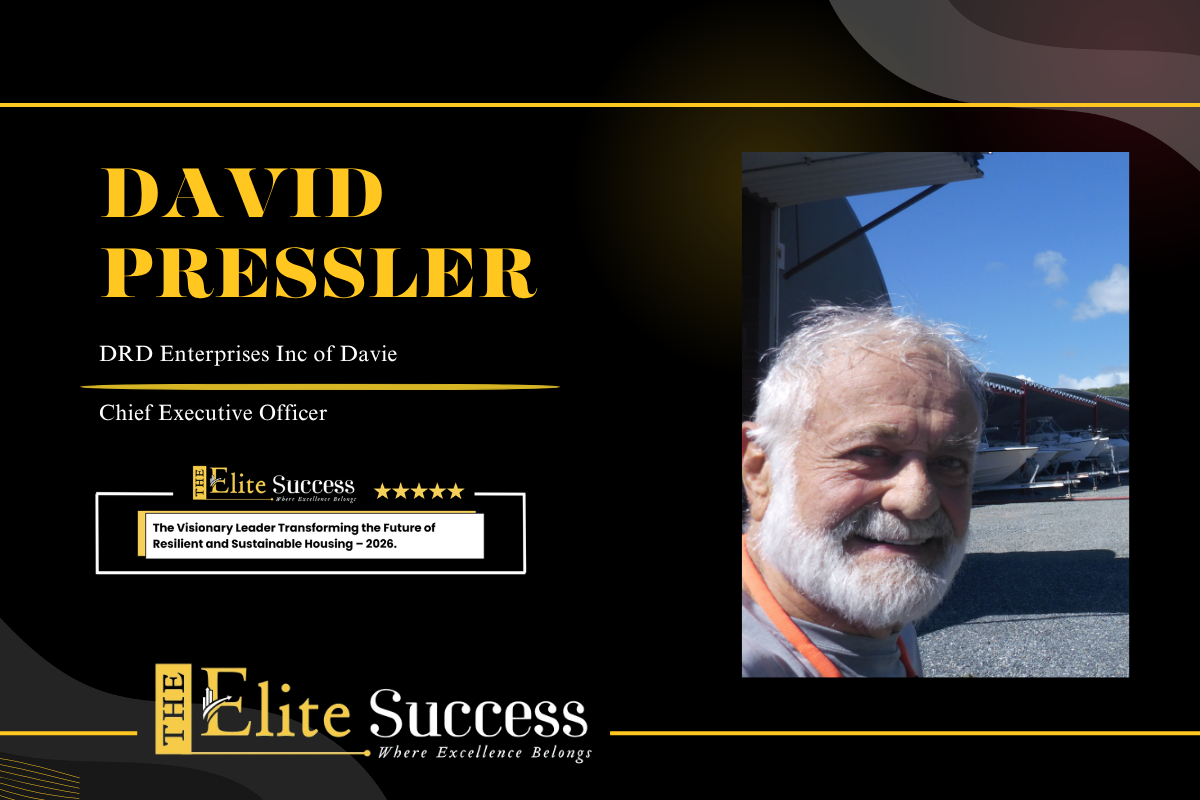
David Pressler: Reinventing Resilient Housing Through Innovation, Sustainability, and
Survival-Centric Design
As hurricanes, tornadoes, and climate-related disasters continue intensifying across the
United States, the conversation around housing is rapidly shifting from conventional
construction toward survival-focused, disaster-resilient infrastructure. Rising insurance
costs, vulnerable power systems, and repeated storm devastation are exposing the
limitations of traditional housing models—creating an urgent need for structures designed
not only to shelter people, but to protect lives. At the same time, growing concerns around
environmental degradation, fossil fuel dependency, and unsustainable construction
practices are forcing innovators to rethink how future generations will live.
Among the voices challenging conventional building systems is David Pressler, Chief
Executive Officer of DRD Enterprises Inc of Davie. For decades, Pressler has dedicated his
work to developing tornado-resistant shelters, storm-proof structures, and energy-
independent housing concepts designed to withstand extreme weather conditions while
promoting long-term sustainability. From monolithic concrete dome homes to SafeDomes
portable bunker storm shelters and metal Quonset hut housing systems, his innovations
reflect a mission-driven vision centered on resilience, survival, and the future of the planet.
Founded in 1994, DRD Enterprises has focused on creating structures that combine disaster
protection, energy efficiency, and off-grid living capabilities. Through innovations in portable
tornado shelters, alternative housing systems, and climate-resilient construction models,
the company continues to challenge traditional industry thinking while advocating for safer,
self-sustaining communities designed for a rapidly changing world.
In this edition, we explore David Pressler’s journey from firefighter to resilient housing
innovator, his unconventional philosophy toward construction and sustainability, and how
DRD Enterprises continues to push the boundaries of survival-centric design and future-
ready living.
Building Beyond Survival: David Pressler’s Mission to Rethink Disaster-Resilient
Construction
Long before disaster-resistant housing became part of mainstream conversation, David
Pressler was already experimenting with unconventional structures designed to survive
hurricanes, tornadoes, and the growing environmental challenges facing modern society.
Inspired by the fuel crisis of the 1970s and the increasing intensity of storms across South
Florida, Pressler began exploring monolithic concrete dome homes that could combine
extreme durability with energy efficiency. “I believed I could build homes that were tornado-
and hurricane-proof while also being super energy efficient,” he says while reflecting on the
early years of his journey.
That belief led to the construction of his first monolithic concrete dome home in
Loxahatchee, Florida, in 1979. What initially appeared unconventional soon became proof of
the structure’s extraordinary resilience. Years later, during an attempt to demolish the
unfinished home, even heavy machinery failed to bring it down. “First an excavator was
brought in—it bounced off. Then a five-ton wrecking ball—it bounced off too,” Pressler
recalls. Eventually, crews equipped with diamond-tip concrete saws had to cut the structure
apart piece by piece. For Pressler, the experience reinforced a belief that conventional
construction methods were failing to prioritize long-term survival and structural strength.
The defining turning point in his journey came in 1992 during Hurricane Andrew. Serving as
a Dade County firefighter at the time, Pressler witnessed firsthand the devastation caused
by weak infrastructure and poorly prepared housing systems across South Florida. “From
Hurricane Andrew devastation came opportunity to rebuild better,” he says. However, he
also discovered how resistant the housing and lending industries were to unconventional
construction concepts. Mortgage lenders struggled to support non-traditional structures
because there were no comparable homes within the market. “That effort went nowhere,”
he admits, reflecting on the challenges of introducing dome housing at scale.
Rather than abandoning the mission, Pressler shifted his focus toward what would
eventually become one of DRD Enterprises’ defining innovations—SafeDomes portable
bunker storm shelters. “If dome homes were not going to happen, then backyard saferooms
would be the next option,” he explains. What began as an idea in his backyard evolved into
multifunctional tornado-resistant structures designed to protect lives during increasingly
severe weather events. His philosophy remained simple: if a structure cannot withstand
tornado-force winds, it cannot truly survive a hurricane.
Over time, SafeDomes gained recognition not only from homeowners but also from
institutions seeking life-saving storm protection systems. DRD Enterprises supplied tornado
shelters to Fort Sill, Oklahoma, while Miami-Dade County approved the structures as
certified portable bunker storm shelters—an achievement Pressler proudly describes as
having “no competitor in America.”
Today, Pressler’s mission extends beyond storm shelters alone. Through DRD Enterprises Inc
of Davie, he continues advocating for a future built around survival-focused construction,
energy-independent housing, and alternative building systems capable of reducing
environmental destruction. Whether through SafeDomes, off-grid infrastructure, or metal
Quonset hut homes designed to produce more energy than they consume, his work reflects
a larger vision centered on resilience, self-sustainability, and what he repeatedly describes
as his mission “to save planet Earth.”
From Dome Homes to SafeDomes: Transforming Survival into Innovation
As David Pressler continued pushing the boundaries of disaster-resistant construction, he
encountered one of the biggest obstacles facing unconventional housing—acceptance from
traditional financial and housing systems. While his monolithic concrete dome homes
demonstrated extraordinary durability and energy efficiency, mortgage lenders struggled to
finance structures that lacked market “comparables.” For homeowners attempting to
rebuild after devastating storms, securing funding for non-traditional housing became
nearly impossible.
Rather than abandoning the vision, Pressler chose to adapt it. “If dome homes were not
going to happen, then backyard saferooms would be the next option,” he explains. That shift
in thinking became the beginning of SafeDomes—portable bunker storm shelters designed
to protect human life during hurricanes, tornadoes, and increasingly unpredictable climate
events.
What started in his own backyard as an experimental project soon evolved into a mission-
driven innovation focused on survival and disaster preparedness. Pressler began designing
multifunctional dome structures that could serve both as storage spaces and tornado-
resistant emergency shelters capable of withstanding extreme wind conditions. “Within
hurricanes are hundreds of tornadoes. If your dwelling is not tornado-proof, it is not
hurricane-proof,” he says, emphasizing a philosophy that continues to guide his work today.
The effectiveness of SafeDomes was tested early. One of the first units delivered to a family
in West Palm Beach endured the destructive winds of Hurricane Wilma, including tornado
activity generated by the storm system. Survivor testimonies and growing local interest
reinforced Pressler’s belief that storm protection needed to become a far greater priority
within residential construction. “My mission began in my backyard,” he reflects while
speaking about the early development of SafeDomes and the lessons learned through
experimentation, setbacks, and persistence.
Over time, the innovation gained institutional credibility. DRD Enterprises supplied
SafeDomes to Fort Sill, Oklahoma, where the United States Army required tornado shelters
for personnel in the field during severe weather emergencies. Miami-Dade County also
approved the structures as certified portable bunker storm shelters for remote training
facilities located deep within the Everglades. For Pressler, these milestones validated
decades of unconventional thinking. “Miami-Dade County and the Department of War
certified SafeDomes as a portable bunker storm shelter—no competitor in America,” he says.
Today, SafeDomes represent more than a product line for DRD Enterprises Inc of Davie.
They reflect Pressler’s broader mission to challenge outdated construction methods and
create structures designed not just for shelter, but for survival in a rapidly changing world.
Redefining the Future of Housing Through Quonset Innovation
For David Pressler, the future of housing is not simply about building stronger homes—it is
about fundamentally rethinking how humanity lives, consumes energy, and prepares for an
increasingly unstable future. Through DRD Enterprises Inc of Davie, Pressler has expanded
his focus toward metal Quonset hut homes, which he believes represent the next evolution
in resilient, self-sustaining construction.
“Affordable housing was solved in 1945 using Quonset huts built in a week,” Pressler says
while explaining why he believes traditional construction systems have failed to evolve.
However, for him, Quonset hut homes are about far more than affordability alone. They
represent a shift away from environmentally destructive building practices, rising insurance
dependency, and outdated infrastructure systems that he believes are no longer sustainable
for the future of the planet.
One of Pressler’s strongest viewpoints centers around reducing the construction industry’s
dependence on concrete. “Saving planet Earth means no more concrete,” he says candidly,
advocating instead for recycled metal panel systems, advanced insulation technologies, and
energy-independent infrastructure capable of dramatically reducing environmental impact.
According to him, the future of housing must combine structural resilience with self-
sustaining energy systems rather than relying on vulnerable utility networks and fossil fuel
consumption.
Through hybrid solar-wind systems, foam insulation, battery storage, composting toilets,
and off-grid infrastructure, Pressler envisions homes capable of producing more energy than
they consume. “Homes of the future should already be green energized,” he explains. By
encapsulating structures with exterior insulation and integrating renewable energy
technologies, DRD Enterprises aims to create housing systems that remain energy efficient,
storm resilient, and largely independent from conventional utility systems.
Pressler also believes these structures can help address one of the fastest-growing concerns
across climate-vulnerable regions—rising homeowners’ insurance costs. “Quonset hut
homes are climate changes, not climate victims,” he remarks, emphasizing that homes built
to withstand severe weather should not remain trapped within the same high-risk insurance
model as traditional housing.
At the center of his philosophy is a broader mission that extends beyond construction alone.
Whether discussing storm-proof housing, renewable energy integration, or alternative
sanitation systems, Pressler consistently returns to one belief: future housing must protect
both people and the planet. Through DRD Enterprises, he continues advocating for a model
of construction focused on resilience, energy independence, disaster preparedness, and
what he describes as the urgent need “to save planet Earth.”
Challenging Conventional Construction and Industry Norms
Throughout his journey, David Pressler has remained outspoken about what he believes are
the biggest failures within the modern construction industry—resistance to change,
dependence on outdated systems, and what he repeatedly describes as the influence of
“GREED” over innovation. While conventional builders continue relying on traditional
housing methods, Pressler has spent decades advocating for structures designed around
survival, energy independence, and long-term environmental responsibility.
“Builders do not want the public to know how to build in a week,” he says candidly while
discussing the challenges unconventional housing concepts continue to face. According to
Pressler, industries connected to construction, insurance, and utilities have little incentive to
embrace systems that reduce dependency on traditional infrastructure. “Insurance agents
do not want tornado storm-proof homes with no home insurance. Utility companies do not
want homes producing more energy than being used,” he explains, reflecting his belief that
large-scale change is often slowed by commercial interests rather than technological
limitations.
One of his strongest criticisms centers around the environmental impact of concrete-based
construction. “Saving planet Earth means no more concrete,” Pressler states firmly,
advocating instead for recycled metal panel systems, advanced insulation technologies, and
construction methods designed to reduce environmental destruction while increasing
structural resilience. In his view, the future of housing cannot continue relying on resource-
heavy systems that contribute to long-term ecological damage.
Through DRD Enterprises Inc of Davie, Pressler continues promoting what he considers the
next evolution in housing—storm-resistant structures capable of operating independently
from conventional utility systems. By integrating hybrid solar-wind technology, battery
storage, exterior foam insulation, composting toilets, and off-grid infrastructure, he believes
homes can eventually produce more energy than they consume while dramatically reducing
dependency on fossil fuels. “Homes should already be green energized,” he says.
Despite skepticism and resistance from traditional industries, Pressler remains committed to
pushing unconventional ideas forward. For him, innovation is not simply about business
growth or market disruption—it is about preparing humanity for the realities of a changing
planet. Whether discussing tornado shelters, Quonset hut homes, or energy-independent
communities, his message remains consistent: meaningful progress will only happen when
society becomes willing to challenge old systems and embrace change. “Only by change can
you reach the future,” he says.
Leadership Philosophy and Vision for the Future
David Pressler’s leadership philosophy is shaped by persistence, honesty, and an
unwavering belief that innovation must ultimately serve humanity and the planet rather
than short-term commercial interests. Over the decades, he has built a reputation not only
as an entrepreneur and inventor, but also as someone willing to challenge conventional
systems that he believes are preventing meaningful progress within the housing and
construction industry.
“Treat everyone fair and honest with truthfulness,” Pressler says while describing the values
that continue to guide both his personal and professional life. For him, leadership is not
defined by titles or authority, but by remaining committed to a mission even when facing
skepticism, setbacks, and resistance from established industries.
Much of that mission has been shaped by witnessing the growing environmental and
infrastructure crises affecting communities worldwide. “Watching Earth burn up and homes
being destroyed rebuilt without change” continues to fuel his determination to advocate for
storm-resistant, energy-independent, and survival-focused housing solutions. Rather than
accepting conventional rebuilding methods after disasters, Pressler believes society must
fundamentally rethink how homes are designed, powered, and protected for future
generations.
Persistence, he says, has played a critical role throughout his journey. From early dome
home experiments to the development of SafeDomes and off-grid Quonset hut housing
systems, many of his ideas faced doubt and resistance before gaining recognition. “Without
spiritual guidance and persistence, many of the projects would never have been completed,”
he reflects while speaking about the challenges of introducing unconventional concepts into
traditional industries.
Today, Pressler remains focused on educating people about what he considers the future of
housing—storm-proof structures, energy-independent living, reduced reliance on fossil
fuels, and communities designed around resilience rather than vulnerability. Whether
speaking to homeowners, builders, or young innovators, he consistently advocates for
embracing change instead of fearing it. “Knowledge is only good if verified,” he says,
emphasizing the importance of experimentation, real-world results, and practical
innovation.
At the center of his vision is a belief that humanity must evolve its approach toward
construction, energy, and environmental responsibility before climate challenges become
irreversible. “Only by change can you reach the future,” Pressler says—a philosophy that
continues to define both his leadership approach and his broader mission to create housing
systems capable of protecting lives while helping “save planet Earth.”
Legacy, Sustainability, and the Road Ahead
“I have never measured success by money, titles, or recognition alone. To me, success is
when an idea or product creates something positive for society and helps improve the future
for coming generations. Everything I have worked toward through DRD Enterprises Inc of
Davie has been connected to one larger mission—creating structures that can protect lives,
reduce environmental destruction, and help move humanity toward a more sustainable
future.
Over the years, I have seen hurricanes destroy communities, homes rebuilt the same way,
and society continue depending on systems that I believe are no longer sustainable. That is
why my work has remained focused on storm-resistant construction, energy-independent
housing, and alternative building systems capable of reducing reliance on fossil fuels and
vulnerable infrastructure. Whether through SafeDomes portable bunker storm shelters or
metal Quonset hut homes designed to produce more energy than they consume, my goal has
always been to create solutions that combine resilience, practicality, and long-term
environmental responsibility.
I strongly believe homes of the future should already be green energized. Through hybrid
solar-wind systems, exterior insulation, battery storage, composting toilets, and off-grid
technologies, I believe communities can eventually become self-sustaining while
dramatically reducing energy consumption and environmental impact. In my view, future
housing should not remain dependent on outdated utility systems, rising insurance costs, or
construction methods that continue harming the planet.
One of the biggest lessons I have learned throughout this journey is that meaningful
innovation always faces resistance. Too often, industries resist change when it threatens
existing systems and profits. But I believe the future can only be reached by challenging old
ideas and being willing to build differently. That belief has guided every stage of my
work—from the first dome home experiments to the development of SafeDomes and the
continued evolution of Quonset hut housing systems.
As I look toward the future, my hope is that younger generations of builders, entrepreneurs,
and innovators continue pushing for solutions that prioritize humanity and the planet rather
than short-term gain. I want my legacy to be remembered not simply for constructing homes
or storm shelters, but for helping change the conversation around how people live, survive,
and prepare for the future. At the end of the day, my mission remains simple: help save
planet Earth by creating safer, stronger, and more sustainable ways for people to live.”